


Strong Binding of Leupeptin with TMPRSS2 Protease May Be an Alternative to Camostat and Nafamostat for SARS-CoV-2 Repurposed Drug: Evaluation from Molecular Docking and Molecular Dynamics Simulations
- PMID: 33512650
- PMCID: PMC7844105
- DOI: 10.1007/s12010-020-03475-8
Strong Binding of Leupeptin with TMPRSS2 Protease May Be an Alternative to Camostat and Nafamostat for SARS-CoV-2 Repurposed Drug: Evaluation from Molecular Docking and Molecular Dynamics Simulations
Abstract
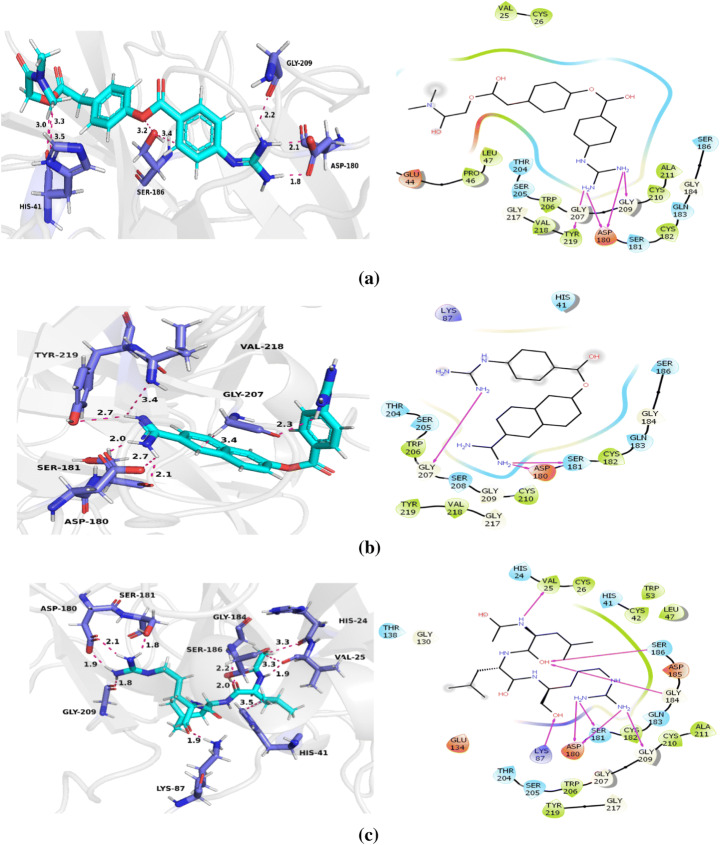
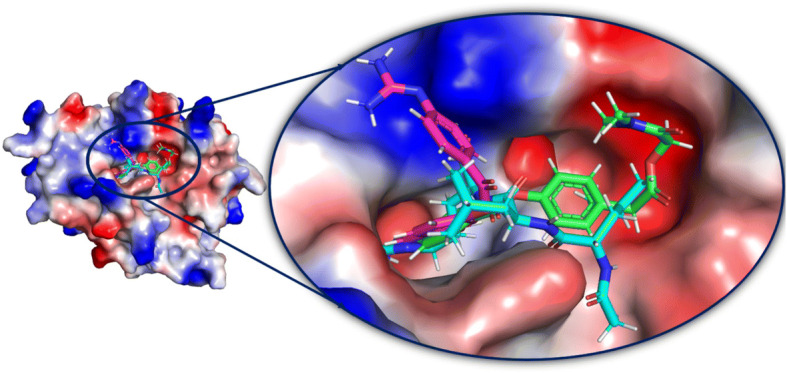
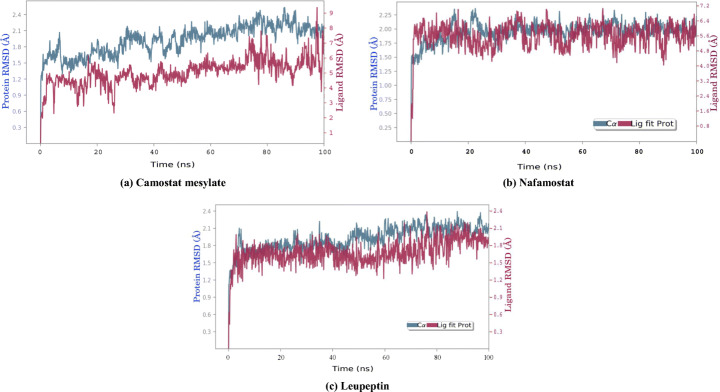
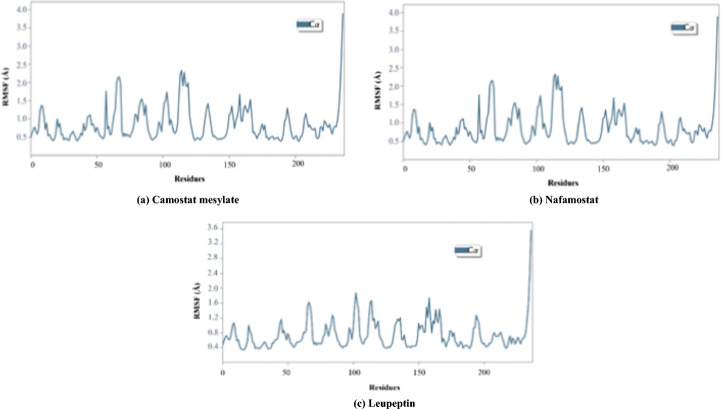
The unprecedented coronavirus SARS-CoV-2 outbreak at Wuhan, China, caused acute respiratory infection to humans. There is no precise vaccine/therapeutic agents available to combat the COVID-19 disease. Some repurposed drugs are saving the life of diseased, but the complete cure is relatively less. Several drug targets have been reported to inhibit the SARS-CoV-2 virus infection, in that TMPRSS2 (transmembrane protease serine 2) is one of the potential targets; inhibiting this protease stops the virus entry into the host human cell. Camostat mesylate, nafamostat, and leupeptin are the drugs, in which the first two drugs are being used for COVID-19 and leupeptin also tested. To consider these drugs as the repurposed drug for COVID-19, it is essential to understand their binding affinity and stability with TMPRSS2. In the present study, we performed the molecular docking and molecular dynamics (MD) simulation of these molecules with the TMPRSS2. The docking study reveals that leupeptin molecule strongly binds with TMPRSS2 protein than the other two drug molecules. The RMSD and RMSF values of MD simulation confirm that leupeptin and the amino acids of TMPRSS2 are very stable than the other two molecules. Furthermore, leupeptin forms interactions with the key amino acids of TMPRSS2 and the same have been maintained during the MD simulations. This structural and dynamical information is useful to evaluate these drugs to be used as repurposed drugs, however, the strong binding profile of leupeptin with TMPRSS2, suggests, it may be considered as a repurposed drug for COVID-19 disease after clinical trial.
Keywords: Binding affinity; Molecular docking; Molecular dynamics; Repurposed drug; SARS-CoV-2; TMPRSS2.
Conflict of interest statement
The authors declare that they have no competing interests.
Figures



References
-
- Woo PC, Lau SK, Lam CS, Lau CC, Tsang AK, Lau JH, Bai R, Teng JL, Tsang CC, Wang M, Zheng BJ, Chan KH, Yuen KY. Discovery of seven novel mammalian and avian coronaviruses in the genus deltacoronavirus supports bat coronaviruses as the gene source of alphacoronavirus and betacoronavirus and avian coronaviruses as the gene source of gammacoronavirus and deltacoronavirus. Journal of Virology. 2012;86(7):3995–4008. doi: 10.1128/JVI.06540-11. - DOI - PMC - PubMed
-
- Kuiken T, Fouchier RA, Schutten M, Rimmelzwaan GF, van Amerongen G, van Riel D, Laman JD, de Jong T, van Doornum G, Lim W, Ling AE, Chan PK, Tam JS, Zambon MC, Gopal R, Drosten C, van der Werf S, Escriou N, Manuguerra JC, Stöhr K, Peiris JS, Osterhaus AD. Newly discovered coronavirus as the primary cause of severe acute respiratory syndrome. The Lancet. 2003;362(9380):263–270. doi: 10.1016/S0140-6736(03)13967-0. - DOI - PMC - PubMed
-
- Zhong NS, Zheng BJ, Li YM, Poon, Xie ZH, Chan KH, Li PH, Tan SY, Chang Q, Xie JP, Liu XQ, Xu J, Li DX, Yuen KY, Peiris, Guan Y. Epidemiology and cause of severe acute respiratory syndrome (SARS) in Guangdong, People’s Republic of China, in February, 2003. The Lancet. 2003;362(9393):1353–1358. doi: 10.1016/S0140-6736(03)14630-2. - DOI - PMC - PubMed
MeSH terms
Substances
LinkOut - more resources
Full Text Sources
Other Literature Sources
Miscellaneous
