


Quantitative vibration perception threshold in assessing diabetic polyneuropathy: Should the cut-off value be adjusted for Chinese individuals with type 2 diabetes?
- PMID: 33512757
- PMCID: PMC8409819
- DOI: 10.1111/jdi.13515
Quantitative vibration perception threshold in assessing diabetic polyneuropathy: Should the cut-off value be adjusted for Chinese individuals with type 2 diabetes?
Abstract
Aims/introduction: To examine the performance and identify the optimal threshold of vibration perception threshold (VPT) for diagnosing diabetic polyneuropathy (DPN) in a Chinese population according to multiple definitions of DPN as gold standards.
Materials and methods: VPT was determined in 421 Chinese individuals with type 2 diabetes, who simultaneously completed a questionnaire of neuropathic symptoms, and underwent the assessment of signs of peripheral neuropathy and electromyography tests. Three definitions of DPN (i.e., clinician-diagnosed DPN, abnormal nerve conduction and confirmed DPN) were taken as reference gold standards.
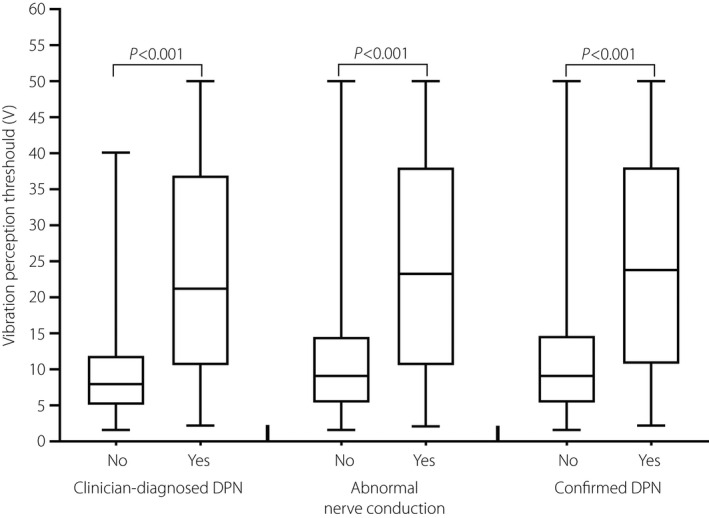
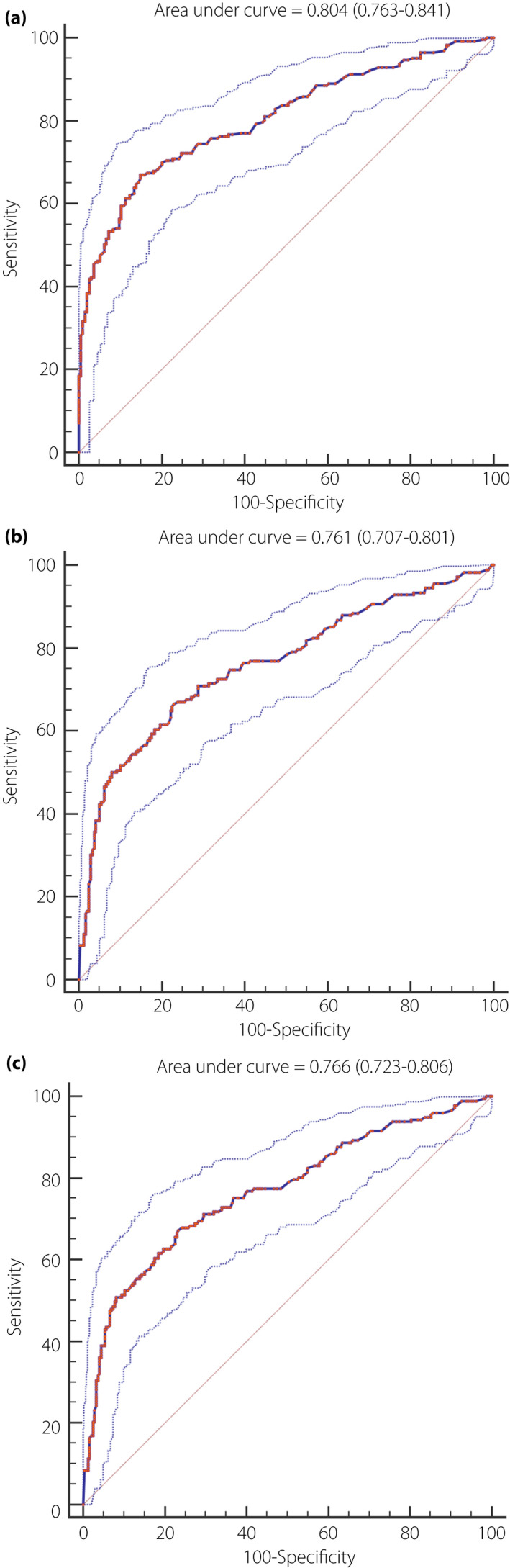
Results: Vibration perception threshold was a specific measure for all three groups of DPN outcomes, with the highest specificity noted for clinician-diagnosed DPN (85.1%). The specificity for abnormal nerve conduction and confirmed DPN was 77.0 and 76.6%, respectively. The sensitivity of VPT was 67.0% for clinician-diagnosed DPN, 66.5% for abnormal nerve conduction and 67.2% for confirmed DPN. The optimal cut-off threshold for abnormal nerve conduction, as well as confirmed DPN, was VPT >14.9 V. The specificity and sensitivity of VPT >14.9 V as the cut-off value for clinician-diagnosed DPN were 85.6 and 66.2%, respectively. When taking clinician-diagnosed DPN as the gold standard, the performance of VPT for diagnosing DPN was best with an area under the curve value of 0.804.
Conclusions: VPT measured using the neurothesiometer had relatively high specificity and best performance for diagnosing DPN when clinician-diagnosed DPN rather than abnormal nerve conduction was taken as the gold standard in a Chinese population. A VPT value of ≥15 V might be equally applicable for diagnosing DPN in a Chinese population.
Keywords: Diabetic polyneuropathy; Type 2 diabetes mellitus; Vibration perception threshold.
© 2021 The Authors. Journal of Diabetes Investigation published by Asian Association for the Study of Diabetes (AASD) and John Wiley & Sons Australia, Ltd.
Conflict of interest statement
The authors declare no conflict of interest.
Figures
References
-
- Dyck PJ, Kratz KM, Karnes JL, et al. The prevalence by staged severity of various types of diabetic neuropathy, retinopathy, and nephropathy in a population‐based cohort: the Rochester Diabetic Neuropathy Study. Neurology 1993; 43: 817–824. - PubMed
-
- Løseth S, Stålberg EV, Lindal S, et al. Small and large fiber neuropathy in those with type 1 and type 2 diabetes: a 5‐year follow‐up study. J Peripher Nerv Syst 2016; 21: 15–21. - PubMed
-
- Boulton AJ, Vinik AI, Arezzo JC, et al. Diabetic neuropathies: a statement by the American Diabetes Association. Diabetes Care 2005; 28: 956–962. - PubMed
-
- Boulton AJ, Kirsner RS, Vileikyte L. Clinical practice. Neuropathic diabetic foot ulcers. N Engl J Med 2004; 351: 48–55. - PubMed
-
- Xu Z, Ran X. Diabetic foot care in China: challenges and strategy. Lancet Diabetes Endocrinol 2016; 4: 297–298. - PubMed
MeSH terms
Grants and funding
- 2017 ZX09304023/National Science and Technology Major Project
- 81700087/National Natural Science Foundation of China
- 2017-CY02-00028-GX/Science and Technology Bureau of Chengdu City
- 2018gfgw001/Health Medical Big Data Application and Innovation Project in Sichuan
- ZYGD18025/1.3.5 Project for disciplines of excellence, West China Hospital, Sichuan University
LinkOut - more resources
Full Text Sources
Other Literature Sources
Medical
