Review
. 2021 Dec;288(24):7096-7122.
doi: 10.1111/febs.15736. Epub 2021 Feb 16.

Human transfer RNA modopathies: diseases caused by aberrations in transfer RNA modifications

Affiliations
Review

Human transfer RNA modopathies: diseases caused by aberrations in transfer RNA modifications

Takeshi Chujo et al. FEBS J. 2021 Dec.

Abstract

tRNA molecules are post-transcriptionally modified by tRNA modification enzymes. Although composed of different chemistries, more than 40 types of human tRNA modifications play pivotal roles in protein synthesis by regulating tRNA structure and stability as well as decoding genetic information on mRNA. Many tRNA modifications are conserved among all three kingdoms of life, and aberrations in various human tRNA modification enzymes cause life-threatening diseases. Here, we describe the class of diseases and disorders caused by aberrations in tRNA modifications as 'tRNA modopathies'. Aberrations in over 50 tRNA modification enzymes are associated with tRNA modopathies, which most frequently manifest as dysfunctions of the brain and/or kidney, mitochondrial diseases, and cancer. However, the molecular mechanisms that link aberrant tRNA modifications to human diseases are largely unknown. In this review, we provide a comprehensive compilation of human tRNA modification functions, tRNA modification enzyme genes, and tRNA modopathies, and we summarize the elucidated pathogenic mechanisms underlying several tRNA modopathies. We will also discuss important questions that need to be addressed in order to understand the molecular pathogenesis of tRNA modopathies.

Keywords: RNA; RNA modification; tRNA; tRNA modopathy; translation.


Conflict of interest statement

The authors declare no conflict of interest.

Figures
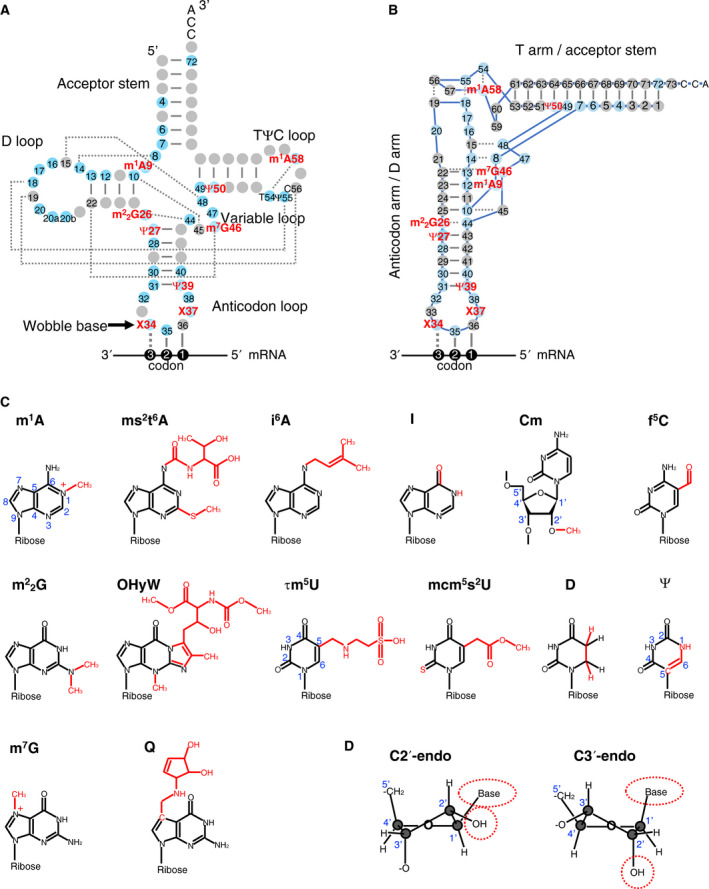
Fig. 1
Fig. 1
tRNA structure and tRNA modifications. (A) tRNA secondary structure depicted in a cloverleaf form. Nucleoside positions are numbered following conventional guidelines [223]. Red‐lettered tRNA modifications affect tRNA structure in at least some tRNA species. Gray circle, unmodified nucleoside; blue circle, nucleoside known to be modified in at least one tRNA species; straight line between bases, Watson‐Crick base pairs; dotted line between bases, hydrogen bond observed in yeast tRNAPhe tertiary structure [21]. (B) tRNA secondary structure depicted in the L‐shape, based on the yeast tRNAPhe crystal structure [21, 22]. Note that in the actual tertiary structure, a base‐paired stem forms a helix. (C) Chemical structures of various tRNA modifications. (D) Ribose ring C2′‐endo conformation and C3′‐endo conformation. Note that in the C2′‐endo form, the base and the 2′hydroxyl group are in close proximity, and Nm or xm5s2U modifications induce steric repulsion between the base and 2′hydroxyl group to favor the C3′‐endo form. 1‐methyladenosine (m1A), ms2t6A (2‐methylthio‐N6‐threonyl carbamoyladenosine), i6A (N6‐isopentenyladenosine), I (inosine), Cm (2'‐O‐methylcytidine), f5C (5‐formylcytidine), m2 2G (N2,N2‐dimethylguanosine), OHyW (hydroxywybutosine), τm5U (5‐taurinomethyluridine), mcm5s2U (5‐methoxycarbonylmethyl‐2‐thiouridine), D (dihydrouridine), Ψ (pseudouridine), m7G (7‐methylguanosine), Q (queuosine), and X (various modifications).
Fig. 2
Fig. 2
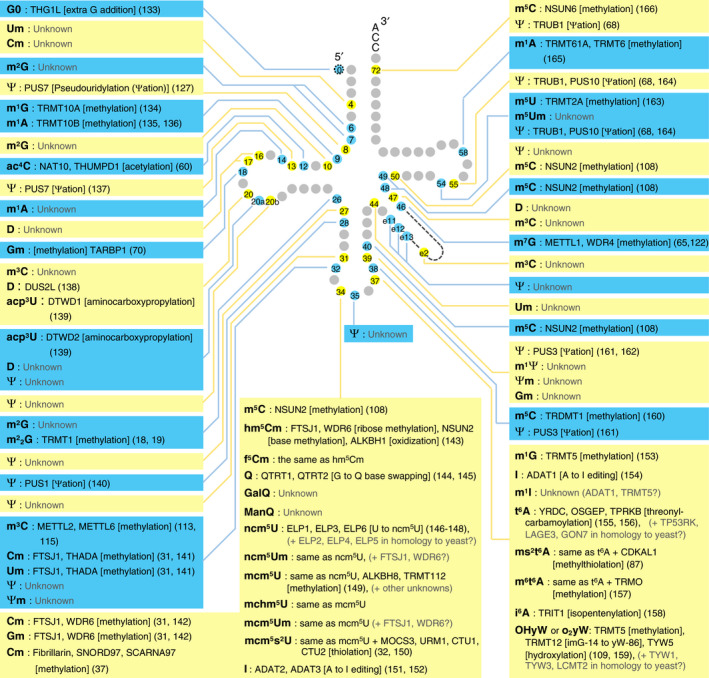
Mammalian cytoplasmic tRNA modifications and modification enzymes. The name of the modification enzyme, the reaction the enzyme is responsible for (in brackets), and the reference (in parentheses) is written next to the species of tRNA modification. Insights are derived mostly from human studies and in part from other mammalian species studies. Note that the strength of evidence varies between different studies, ranging from checking only that the protein is necessary for modification to completely confirming that the protein is both necessary and sufficient for the modification. For the structures of modifications not depicted in Fig. 1, please refer to the RNA Modification Database (https://mods.rna.albany.edu). Abbreviations not described in Fig. 1: G0 (Guanosine added post‐transcriptionally), Um (2′‐O‐methyluridine), m2G (N2‐methylguanosine), m1G (1‐methylguanosine), ac4C (N4‐acetylcytidine), Gm (2′‐O‐methylguanosine), m3C (3‐methylcytidine), acp3U (3‐(3‐amino‐3‐carboxypropyl)uridine), Ψm (2′‐O‐methylpseudouridine), m5C (5‐methylcytidine), hm5Cm (5‐hydroxymethyl‐2′‐O‐methylcytidine), f5Cm (5‐formyl‐2′‐O‐methylcytidine), GalQ (galactosyl‐queuosine), ManQ (mannosyl‐queuosine), ncm5U (5‐carbamoylmethyluridine), mcm5U (5‐methoxycarbonylmethyluridine), mchm5U (5‐(carboxyhydroxymethyl)uridine methyl ester), mcm5Um (5‐methoxycarbonylmethyl‐2′‐O‐methyluridine), m1I (1‐methylinosine), m6t6A (N6‐methyl‐N6‐threonylcarbamoyladenosine), o2yW (peroxywybutosine), m1Ψ (1‐methylpseudouridine), m5U (5‐methyluridine), and m5Um (5,2′‐O‐dimethyluridine).
Fig. 3
Fig. 3
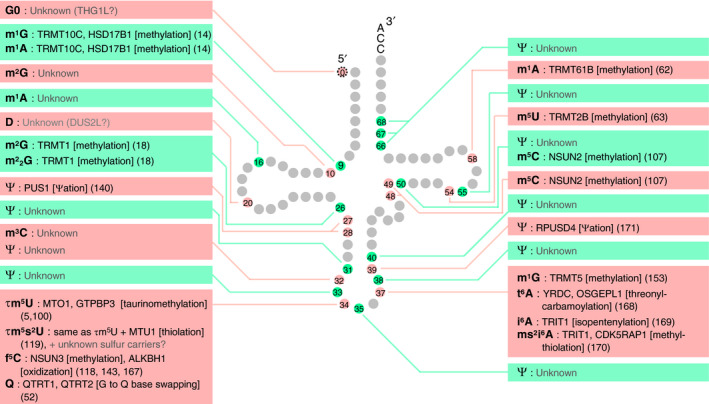
Human mitochondrial (mt) tRNA modifications and modification enzymes. The name of the modification enzyme, the reaction the enzyme is responsible for (in brackets), and the reference (in parentheses) is written next to the species of tRNA modification [52]. Note that the strength of evidence varies between different studies, ranging from checking only that the protein is necessary for modification to fully confirming that the protein is both necessary and sufficient for the modification. For the structures of modifications not depicted in Fig. 1C, please refer to the RNA Modification Database (https://mods.rna.albany.edu). The secondary structures of many mt tRNAs are different from the canonical cloverleaf structure in three ways [13, 46, 224, 225, 226, 227]: (a) mt tRNASer(AGY) lacks the entire D loop, (b) mt tRNASer(UCN) lacks U8 and has a small D loop, a small variable loop, and an extended anticodon stem, and (c) several mt tRNAs do not have canonical D loop/T loop interactions and instead have alternative interactions. Abbreviations not described in Figs. 1 and 2: τm5s2U (5‐taurinomethyl‐2‐thiouridine) and ms2i6A (2‐methylthio‐N6‐isopentenyladenosine).
Fig. 4
Fig. 4
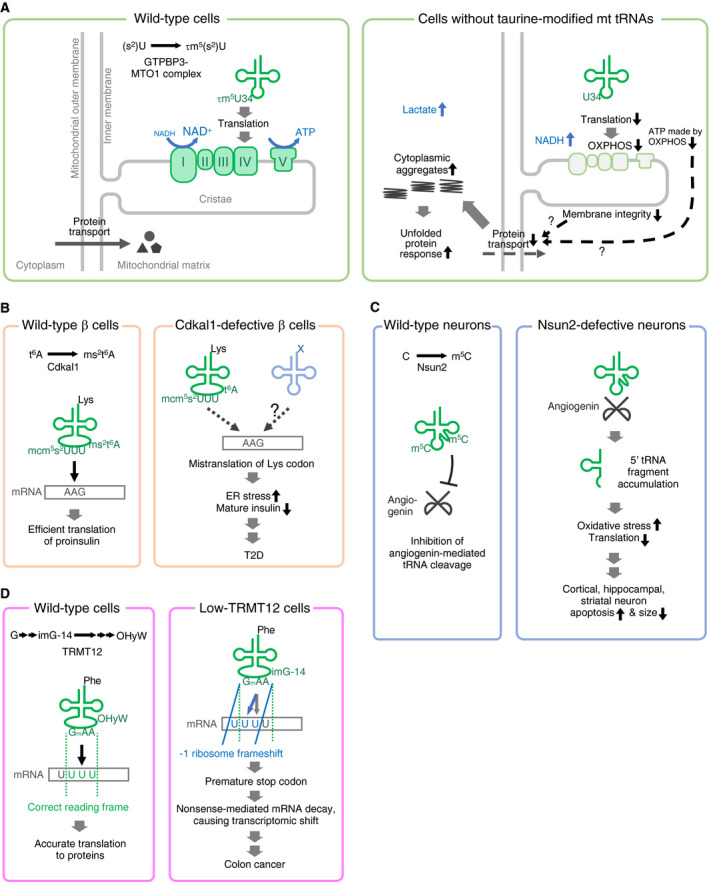
Pathogenic molecular mechanisms of tRNA modopathies. (A) Μitochondrial (mt) diseases caused by deficiencies of mt tRNA taurine modifications at position 34. The GTPBP3–MTO1 complex incorporates τm5U34 modification into five mt tRNAs. Without the taurine modification, the translation rate of OXPHOS complex proteins declines, causing a metabolic shift as well as a proteostasis shift, especially affecting energy‐demanding organs such as the brain and muscle. (B) Type 2 diabetes caused by a deficiency of CDKAL1‐mediated thiomethylation of cytoplasmic tRNALys UUU at position 37. Cdkal1 incorporates the ms2 modification to t6A37 of tRNALys UUU and promotes translation of lysine from the AAA and AAG codons. Cdkal1 is especially important in pancreatic β cells, in which lysine‐containing proinsulin is rapidly and massively translated upon glucose stimulus. (C) Neurodevelopmental disorder caused by a deficiency of NSUN2‐mediated m5C modifications. NSUN2 incorporates m5C into several sites within tRNAs and inhibits angiogenin‐mediated tRNA cleavage. NSUN2 deficiency induces the accumulation of 5′ tRFs, which evokes reduced translation rates and activated stress responses and is the cause of brain disorders, including microcephaly and intellectual disability. (D) Colon cancer caused by epigenetic loss of TRMT12‐mediated OHyW modification of tRNAPhe at position 37. Epigenetic silencing of TYW2 is a cause of colon cancer via the loss of the OHyW37 modification, inducing a −1 ribosome frameshift to downregulate various mRNAs, conferring enhanced migration properties and epithelial‐to‐mesenchymal features to the cells.

References

    1. Crick F (1958) On protein synthesis. Symp Soc Exp Biol 12, 138–163. - PubMed
    1. Hoagland MB, Stephenson ML, Scott JF, Hecht LI & Zamecnik PC (1958) A soluble ribonucleic acid intermediate in protein synthesis. J Biol Chem 231, 241–257. - PubMed
    1. Chan PP & Lowe TM (2016) GtRNAdb 2.0: an expanded database of transfer RNA genes identified in complete and draft genomes. Nucleic Acids Res 44, D184–D189. - PMC - PubMed
    1. Anderson S, Bankier AT, Barrell BG, de Bruijn MH, Coulson AR, Drouin J, Eperon IC, Nierlich DP, Roe BA, Sanger F et al. (1981) Sequence and organization of the human mitochondrial genome. Nature 290, 457–465. - PubMed
    1. Asano K, Suzuki T, Saito A, Wei FY, Ikeuchi Y, Numata T, Tanaka R, Yamane Y, Yamamoto T, Goto T et al. (2018) Metabolic and chemical regulation of tRNA modification associated with taurine deficiency and human disease. Nucleic Acids Res 46, 1565–1583. - PMC - PubMed

Publication types

MeSH terms