Review
. 2021 Jan 27;12(2):183.
doi: 10.3390/genes12020183.

Insights on the Pathogenesis of Aneurysm through the Study of Hereditary Aortopathies

Affiliations
Review

Insights on the Pathogenesis of Aneurysm through the Study of Hereditary Aortopathies

Tyler J Creamer et al. Genes (Basel). .

Abstract

Thoracic aortic aneurysms (TAA) are permanent and localized dilations of the aorta that predispose patients to a life-threatening risk of aortic dissection or rupture. The identification of pathogenic variants that cause hereditary forms of TAA has delineated fundamental molecular processes required to maintain aortic homeostasis. Vascular smooth muscle cells (VSMCs) elaborate and remodel the extracellular matrix (ECM) in response to mechanical and biochemical cues from their environment. Causal variants for hereditary forms of aneurysm compromise the function of gene products involved in the transmission or interpretation of these signals, initiating processes that eventually lead to degeneration and mechanical failure of the vessel. These include mutations that interfere with transduction of stimuli from the matrix to the actin-myosin cytoskeleton through integrins, and those that impair signaling pathways activated by transforming growth factor-β (TGF-β). In this review, we summarize the features of the healthy aortic wall, the major pathways involved in the modulation of VSMC phenotypes, and the basic molecular functions impaired by TAA-associated mutations. We also discuss how the heterogeneity and balance of adaptive and maladaptive responses to the initial genetic insult might contribute to disease.

Keywords: Loeys–Dietz syndrome; Marfan syndrome; TGF-β; aneurysm; aorta; aortopathy; extracellular matrix; familial thoracic aortic aneurysm; thoracic aortic aneurysm.


Conflict of interest statement

The authors declare no conflict of interest.

Figures
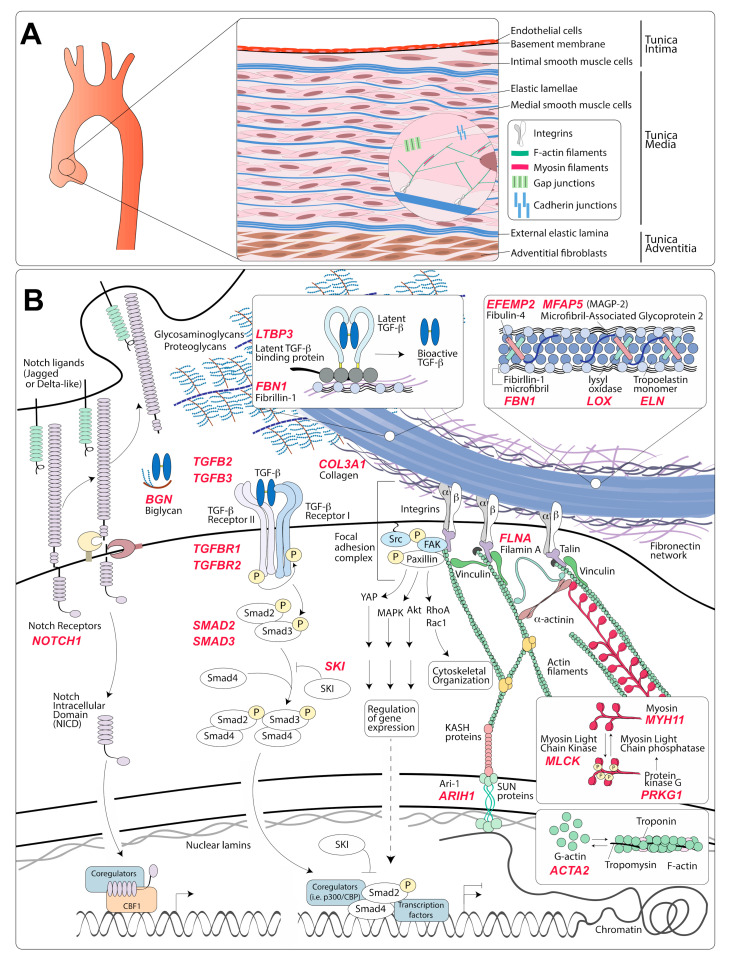
Figure 1
Figure 1
Organization of the aortic wall and representation of molecular pathways affected in hereditary aneurysm disorders. (A) Schematic representation of the thoracic aorta magnified to illustrate the composition of the three aortic layers, cell types, and intracellular features of vascular smooth muscle cells (VSMCs). The aortic media is composed of alternating layers of VSMCs and elastic lamellae. Integrins link the actin cytoskeleton to elastic fibers and other extracellular matrix components (ECM). Cadherin and gap junctions allow sharing of mechanical and biochemical information between adjacent cells. (B) Representation of molecular components involved in the transmission of mechanical and biochemical information in the vascular wall. Causal mutations for hereditary thoracic aortic aneurysm (TAA) have been found in proteins coded by genes noted in red. Elastic fibers are composed of a core of elastin surrounded by microfibrils; although fibrillin-1 is the main component of microfibrils, they also include other glycoproteins such as microfibril-associated glycoproteins and fibulins. Maturation of elastic fibers requires lysyl oxidase enzymatic activity, which catalyzes a crosslinking reaction between monomers of tropoelastin. Mechanical stimuli are transmitted from the elastic fibers to the VSMCs via integrins, which are heterodimeric transmembrane proteins that bind to matrix proteins, including fibrillin-1, via multi-protein complexes called focal adhesions. Focal adhesions contain several adaptor proteins anchoring integrins to the actin and myosin cytoskeleton and to the linker of nucleoskeleton and cytoskeleton (LINC) complex. Myosin light chain kinase (MLCK) promotes contraction by phosphorylation of myosin regulatory light chain (RLC), whereas myosin light chain phosphatase (MLCP) dephosphorylates RLC and promotes relaxation. Integrins transfer mechanical inputs from the cytoskeleton to the ECM and from the ECM to the cytoskeleton. Integrin engagement promotes the polymerization of globular actin (G-actin) into actin filaments (F-actin). Several signaling molecules are regulated by focal adhesions, including focal adhesion kinase (FAK), mitogen-activated protein kinases (MAPK), Akt, Rac and Rho GTPases, and Yes-associated protein (YAP). Transforming growth factor-β (TGF-β) ligands are secreted as inactive latent complexes that are converted into a bioactive TGF-β ligand by chemical, mechanical, and enzymatic processes in the ECM. TGF-β ligand binds to the TGF-β receptor complex and induces the phosphorylation of Smad2 and Smad3. Then, phosphorylated Smad2 and Smad3 (pSmad2/3) can bind to Smad4 and translocate to the nucleus, where they regulate TGF-β responsive genes. Sloan-Kettering Institute (SKI) is a repressor of TGF-β signaling that inhibits the association of pSmad2/3 with Smad4, and with other transcriptional co-regulators such as p300. The binding of Notch to its cognate receptor induces a conformational change that triggers multiple proteolytic processing steps that release the Notch intracellular domain (NICD) from the membrane and promote its translocation to the nucleus, where it regulates transcription via interaction with other factors.
Figure 2
Figure 2
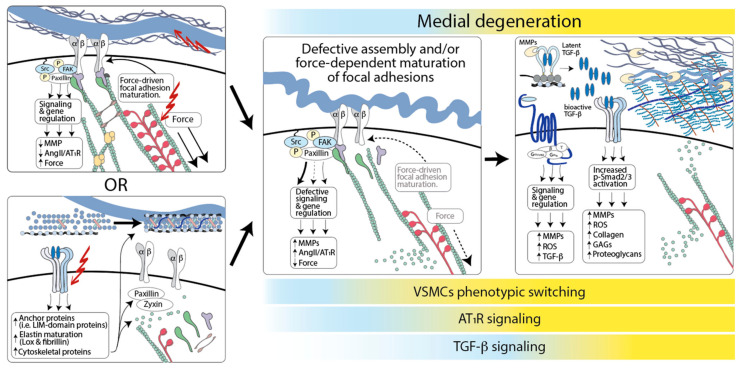
A model for hereditary aneurysm pathogenesis. Defective assembly of connections between elastic fibers and VSMCs initiates their phenotypic switch toward a proteolytic phenotype that promotes medial degeneration. The pathogenic process can be initiated by genetic mutations (red lightening) that directly target ECM structures or intracellular components necessary for the assembly/function of focal adhesions, including cytoskeletal components necessary for force-dependent focal adhesion maturation. It can also be initiated by mutations that target signaling pathways, such as TGF-β and Notch signaling, which modulate the expression of components of the focal adhesion machinery (ECM components, adaptor/anchoring proteins such as zyxin and paxillin, and actin-binding proteins such as Sm22). Opportunity to establish proper connections between VSMCs and the ECM may be developmentally restricted, given that adult VSMCs have limited ability to elaborate and organize components of the elastic fibers. Dysfunctional signaling downstream of focal adhesions would promote phenotypic switching, inducing a downregulation of contractile proteins, upregulation of metalloproteinases, and other matrix proteins, such as thrombospondin-1, that positively regulate AT1R and TGF-β signaling, further exacerbating ECM pathogenic remodeling. The activation of AT1R signaling and AT1R-dependent upregulation of TGF-β signaling would result in the deposition of collagen, accumulation of proteoglycans, and production metalloproteinases and reactive oxygen species (ROS). TGF-β signaling is modeled as protective at early stages of disease, when it may promote the restoration of ECM–VSMC interaction, and progressively more pathogenic when the establishment of ECM–VSMC interaction is no longer developmentally possible, and TGF-β promotes the deposition of proteoglycans and glycosaminoglycans, and production of ROS.

References

    1. Melvinsdottir I.H., Lund S.H., Agnarsson B.A., Sigvaldason K., Gudbjartsson T., Geirsson A. The incidence and mortality of acute thoracic aortic dissection: Results from a whole nation study. Eur. J. Cardiothorac. Surg. 2016;50:1111–1117. doi: 10.1093/ejcts/ezw235. - DOI - PubMed
    1. Hiratzka L.F., Bakris G.L., Beckman J.A., Bersin R.M., Carr V.F., Casey D.E., Jr., Eagle K.A., Hermann L.K., Isselbacher E.M., Kazerooni E.A., et al. 2010 ACCF/AHA/AATS/ACR/ASA/SCA/SCAI/SIR/STS/SVM guidelines for the diagnosis and management of patients with Thoracic Aortic Disease: A report of the American College of Cardiology Foundation/American Heart Association Task Force on Practice Guidelines, American Association for Thoracic Surgery, American College of Radiology, American Stroke Association, Society of Cardiovascular Anesthesiologists, Society for Cardiovascular Angiography and Interventions, Society of Interventional Radiology, Society of Thoracic Surgeons, and Society for Vascular Medicine. Circulation. 2010;121:e266–e369. - PubMed
    1. Quintana R.A., Taylor W.R. Introduction to the Compendium on Aortic Aneurysms. Circ. Res. 2019;124:470–471. doi: 10.1161/CIRCRESAHA.119.314765. - DOI - PubMed
    1. Wong D.R., Willett W.C., Rimm E.B. Smoking, hypertension, alcohol consumption, and risk of abdominal aortic aneurysm in men. Am. J. Epidemiol. 2007;165:838–845. doi: 10.1093/aje/kwk063. - DOI - PubMed
    1. Pinard A., Jones G.T., Milewicz D.M. Genetics of Thoracic and Abdominal Aortic Diseases. Circ. Res. 2019;124:588–606. doi: 10.1161/CIRCRESAHA.118.312436. - DOI - PMC - PubMed

Publication types

MeSH terms

LinkOut - more resources