Self-Collected Saline Gargle Samples as an Alternative to Health Care Worker-Collected Nasopharyngeal Swabs for COVID-19 Diagnosis in Outpatients
- PMID: 33514627
- PMCID: PMC8092743
- DOI: 10.1128/JCM.02427-20
Self-Collected Saline Gargle Samples as an Alternative to Health Care Worker-Collected Nasopharyngeal Swabs for COVID-19 Diagnosis in Outpatients
Abstract
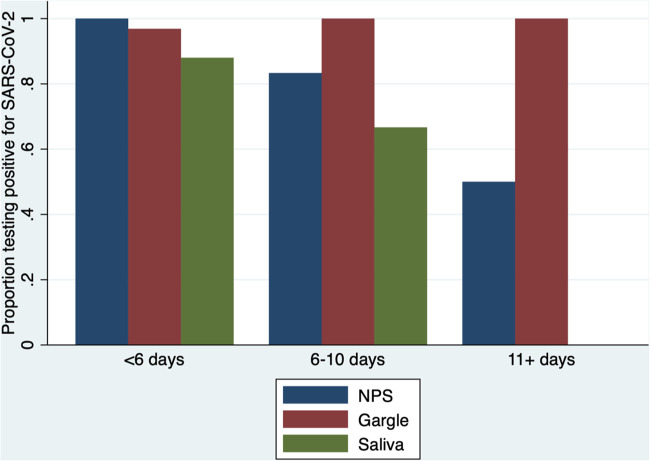
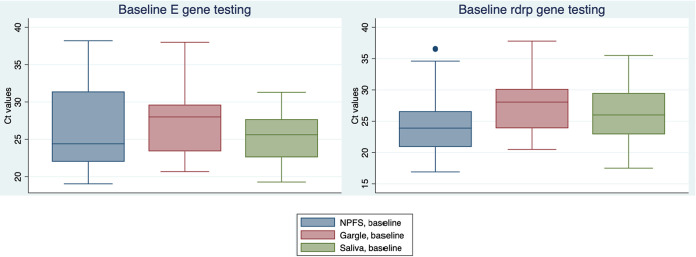
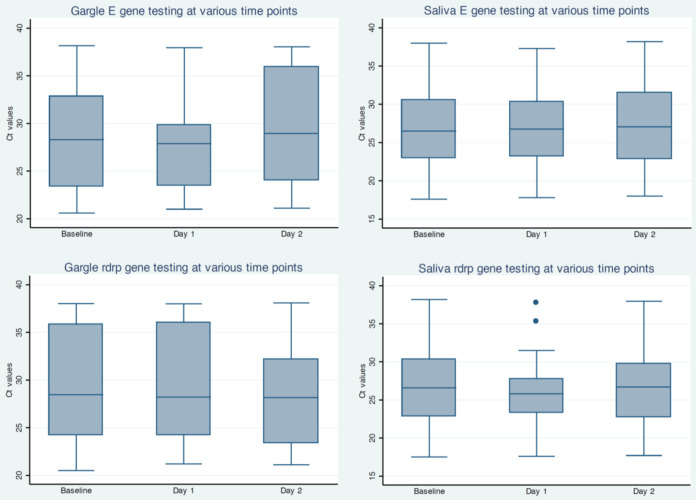
We assessed the performance, stability, and user acceptability of swab-independent self-collected saliva and saline mouth rinse/gargle sample types for the molecular detection of severe acute respiratory syndrome coronavirus 2 (SARS-CoV-2) in adults and school-aged children. Outpatients who had recently been diagnosed with COVID-19 or were presenting with suspected COVID-19 were asked to have a nasopharyngeal (NP) swab collected and provide at least one self-collected sample type. Participants were also asked about sample acceptability using a five-point Likert scale. For those previously diagnosed with COVID-19, all samples underwent real-time PCR testing using a lab-developed assay, and the majority were also tested using an FDA-authorized assay. For those presenting with suspected COVID-19, only those with a positive nasopharyngeal swab sample went on to have other samples tested. Saline mouth rinse/gargle and saliva samples were tested daily at time zero, day 1, and day 2 to assess nucleic acid stability at room temperature. Fifty participants (aged 4 to 71 years) were included; of these, 40 had at least one positive sample and were included in the primary sample yield analysis. Saline mouth rinse/gargle samples had a sensitivity of 98% (39/40), while saliva samples had a sensitivity of 79% (26/33). Both saline mouth rinse/gargle and saliva samples showed stable viral RNA detection after 2 days of room temperature storage. Mouth rinse/gargle samples had the highest (mean, 4.9) and health care worker (HCW)-collected NP swabs had the lowest acceptability scores (mean, 3.1). In conclusion, saline mouth rinse/gargle samples demonstrated higher combined user acceptability ratings and analytical performance than saliva and HCW-collected NP swabs. This sample type is a promising swab-independent option, particularly for outpatient self-collection in adults and school-aged children.
Keywords: COVID-19; PCR; SARS-CoV-2; gargle; saliva.
Copyright © 2021 American Society for Microbiology.
Figures
References
-
- Callahan CJ, Lee R, Zulauf KE, Tamburello L, Smith KP, Previtera J, Cheng A, Green A, Abdul Azim A, Yano A, Doraiswami N, Kirby JE, Arnaout RA. 2020. Open development and clinical validation of multiple 3D-printed nasopharyngeal collection swabs: rapid resolution of a critical COVID-19 testing bottleneck. J Clin Microbiol 58:e00876-20. doi: 10.1128/JCM.00876-20. - DOI - PMC - PubMed
-
- Hanson KE, Caliendo AM, Arias CA, Englund JA, Lee MJ, Loeb M, Patel R, El Alayli A, Kalot MA, Falck-Ytter Y, Lavergne V, Morgan RL, Murad MH, Sultan S, Bhimraj A, Mustafa RA. 2020. Infectious Diseases Society of America guidelines on the diagnosis of COVID-19. Clin Infect Dis 16:ciaa760. doi: 10.1093/cid/ciaa760. - DOI - PMC - PubMed
-
- LeBlanc JJ, Gubbay JB, Li Y, Needle R, Arneson SR, Marcino D, Charest H, Desnoyers G, Dust K, Fattouh R, Garceau R, German G, Hatchette TF, Kozak RA, Krajden M, Kuschak T, Lang ALS, Levett P, Mazzulli T, McDonald R, Mubareka S, Prystajecky N, Rutherford C, Smieja M, Yu Y, Zahariadis G, Zelyas N, Bastien N, COVID-19 Pandemic Diagnostics Investigation Team of the Canadian Public Health Laboratory Network (CPHLN) Respiratory Virus Working Group. 2020. Real-time PCR-based SARS-CoV-2 detection in Canadian laboratories. J Clin Virol 128:104433. doi: 10.1016/j.jcv.2020.104433. - DOI - PMC - PubMed
MeSH terms
LinkOut - more resources
Full Text Sources
Other Literature Sources
Medical
Miscellaneous