


Research Note: The administration schedule of coccidia is a major determinant in broiler necrotic enteritis models
- PMID: 33516484
- PMCID: PMC7936161
- DOI: 10.1016/j.psj.2020.10.060
Research Note: The administration schedule of coccidia is a major determinant in broiler necrotic enteritis models
Abstract
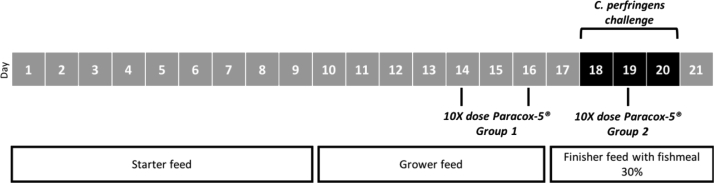
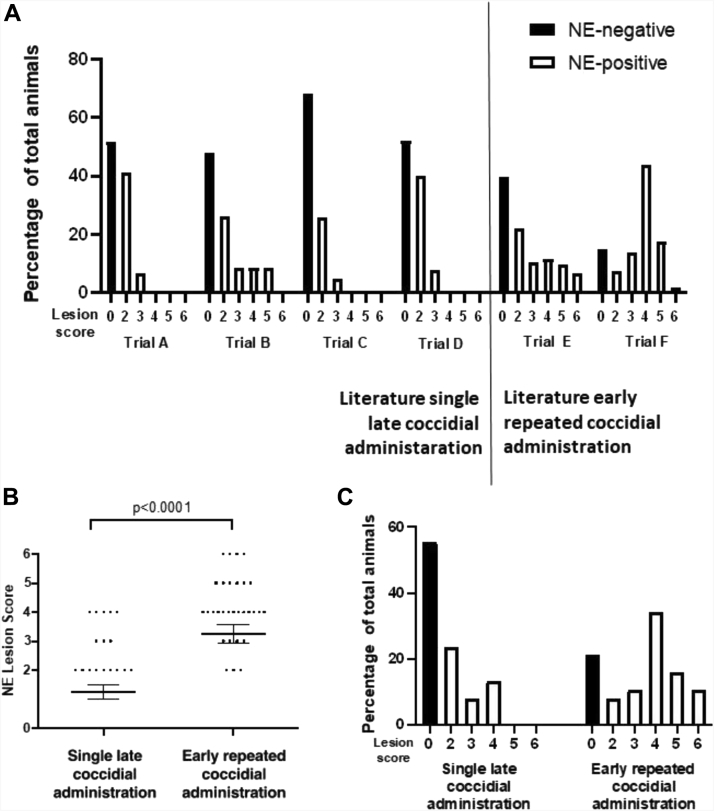
A reliable and reproducible in vivo experimental model is an essential tool to study the pathogenesis of broiler necrotic enteritis and to evaluate control methods. Most current in vivo models use Eimeria as predisposing factor. Nevertheless, most models only result in a limited number of animals with intestinal necrosis. This research describes the necrotic enteritis incidence and severity using 2 previously described experimental models varying in the time point and frequency of Eimeria administration: single late and early repeated Eimeria administration models. In an in vivo model in which Clostridium perfringens is administered at 3 consecutive days between day 18 and 20 of age, birds belonging to the single late Eimeria administration regimen received a single administration of a tenfold dose of a live attenuated Eimeria vaccine on the second day of C. perfringens challenge. Broilers belonging to the early repeated administration regimen were inoculated with the same Eimeria vaccine 4 and 2 d before the start of the C. perfringens challenge. Early repeated coccidial administration resulted in a significant increase in average necrotic lesion score (value 3.26) as compared with a single late Eimeria administration regimen (value 1.2). In addition, the number of necrotic enteritis-positive animals was significantly higher in the group that received the early repeated coccidial administration. Single Eimeria administration during C. perfringens challenge resulted in a skewed distribution of lesion scoring with hardly any birds in the high score categories. A more centered distribution was obtained with the early repeated Eimeria administration regimen, having observations in every lesion score category. These findings allow better standardization of a subclinical necrotic enteritis model and reduction of the required numbers of experimental animals.
Keywords: coccidiosis; experimental model; necrotic enteritis.
Copyright © 2020 The Authors. Published by Elsevier Inc. All rights reserved.
Figures
References
-
- Adhikari P., Kiess A., Adhikari R., Jha R. An approach to alternative strategies to control avian coccidiosis and necrotic enteritis. J. Appl. Poult. Res. 2020;29:515–534.
-
- Al-Sheikhly F., Al-Saieg A. Role of Coccidia in the Occurrence of necrotic enteritis of chickens. Am. Assoc. Avian Pathol. 1980;24:324–333. - PubMed
-
- Alnassan A.A., Kotsch M., Shehata A.A., Krüger M., Daugschies A., Bangoura B. Necrotic enteritis in chickens: development of a straightforward disease model system. Vet. Rec. 2014;174:555. - PubMed
-
- Bortoluzzi C., Vieira B.S., Hofacre C., Applegate T.J. Effect of different challenge models to induce necrotic enteritis on the growth performance and intestinal microbiota of broiler chickens. Poult. Sci. 2019;98:2800–2812. - PubMed
-
- Cooper K.K. The University of Arizona Libraries; Tucson, AZ: 2016. Pages 1–144 in Necrotic Enteritis in Broiler Chickens: Studies in Disease Reproduction and Pathogenesis in the Graduate College.
MeSH terms
Substances
LinkOut - more resources
Full Text Sources
Other Literature Sources
