Importance of extracellular vesicles in hypertension
- PMID: 33517775
- PMCID: PMC7876642
- DOI: 10.1177/1535370220974600
Importance of extracellular vesicles in hypertension
Abstract
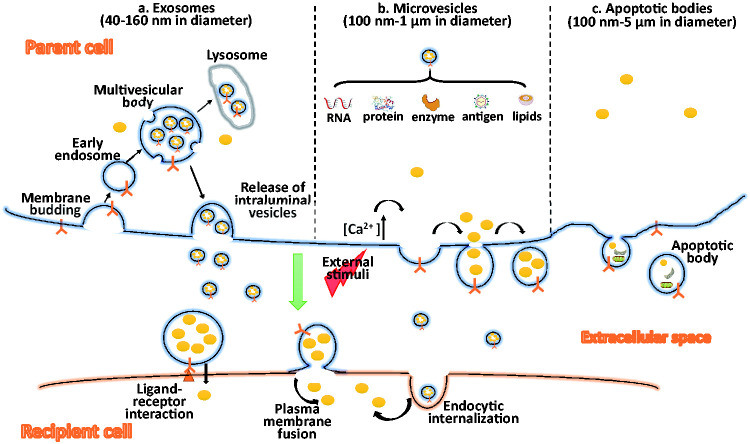
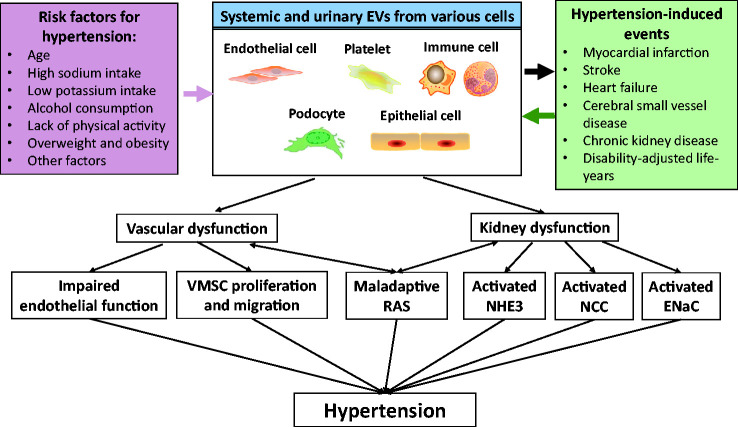
Hypertension affects approximately 1.13 billion adults worldwide and is the leading global risk factor for cardiovascular, cerebrovascular, and kidney diseases. There is emerging evidence that extracellular vesicles participate in the development and progression of hypertension. Extracellular vesicles are membrane-enclosed structures released from nearly all types of eukaryotic cells. During their formation, extracellular vesicles incorporate various parent cell components, including proteins, lipids, and nucleic acids that can be transferred to recipient cells. Extracellular vesicles mediate cell-to-cell communication in a variety of physiological and pathophysiological processes. Therefore, studying the role of circulating and urinary extracellular vesicles in hypertension has the potential to identify novel noninvasive biomarkers and therapeutic targets of different hypertension phenotypes. This review discusses the classification and biogenesis of three EV subcategories (exosomes, microvesicles, and apoptotic bodies) and provides a summary of recent discoveries in the potential impact of extracellular vesicles on hypertension with a specific focus on their role in the blood pressure regulation by organs-artery and kidney, as well as renin-angiotensin-system.
Keywords: Hypertension; RAS; endothelium; extracellular vesicles; sodium transporter; vascular smooth muscle cells.
Conflict of interest statement
Figures
References
-
- Olsen MH, Angell SY, Asma S, Boutouyrie P, Burger D, Chirinos JA, Damasceno A, Delles C, Gimenez-Roqueplo AP, Hering D, López-Jaramillo P, Martinez F, Perkovic V, Rietzschel ER, Schillaci G, Schutte AE, Scuteri A, Sharman JE, Wachtell K, Wang JG. A call to action and a lifecourse strategy to address the global burden of raised blood pressure on current and future generations: the lancet commission on hypertension. Lancet 2016; 388:2665–712 - PubMed
-
- Virani SS, Alonso A, Benjamin EJ, Bittencourt MS, Callaway CW, Carson AP, Chamberlain AM, Chang AR, Cheng S, Delling FN, Djousse L, Elkind MSV, Ferguson JF, Fornage M, Khan SS, Kissela BM, Knutson KL, Kwan TW, Lackland DT, Lewis TT, Lichtman JH, Longenecker CT, Loop MS, Lutsey PL, Martin SS, Matsushita K, Moran AE, Mussolino ME, Perak AM, Rosamond WD, Roth GA, Sampson UKA, Satou GM, Schroeder EB, Shah SH, Shay CM, Spartano NL, Stokes A, Tirschwell DL, VanWagner LB, Tsao CW. Heart disease and stroke statistics-2020 update: a report from the American Heart Association. Circulation 2020; 141:e139–e596 - PubMed
Publication types
MeSH terms
Substances
Grants and funding
LinkOut - more resources
Full Text Sources
Medical