


Dietary squalene supplementation alleviates diquat-induced oxidative stress and liver damage of broiler chickens
- PMID: 33518324
- PMCID: PMC7936218
- DOI: 10.1016/j.psj.2020.12.017
Dietary squalene supplementation alleviates diquat-induced oxidative stress and liver damage of broiler chickens
Abstract
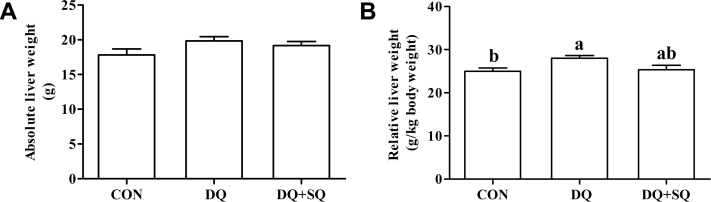
The aim of this study was to explore the protective effects of squalene supplementation on growth performance, oxidative status, and liver function of diquat-challenged broilers. One hundred forty-four 1-day-old male Ross 308 broiler chicks were allocated to 3 groups, and each group consisted of 6 replicates of 8 birds each. The three groups were as follows: 1) nonchallenged broilers fed with a basal diet (control group), 2) diquat-challenged broilers fed a basal diet, and 3) diquat-challenged broilers fed with a basal diet supplemented with 1.0 g/kg of squalene. Broilers were intraperitoneally injected with 20 mg/mL of diquat solution at a dosage of 1 mL/kg of BW or an equivalent amount of saline at 20 d. Compared with the control group, weight gain and BW change rate during 24 h after injection were decreased by diquat challenge (P < 0.05), and the diquat-induced compromised growth performance was improved by squalene supplementation (P < 0.05). Diquat administration reduced plasma superoxide dismutase activity and increased malondialdehyde accumulation and glutathione peroxidase activity in both plasma and the liver (P < 0.05). In contrast, plasma glutathione peroxidase activity in diquat-challenged broilers was reduced by squalene supplementation (P < 0.05). The hepatic glutathione level was reduced by diquat administration (P < 0.05), whereas its level in plasma and the liver of diquat-challenged broilers was increased by squalene supplementation (P < 0.05). The relative liver weight of broilers was increased by diquat challenge (P < 0.05), with its value being intermediate in the squalene-supplemented group (P > 0.05). The plasma aminotransferase activities and total bilirubin concentration were increased by diquat challenge (P < 0.05), which were reduced by squalene supplementation (P < 0.05). The mRNA abundance of hepatic nuclear factor erythroid 2-related factor 2 (P < 0.05) was upregulated by diquat treatment, regardless of squalene supplementation. The mRNA abundance of hepatic glutathione peroxidase 1 and B-cell lymphoma/leukemia 2-associated X protein was upregulated by diquat challenge (P < 0.05), which was reversed by squalene administration (P < 0.05). Squalene increased NAD(P)H quinone dehydrogenase 1 mRNA abundance and decreased caspase 3 mRNA abundance in the liver of diquat-challenged broilers (P < 0.05). The results suggested that squalene can increase weight gain, improve oxidative status, and alleviate liver injury in diquat-challenged broilers.
Keywords: broiler; diquat; liver; oxidative stress; squalene.
Copyright © 2020 The Authors. Published by Elsevier Inc. All rights reserved.
Figures
References
-
- Belhadj Slimen I., Najar T., Ghram A., Abdrrabba M. Heat stress effects on livestock: molecular, cellular and metabolic aspects, a review. J. Anim. Physiol. Anim. Nutr. 2016;100:401–412. - PubMed
-
- Brookes P.S., Yoon Y., Robotham J.L., Anders M.W., Sheu S.S. Calcium, ATP, and ROS: a mitochondrial love-hate triangle. Am. J. Physiol. Cell Physiol. 2004;287:C817–C833. - PubMed
-
- Bryan H.K., Olayanju A., Goldring C.E., Park B.K. The Nrf2 cell defence pathway: keap1-dependent and -independent mechanisms of regulation. Biochem. Pharmacol. 2013;85:705–717. - PubMed
-
- Buddhan S., Sivakumar R., Dhandapani N., Ganesan B., Anandan R. Protective effect of dietary squalene supplementation on mitochondrial function in liver of aged rats. Prostaglandins Leukot. Essent. Fatty Acids. 2007;76:349–355. - PubMed
MeSH terms
Substances
LinkOut - more resources
Full Text Sources
Other Literature Sources
Research Materials
