


Hilar Malignant Biliary Obstruction Treated with Four Metallic Stents Involving a New Slim Device
- PMID: 33518571
- PMCID: PMC8263184
- DOI: 10.2169/internalmedicine.6356-20
Hilar Malignant Biliary Obstruction Treated with Four Metallic Stents Involving a New Slim Device
Abstract
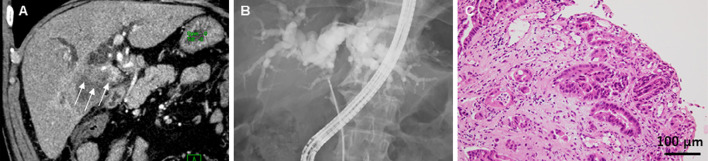
Endoscopic hilar multiple stenting is challenging. A 68-year-old patient had self-expandable metallic stents (SEMSs) inserted for unresectable hilar malignant biliary obstruction. After the SEMSs were inserted into the left hepatic duct and bile duct branch of segment (B) 6, a new SEMS with a wide mesh and slim delivery system was inserted into the right anterior hepatic duct. However, liver abscess and dilated B7 were observed on computed tomography; therefore, an additional new SEMS was quickly and easily inserted into B7. After the placement of these four SEMSs, the liver abscess improved. The new SEMS was effective for hilar multiple biliary drainage.
Keywords: bilateral biliary drainage; hilar malignant biliary obstruction; self-expandable metallic stent.
Conflict of interest statement
Figures


References
-
- Nuzzo G, Giuliante F, Ardito F, et al. . Improvement in perioperative and long-term outcome after surgical treatment of hilar cholangiocarcinoma: results of an Italian multicenter analysis of 440 patients. Arch Surg 147: 26-34, 2012. - PubMed
-
- Takahashi Y, Nagino M, Nishio H, Ebata T, Igami T, Nimura Y. Percutaneous transhepatic biliary drainage catheter tract recurrence in cholangiocarcinoma. Br J Surg 97: 1860-1866, 2010. - PubMed
-
- Kawakami H, Kuwatani M, Onodera M, et al. . Endoscopic nasobiliary drainage is the most suitable preoperative biliary drainage method in the management of patients with hilar cholangiocarcinoma. J Gastroenterol 46: 242-248, 2011. - PubMed
Publication types
MeSH terms
LinkOut - more resources
Full Text Sources
Other Literature Sources
Medical
Research Materials
