. 2021 Feb:254:108952.
doi: 10.1016/j.biocon.2021.108952. Epub 2021 Jan 5.

Does public fear that bats spread COVID-19 jeopardize bat conservation?

Affiliations

Does public fear that bats spread COVID-19 jeopardize bat conservation?

Manman Lu et al. Biol Conserv. 2021 Feb.

Abstract

With >1 400 species, bats comprise the second-largest order of mammals and provide critical ecological services as insect consumers, pollinators, and seed dispersers. Yet, bats are frequently associated with infectious human diseases such as SARS, MERS, and Ebola. As early as the end of January 2020, several virological studies have suggested bats as a probable origin for SARS-CoV-2, the causative agent of COVID-19. How does the public view the role of bats in COVID-19? Here we report pilot data collected shortly after the outbreak of COVID-19 using two online surveys, combined with a conservation intervention experiment, primarily on people who are receiving or have received higher education in China. We found that 84% of the participants of an online survey (n = 13 589) have misunderstood the relationship between bats and COVID-19, which strengthened negative attitudes towards bats. Knowledge of bats, gender, and education level of the participants affected their attitudes towards bats. Participants who indicated a better knowledge of bats had a more positive attitude towards bats. The proportion of female participants who had negative attitudes towards bats was higher than that of male participants. Participants with a higher education level indicated a more positive attitude towards bats after the outbreak of COVID-19. A specially prepared bat conservation lecture improved peoples' knowledge of bats and the positive attitudes, but failed to correct the misconception that bats transmit SARS-CoV-2 to humans directly. We suggest that the way virologists frame the association of bats with diseases, the countless frequently inaccurate media coverages, and the natural perceptual bias of bats carrying and transmitting diseases to humans contributed to the misunderstandings. This probably led to a rise in the events of evicting bats from dwellings and structures by humans and the legislative proposal for culling disease-relevant wildlife in China. A better understanding of the relationship between disease, wildlife and human health could help guide the public and policymakers in an improved program for bat conservation.

Keywords: Biodiversity conservation; Misinformation; SARS-CoV-2; Science communication; Zoonoses.


Conflict of interest statement

The authors declare that they have no known competing financial interests or personal relationships that could have appeared to influence the work reported in this paper.

Figures
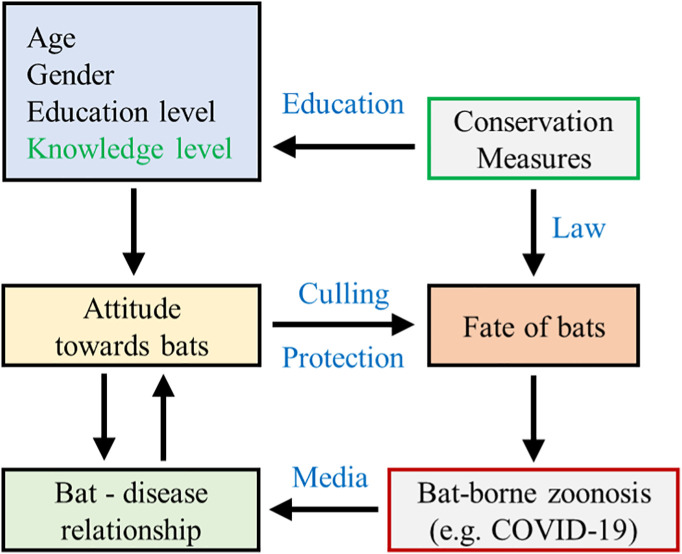
Fig. 1
Fig. 1
A framework that may link COVID-19 to the fate of bats. Humans' attitudes towards bats are potentially influenced by several factors, among which the knowledge level of people represents a flexible one and can be changed through education. Humans' attitude towards bats is also affected by their attitudes towards the bat-disease relationship that depends critically on how the media report scientific advances. Specifically, the misinterpreted role of bats in zoonosis can lead to misunderstandings of the relationships between bats and disease.
Fig. 2
Fig. 2
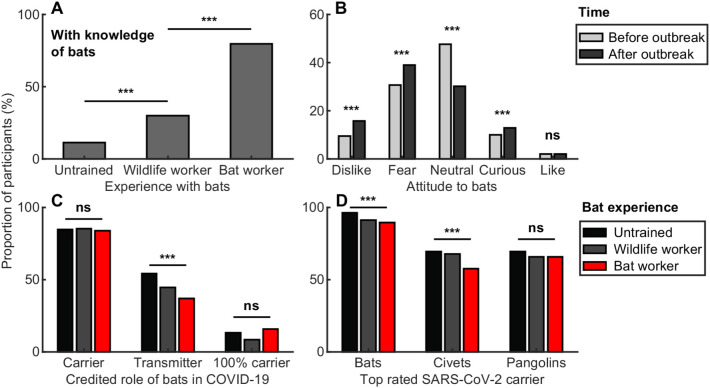
Perceptions of bats with COVID-19 by the public. (A) The proportion of participants who indicated some or plenty of knowledge of bats among the wildlife untrained, wildlife workers, and bat workers. (B) Attitude towards bats before and after the COVID-19 outbreak. (C) The proportion of participants who misbelieved that bats carry SARS-CoV-2 (‘Carrier’), bats transmit SARS-CoV-2 directly to humans (‘Transmitter’), and every individual of bat carries SARS-CoV-2 (100% carrier). (D) Among 10 groups of animals mentioned by media, bats, civets, and pangolins are the three top-rated ones believed to carry SARS-CoV-2. Statistical significance between groups is indicated by asterisks: *** (P < 0.001) and ns (P > 0.05). The minimum sample size across all statistical analyses was 36 (number of bat workers of the “100% carrier” group in panel C).
Fig. 3
Fig. 3
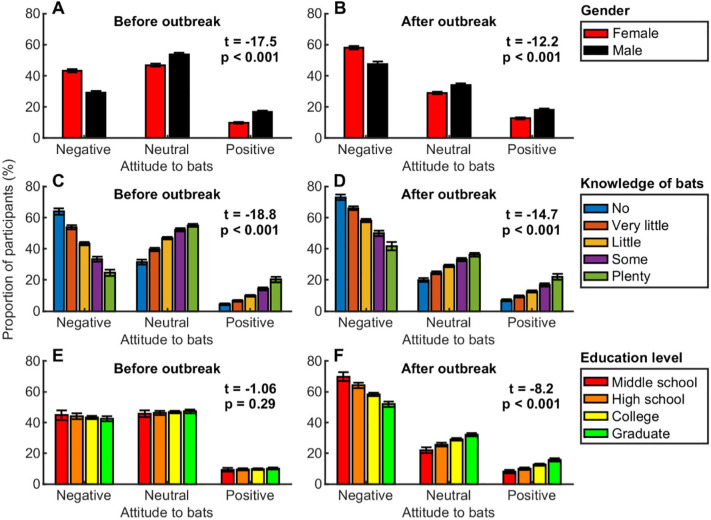
Attributes of the participants explain the attitude differences to bats. (A, B) The attitude towards bats by female participants was more negative than that by male participants. (C, D) Participants with less knowledge of bats were more negative in attitudes towards bats. (E, F) After the outbreak of COVID-19, participants with more education were less negative in attitudes towards bats. The minimum sample size across all statistical analyses was 28 (number of participants who had no knowledge of bats and indicated a positive attitude in panel C).
Fig. 4
Fig. 4
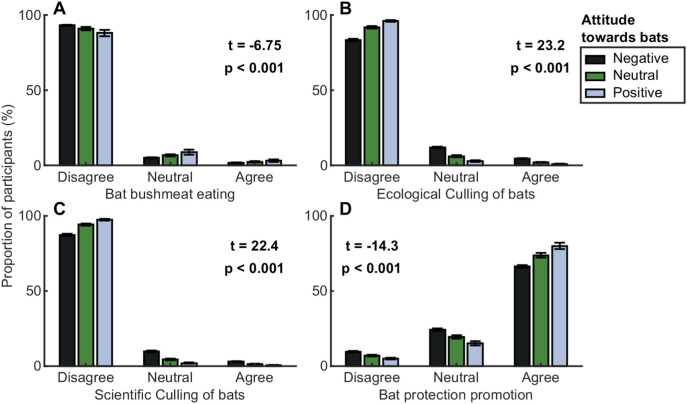
Effects of attitudes towards bats on attitudes towards human actions on bats. Most participants disagreed with the bat bushmeat eating (A) and the bat culling proposals (B, C) and agreed with bat conservation (D). Participants who indicated a negative (fear or dislike) attitude towards bats were more likely to support the bat culling proposals, but less likely to support bat protection. Data were the predicted effect of the target factor (attitude to bats) with the multinomial proportional odds model. Error bars indicate the 95% confidence interval.
Fig. 5
Fig. 5
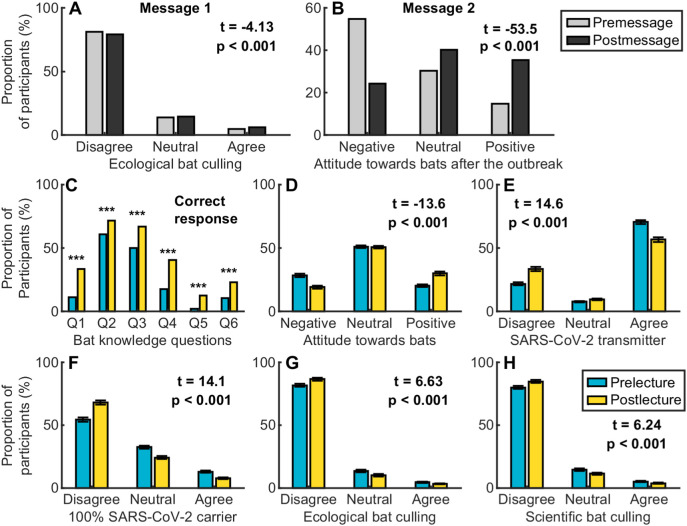
Effects of conservation measure on peoples' attitudes towards bats. (A) Effects of Message 1, which highlighted the ecological values of bats, on peoples' attitudes towards the “Ecological Culling” proposal for bats. (B) Effects of Message 2 on peoples' attitudes after the pandemic towards bats. In Message 2, we explained the relationships between bats and viruses based on the best available scientific evidence and warned of potentially serious ecological consequences associated with the “Ecological Culling” of bats. (C) Effects of a bat conservation lecture on peoples' knowledge of bats. Q1, self-indicated some or plenty of knowledge of bats; Q2 to Q6 are bat fact questions that correspond to questions 7, 8, 9, 10, and 17 in questionnaire 2 (Appendix). (D–H) Effects of the bat conservation lecture on participants' attitudes towards bats, the bat-virus relationship, and bat culling proposals. Figure legends for panels C-H are shown in panel H. Statistical significance between two groups in panel C is indicated by asterisks: *** (P < 0.001). Data in panels D–H were the predicted effect of the target factor (bat lecture) with the multinomial proportional odds model, after controlling for the influences of other factors. Error bars indicate the 95% confidence interval. The minimum sample size across all statistical analyses was 118 (number of participants who made a correct response to question 5 (Q5) in the pre-lecture test in panel C).

References

    1. Abdelhafiz A.S., Mohammed Z., Ibrahim M.E., Ziady H.H., Alorabi M., Ayyad M., Sultan E.A. Knowledge, perceptions, and attitude of Egyptians towards the novel coronavirus disease (COVID-19) J. Community Health. 2020 doi: 10.1007/s10900-020-00827-7. - DOI - PMC - PubMed
    1. Amman B.R., Nyakarahuka L., McElroy A.K., Dodd K.A., Sealy T.K., Schuh A.J., Shoemaker T.R., Balinandi S., Atimnedi P., Kaboyo W., Nichol S.T., Towner J.S. Marburgvirus resurgence in Kitaka mine bat population after extermination attempts, Uganda. Emerg. Infect. Dis. 2014;20:1761–1764. doi: 10.3201/eid2010.140696. - DOI - PMC - PubMed
    1. Azlan A.A., Hamzah M.R., Sern T.J., Ayub S.H., Mohamad E. Public knowledge, attitudes and practices towards COVID-19: a cross-sectional study in Malaysia. PLoS One. 2020;15 doi: 10.1371/journal.pone.0233668. - DOI - PMC - PubMed
    1. Beretti M., Stuart D. Food safety and environmental quality impose conflicting demands on Central Coast growers. Calif. Agric. 2008;62:68–73. doi: 10.3733/ca.v062n02p68. - DOI
    1. Bjerke T., Østdahl T. Animal-related attitudes and activities in an urban population. Anthrozoös. 2004;17:109–129. doi: 10.2752/089279304786991783. - DOI