


An overview of fractional anisotropy as a reliable quantitative measurement for the corticospinal tract (CST) integrity in correlation with a Fugl-Meyer assessment in stroke rehabilitation
- PMID: 33519079
- PMCID: PMC7829559
- DOI: 10.1589/jpts.33.75
An overview of fractional anisotropy as a reliable quantitative measurement for the corticospinal tract (CST) integrity in correlation with a Fugl-Meyer assessment in stroke rehabilitation
Abstract
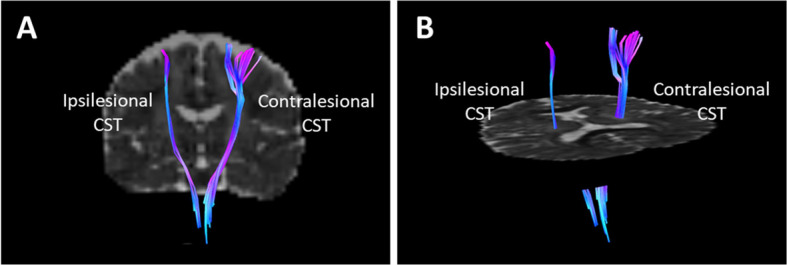
[Purpose] Understanding the essential mechanisms in post-stroke recovery not only provides important basic insights into brain function and plasticity but can also guide the development of new therapeutic approaches for stroke patients. This review aims to give an overview of how various variables of Magnetic Resonance-Diffusion Tensor Imaging (MR-DTI) metrics of fractional anisotropy (FA) can be used as a reliable quantitative measurement and indicator of corticospinal tract (CST) changes, particularly in relation to functional motor outcome correlation with a Fugl-Meyer assessment in stroke rehabilitation. [Methods] PubMed electronic database was searched for the relevant literature, using key words of diffusion tensor imaging (dti), corticospinal tract, and stroke. [Results] We reviewed the role of FA in monitoring CST remodeling and its role of predicting motor recovery after stroke. We also discussed the mechanism of CST remodeling and its modulation from the value of FA and FMA-UE. [Conclusion] Heterogeneity of post-stroke brain disorganization and motor impairment is a recognized challenge in the development of accurate indicators of CST integrity. DTI-based FA measurements offer a reliable and evidence-based indicator for CST integrity that would aid in predicting motor recovery within the context of stroke rehabilitation.
Keywords: Corticospinal tract; Fractional anisotropy; Stroke.
2021©by the Society of Physical Therapy Science. Published by IPEC Inc.
Figures
References
-
- Kyu HH, Abate D, Abate KH, et al. GBD 2017 DALYs and HALE Collaborators: Global, regional, and national disability-adjusted life-years (DALYs) for 359 diseases and injuries and healthy life expectancy (HALE) for 195 countries and territories, 1990-2017: a systematic analysis for the Global Burden of Disease Study 2017. Lancet, 2018, 392: 1859–1922. - PMC - PubMed
-
- O’Donnell MJ, Chin SL, Rangarajan S, et al. INTERSTROKE investigators: Global and regional effects of potentially modifiable risk factors associated with acute stroke in 32 countries (INTERSTROKE): a case-control study. Lancet, 2016, 388: 761–775. - PubMed
-
- Levin MF, Kleim JA, Wolf SL: What do motor “recovery” and “compensation” mean in patients following stroke? Neurorehabil Neural Repair, 2009, 23: 313–319. - PubMed
-
- Selzer ME, Clarke S, Cohen LG, et al. : Introduction to neural repair and rehabilitation. Textbook of neural repair and rehabilitation: volume 2. Med Neurorehabilitation, 2014, 2: xviii–xxiv.
-
- Filippi M, Agosta F: Diffusion tensor imaging and functional MRI. Handb Clin Neurol, 2016, 136: 1065–1087. - PubMed
Publication types
LinkOut - more resources
Full Text Sources
Other Literature Sources
