Review
. 2021 Jan:143:100594.
doi: 10.1016/j.mser.2020.100594. Epub 2020 Nov 20.

Electrospun ultrafine fibers for advanced face masks

Affiliations
Review

Electrospun ultrafine fibers for advanced face masks

Zhenfang Zhang et al. Mater Sci Eng R Rep. 2021 Jan.

Abstract

The outbreak of Coronavirus Disease 2019 (COVID-19), which is caused by severe acute respiratory syndrome coronavirus 2 (SARS-CoV-2), has triggered great global public health concern. Face masks are essential tools to reduce the spread of SARS-CoV-2 from human to human. However, there are still challenges to prolong the serving life and maintain the filtering performance of the current commercial mask. Filters composed of ultrafine fibers with diameter down to tens of nanometers have the potential to physically block viruses. With adjustable composition and nanostructures, the electrospun ultrafine fiber filter is possible to achieve other necessary functions beyond virus blocking, such as antiviral, transparent, and degradable, making it an important part of fighting the epidemic. In this review, beginning with the basic information of the viruses, we summarize the knowledge of masks and respirators, including the filtering mechanism, structure, classification, and standards. We further present the fabrication method, filtering performance, and reusable potential of electrospun ultrafine fiber-based masks. In the end, we discuss the development directions of ultrafine fibers in protective devices, especially their new functional applications and possible contributions in the prevention and control of the epidemic.

Keywords: COVID-19; Filtering mechanism; Mask; Nanofibers; Respirator; Reusable mask; SARS-CoV-2; Virus.


Conflict of interest statement

The authors declare no conflict of interest.

Figures
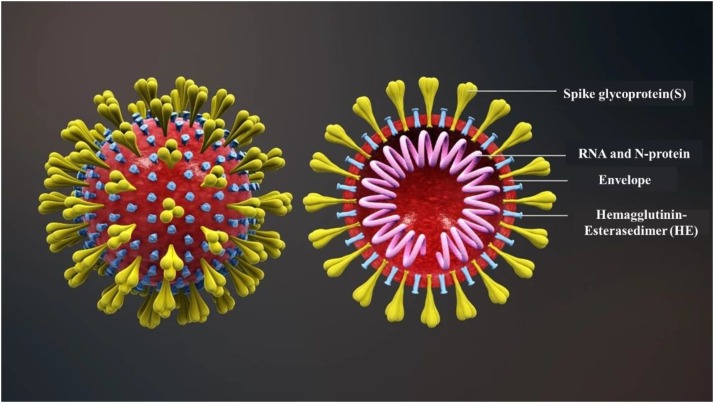
Fig. 1
Fig. 1
The structure of SARS-CoV-2. Reproduced with permission from [44]. Copyright 2020, http://www.seebio.cn/Article/1_1.html.
Fig. 2
Fig. 2
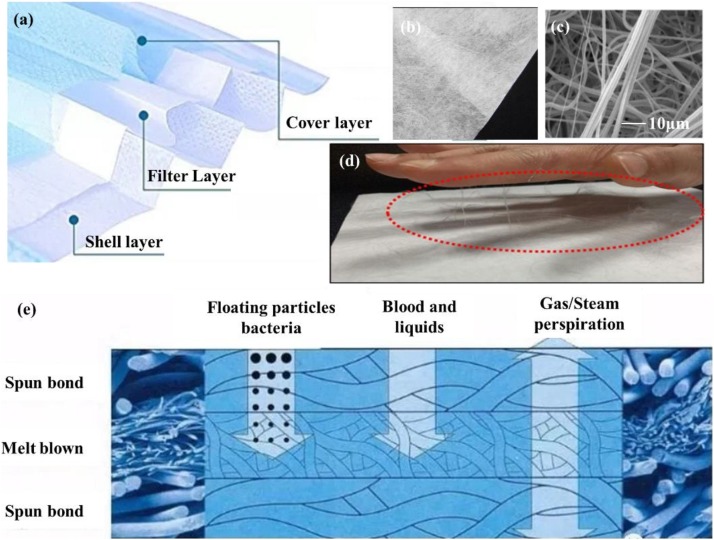
(a) Diagram of the structure of a surgical mask. (b) Digital photo of the PP melt-blown cloth. (c) SEM image of melt-blown PP fibers. (d) Observation of static charge on the surfaces of melt-blown PP filters. Reproduce with permission from [64]. Copyright 2020, ACS Applied Nano Materials. (e) Schematic diagram of the filtering functions of the three layer.
Fig. 3
Fig. 3
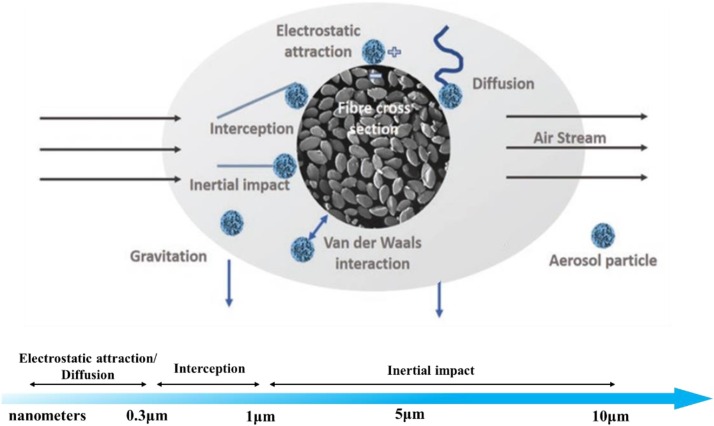
Filtration mechanism of fiber filter based on the particle size. Reproduced with permission from [65]. Copyright 2019, ACS Applied Nano Materials.
Fig. 4
Fig. 4
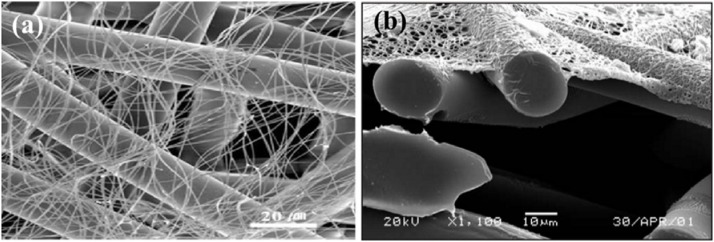
(a) Comparison of electrospun fiber and PP fiber. (b) SEM image of cross-section of nanofibers on a polyester spun-bond substrate. Reproduced with permission from [78]. Copyright 2003, International Nonwovens Journal.
Fig. 5
Fig. 5
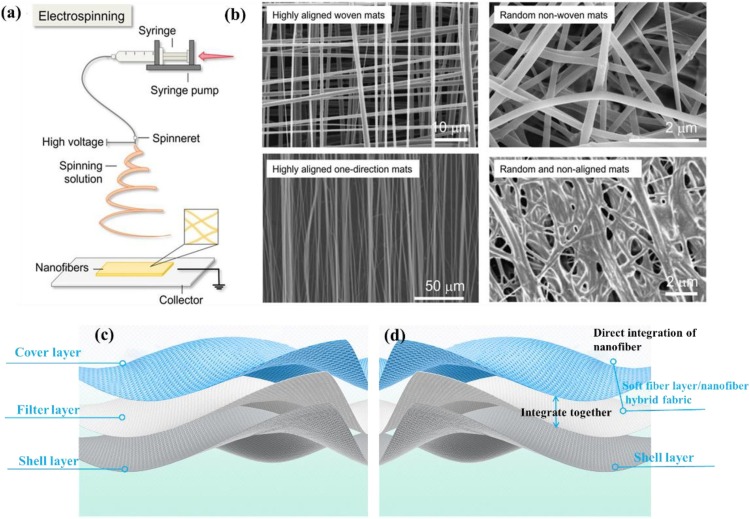
(a) Schematic diagram of electrospinning technology. (b) SEM images of electrospun nanofibers with different geometries and styles. Reproduced with permission from [81]. Copyright 2020, Advanced Fiber Materials. (c) Structure of commonly used masks. (d) The proposed structure of electrospun ultrafine fibrous masks.
Fig. 6
Fig. 6
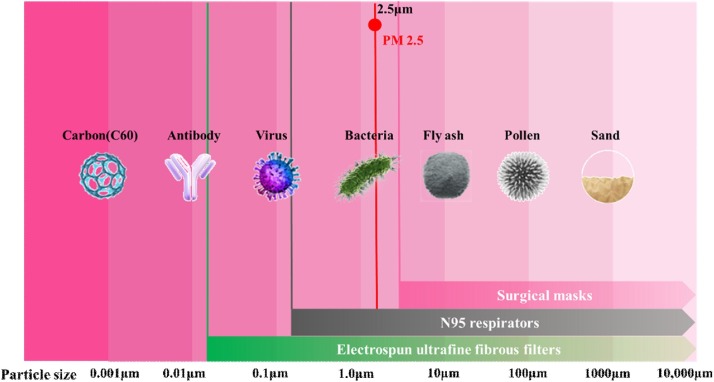
The comparison of filtration performance of electrospun ultrafine fibrous filters, N95 respirators and commonly used surgical facemasks.
Fig. 7
Fig. 7
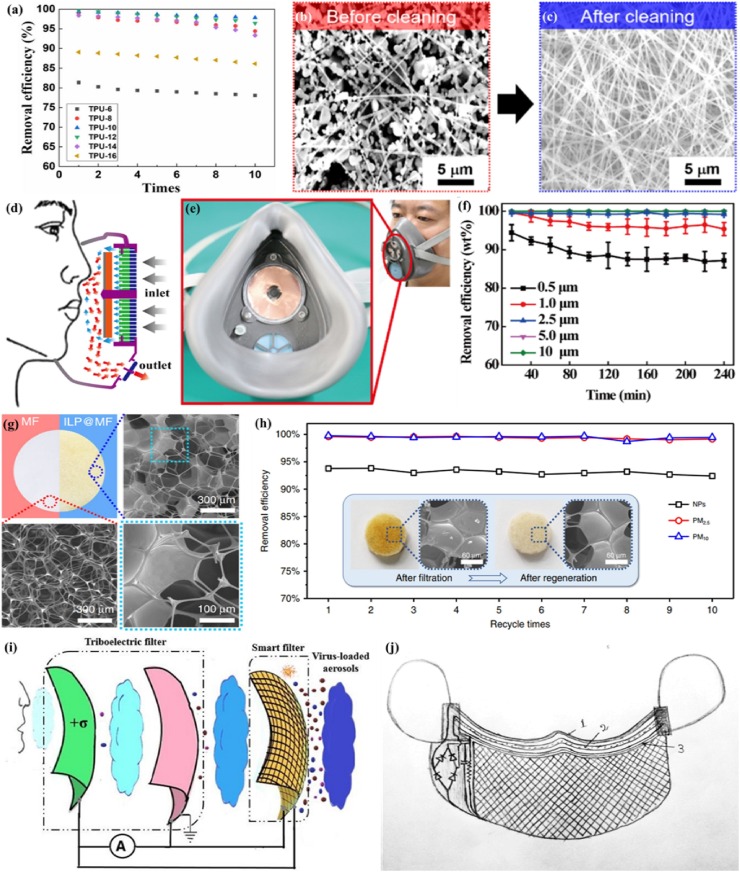
(a) Reusability of the TPU-10 nanofiber filter. Reproduced with permission from [115]. Copyright 2019, Nanoscale Research Letters. (b) and (c) SEM images showing nanofibers of the PBI filter before and after the cleaning process using inorganic particulate matters. Reproduced with permission from [116]. Copyright 2019, ACS Applied Materials and Interfaces. (d) Structure of the R-TENG. (e) Digital photo of the SEA-FM. (f) Durability test on the removal efficiency of the SEA-FM after 30 days. Reproduced with permission from [118]. Copyright 2018, ACS Applied Materials and Interfaces. (g) Photographs and SEM images of the MF sponge (red) and the ILP@MF filter (blue). (h) Filtration efficiency of the charged [C4mim][OAc]–PVP@MF filter regenerated for 1–10 times. Reproduced with permission from [119]. Copyright 2020, Nature Communications. (i) The schematic of the working mechanism of self-powered smart masks. (j) The proposed self-powered smart mask (1-inner layer, 2-middle layer, 3-smart layer). Reproduced with permission from [120]. Copyright 2020, arXiv:2005.08305. (For interpretation of the references to colour in this figure legend, the reader is referred to the web version of this article).
Fig. 8
Fig. 8
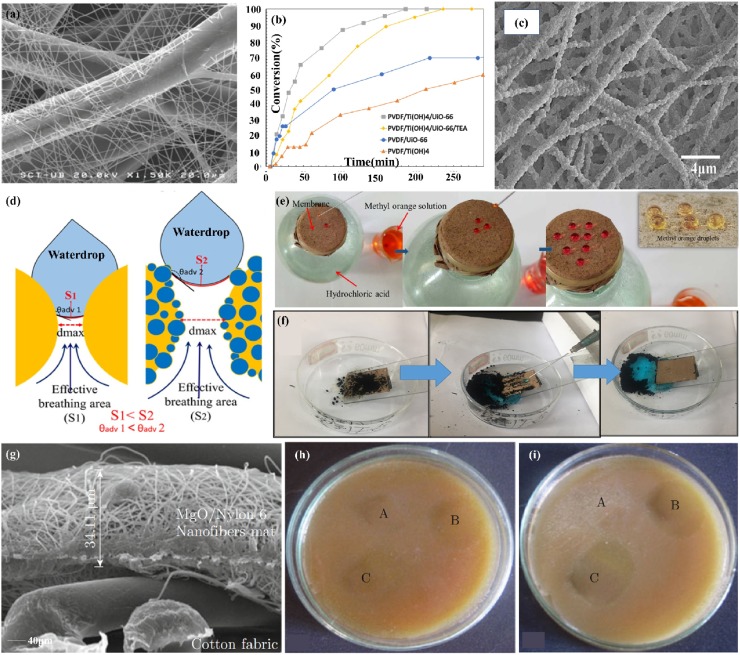
(a) SEM image of PA6 electrospun nanofibers that thermally bonded onto the viscose non-woven. Reproduced with permission from [123]. Copyright 2012, Journal of Nanomaterials. (b)The percent conversion of GD nerve agent with PVDF composite samples. Reproduced with permission from [124]. Copyright 2018, ACS Applied Materials & Interfaces. (c) SEM image of 7.3 wt% SiO2@PTFE. (d) Schematic illustration of porous structure and breathability of BLNFMs. (e) Breathable performance of BLNFMs. (f) Self-cleaning performance of the superhydrophobic BLNFMs. Reproduced with permission from [126]. Copyright 2018, Applied Surface Science. (f) FE-SEM image show the cross section view of MN6C. Antibacterial activities of (g) Staphylococcus aureus and (h) Escherichia coli. A-UC, B-N6C, and C-MN6C. Reproduced with permission from [128]. Copyright 2014, Nano-Micro Letters.
Fig. 9
Fig. 9
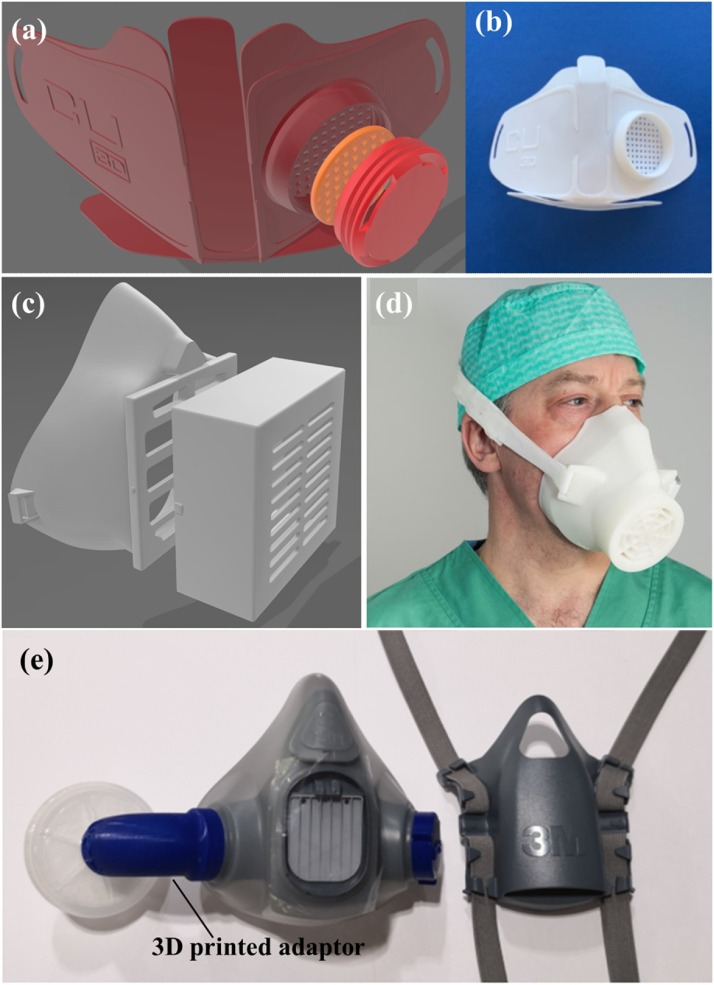
(a, b) Copper3D NanoHack mask. (c,d) HEPA mask design with a box for filter insertion. Reproduced with permission from [135]. Copyright 2020, International Journal of Oral and Maxillofacial Surgery. (e) The 3D-printed adaptor on reusable elastomeric respirators. Reproduced with permission from [136]. Copyright 2020, Anaesthesia.
Fig. 10
Fig. 10
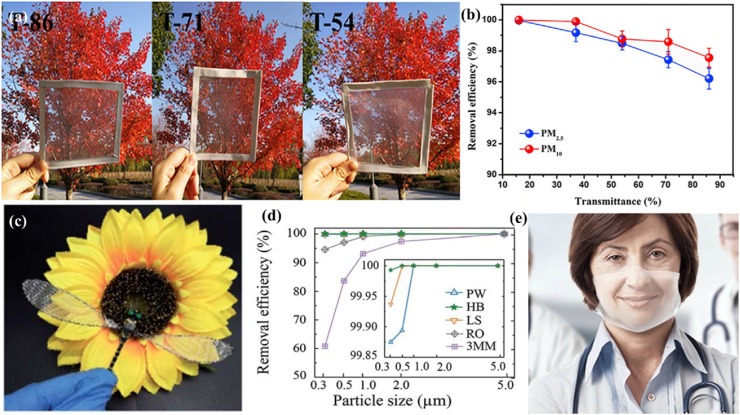
(a) Photographs of PDMS/PMMA-chitosan transparent air filter with different optical transmittance. (b) PM 2.5 and PM 10 removal efficiency of transparent filters with different transmittances. Reproduced with permission from [138]. Copyright 2019, iScience. (c) The prepared transparent air filter was integrated into the wing of a dragonfly model to observe its transmittance in front of a cloth sunflower. (d) Comparison of the removal efficiency between plain weave (PW), herringbone (HB), lozenge stria (LS) pattern of the fibrous membranes. Reproduced with permission from [137]. Copyright 2020, RSC Advances. (e) The transparent Hello Mask. Reproduced with permission from [140]. Copyright 2020, https://www.empa.ch/web/s604/schutzmaske.
Fig. 11
Fig. 11
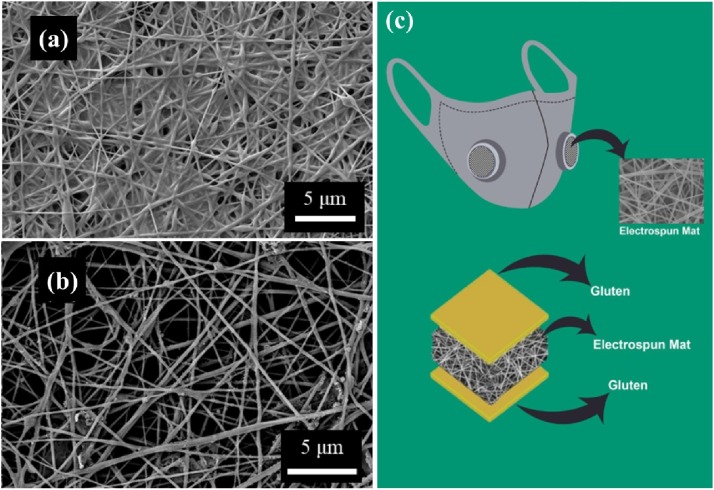
SEM images of fouled PVA/CNCs filters (a) before (b) after water washing. Reproduced with permission from [143]. Copyright 2020, Chemical Engineering Journal. (c) Schematic showing the final shape and internal structure of the fully bio-based facemasks. Reproduced with permission from [144]. Copyright 2020, Science of the Total Environment.
Fig. 12
Fig. 12
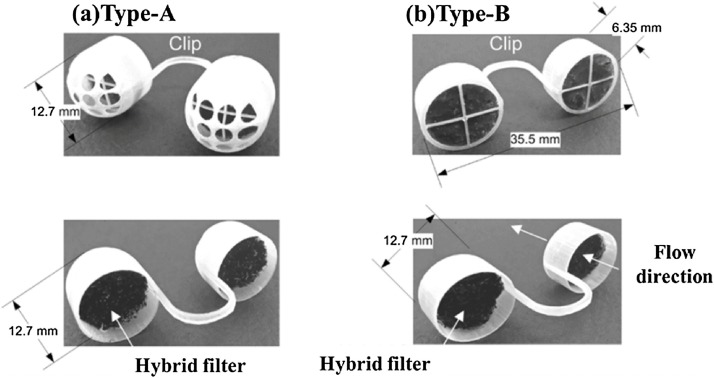
Photos of the prototypes of NNF (a) type-A and (b) type-B: the frames fabricated by using a 3D printer and then a pair of hybrid filters were installed. Reproduced with permission from [147]. Copyright 2018, Aerosol and Air Quality Research.

References

    1. C.S.G. of the International Nat. Microbiol. 2020;5:536–544.
    1. Xie M., Chen Q. Int. J. Infect. Dis. 2020;94:119–124. - PMC - PubMed
    1. Rothan H.A., Byrareddy S.N. J. Autoimmun. 2020;109:102433–102437. - PMC - PubMed
    1. Zheng Y.-Y., Ma Y.-T., Zhang J.-Y., Xie X. Nat. Rev. Cardiol. 2020;17:259–260. - PMC - PubMed
    1. Huang C., Wang Y., Li X., Ren L., Zhao J., Hu Y., Zhang L., Fan G., Xu J., Gu X. Lancet. 2020;395:497–506. - PMC - PubMed