


Screening colonoscopy: The present and the future
- PMID: 33519138
- PMCID: PMC7814366
- DOI: 10.3748/wjg.v27.i3.233
Screening colonoscopy: The present and the future
Abstract
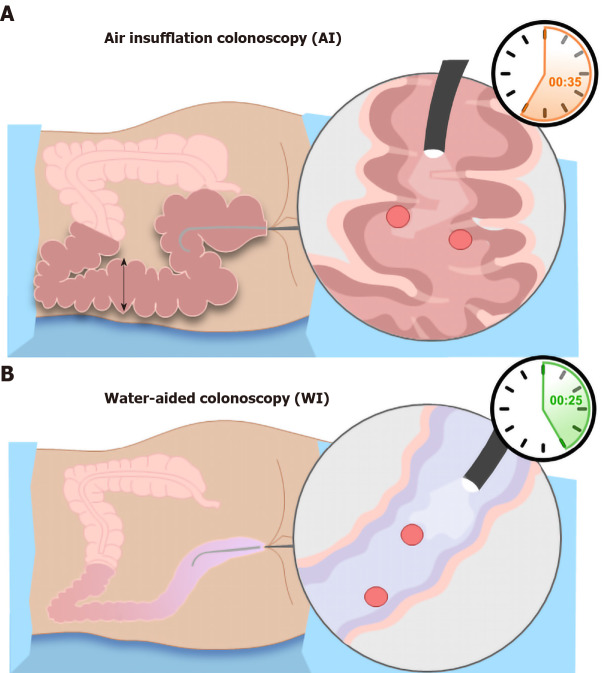
In the United States, colorectal cancer (CRC) is the second leading cause of mortality in men and women. We are now seeing an increasing number of patients with advanced-stage diagnosis and mortality from colorectal cancer before 50 years of age, which requires earlier screening. With the increasing need for CRC screening through colonoscopy, and thus endoscopists, easier and simpler techniques are needed to train proficient endoscopists. The most widely used approach by endoscopists is air insufflation colonoscopy, where air distends the colon to allow visualization of the colonic mucosa. This technique is un-comfortable for patients and requires an anesthetist to administer sedation. In addition, patients commonly complain about discomfort post-op as air escapes into the small bowel and cannot be adequately removed. Current research into the use of water insufflation colonoscopies has proved promising in reducing the need for sedation, decreasing discomfort, and increasing the visibility of the colonic mucosa. Future direction into water insufflation colonoscopies which have shown to be simpler and easier to teach may increase the number of proficient endoscopists in training to serve our aging population.
Keywords: Adenoma detection rate; Adenomatous polyps; Air-insufflation colonoscopy; Colorectal cancer; Water-insufflation colonoscopy.
©The Author(s) 2021. Published by Baishideng Publishing Group Inc. All rights reserved.
Conflict of interest statement
Conflict-of-interest statement: Chelsea V Hayman and Dinesh Vyas have nothing to disclose.
Figures
References
-
- Seeff LC, Richards TB, Shapiro JA, Nadel MR, Manninen DL, Given LS, Dong FB, Winges LD, McKenna MT. How many endoscopies are performed for colorectal cancer screening? Gastroenterology. 2004;127:1670–1677. - PubMed
-
- Wolff WI. Colonoscopy: history and development. Am J Gastroenterol. 1989;84:1017–1025. - PubMed
-
- Muto T, Bussey HJ, Morson BC. The evolution of cancer of the colon and rectum. Cancer. 1975;36:2251–2270. - PubMed
-
- Phaosawasdi K, Cooley W, Wheeler J, Rice P. Carbon dioxide-insufflated colonoscopy: an ignored superior technique. Gastrointest Endosc. 1986;32:330–333. - PubMed
Publication types
MeSH terms
LinkOut - more resources
Full Text Sources
Other Literature Sources
Medical
Miscellaneous
