


Evaluating the potency of Sulawesi propolis compounds as ACE-2 inhibitors through molecular docking for COVID-19 drug discovery preliminary study
- PMID: 33519145
- PMCID: PMC7834134
- DOI: 10.1016/j.jksus.2020.101297
Evaluating the potency of Sulawesi propolis compounds as ACE-2 inhibitors through molecular docking for COVID-19 drug discovery preliminary study
Abstract
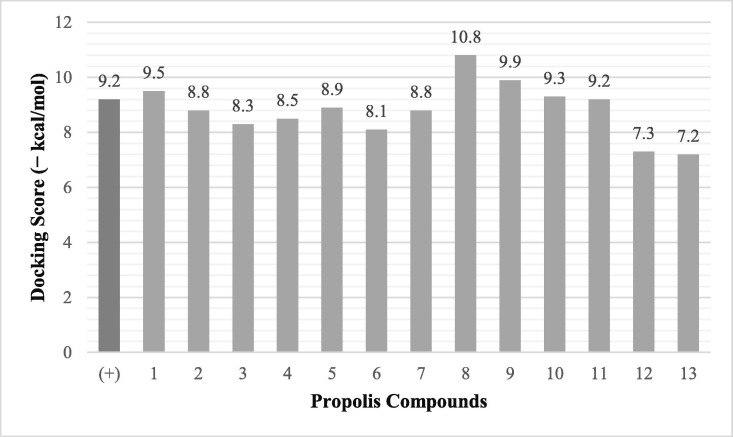
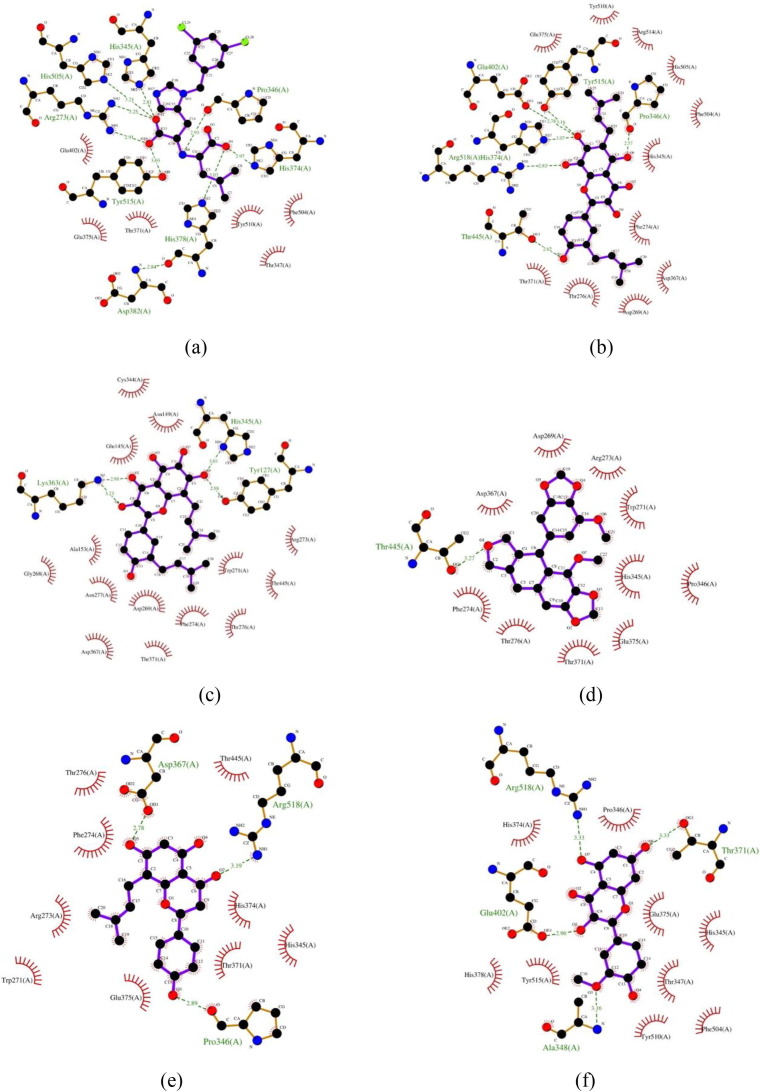
Coronavirus disease (COVID-19) is a global pandemic caused by severe acute respiratory syndrome coronavirus-2 (SARS-CoV-2). Up to date, there has been no specific cure to treat the disease. Indonesia is one of the countries that is still fighting to control virus transmission. Yet, at the same time, Indonesia has a rich biodiversity of natural medicinal products that potentially become an alternative cure. Thus, this study examined the potency of a natural medicinal product, Sulawesi propolis compounds produced by Tetragonula sapiens, inhibiting angiotensin-converting activity enzyme-2 (ACE-2), a receptor of SARS-CoV-2 in the human body. In this study, molecular docking was done to analyze the docking scores as the representation of binding affinity and the interaction profiles of propolis compounds toward ACE-2. The results illustrated that by considering the docking score and the presence of interaction with targeted sites, five compounds, namely glyasperin A, broussoflavonol F, sulabiroins A, (2S)-5,7-dihydroxy-4'-methoxy-8-prenylflavanone and isorhamnetin are potential to inhibit the binding of ACE-2 and SARS-CoV-2, with the docking score of -10.8, -9.9, -9.5, -9.3 and -9.2 kcal/mol respectively. The docking scores are considered to be more favorable compared to MLN-4760 as a potent inhibitor.
Keywords: ACE-2; COVID-19; Molecular docking; Potent inhibitor; Sulawesi propolis.
© 2020 The Author(s).
Conflict of interest statement
The authors declare that they have no known competing financial interests or personal relationships that could have appeared to influence the work reported in this paper.
Figures
References
-
- Afriza D., Suriyah W.H., Ichwan S.J.A. In silico analysis of molecular interactions between the anti-apoptotic protein survivin and dentatin, nordentatin, and quercetin. J. Phys. Conf. Ser. 2018;1073:032001. doi: 10.1088/1742-6596/1073/3/032001. - DOI
-
- Alday, E., Navarro-Navarro, M., Garibay-Escobar, A., Robles-Zepeda, R., Hernandez, J., Velazquez, C., 2016. Advances in pharmacological activities and chemical composition of propolis produced in Americas. Beekeeping and Bee Conservation—Advances in Research.
-
- Arora, R., Tchertanov, L., 2012. The HIV-1 Integrase: Modeling and Beyond. INTECH
LinkOut - more resources
Full Text Sources
Other Literature Sources
Miscellaneous