


The Effectiveness of a Self-Efficacy-Focused Structured Education Program (SSEP) in Improving Metabolic Control and Psychological Outcomes of Type 2 Diabetes Patients: A 12-Month Follow-Up of a Multicenter Randomized Controlled Trial
- PMID: 33519219
- PMCID: PMC7837544
- DOI: 10.2147/DMSO.S290029
The Effectiveness of a Self-Efficacy-Focused Structured Education Program (SSEP) in Improving Metabolic Control and Psychological Outcomes of Type 2 Diabetes Patients: A 12-Month Follow-Up of a Multicenter Randomized Controlled Trial
Abstract
Background and objective: The 12-month follow-up effect of the self-efficacy-focused structured education program (SSEP) requires in-depth confirmation. This study aims to verify whether the benefits of SSEP can be maintained in 12 months.
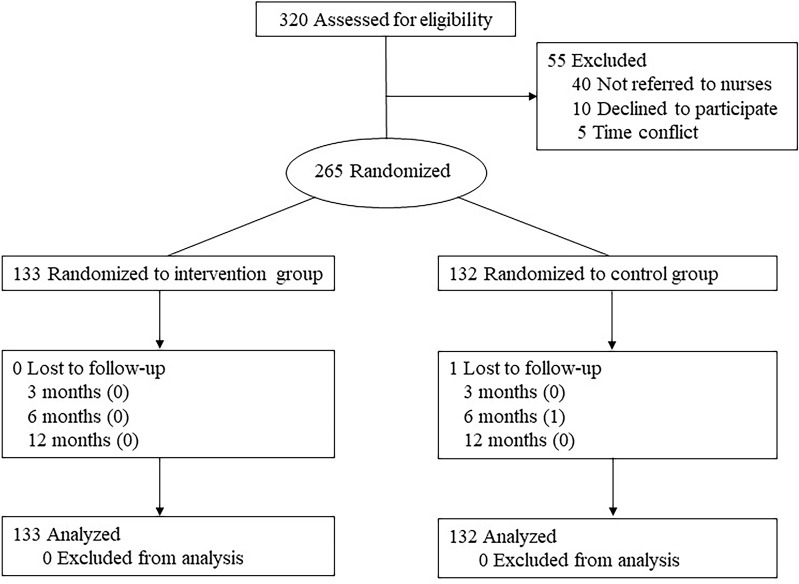
Materials and methods: A multicenter randomized controlled trial with 12-month follow-up conducted among 265 type 2 diabetes patients not on insulin from 4 hospitals in mainland China. The intervention group (n = 133) was administrated with SSEP, and the control group (n = 132) received the routine education. The indicators of metabolic and psychosocial aspects of the patients were assessed at baseline and 12 months.
Results: As opposed to the control group, the primary outcomes of HbA1c in the intervention group were improved obviously in the 12th month during the 12-month follow-up (-1.13%, P < 0.001). The secondary outcomes (ie, waist circumference, total cholesterol, low-density lipoprotein cholesterol, diabetes self-efficacy, diabetes self-management behaviors, diabetes knowledge and diabetes distress) were improved significantly in the intervention group as compared with the control group in the 12th month during the 12-month follow-up (-3.14 cm, P = 0.001; -0.30 mmol/L, P = 0.032; -0.25 mmol/L, P = 0.008; 0.87, P < 0.001; 10.67, P < 0.001; 3.42, P < 0.001; -4.97, P < 0.001). The non-significant difference in the secondary outcomes (ie, systolic pressure, diastolic pressure, triglycerides and high-density lipoprotein cholesterol) was identified between the two groups in the 12th month during the 12-month follow-up (P > 0.05).
Conclusion: The SSEP provided sustainable benefits in outcomes of HbA1c, waist circumference, total cholesterol, low-density lipoprotein cholesterol, diabetes knowledge, diabetes distress, diabetes self-efficacy and diabetes self-management behaviors for type 2 diabetes patients not on insulin in the 12th month during the 12-month follow-up. Thus, it will be an effective education model capable of being generalized nationwide, and it can be referenced for the nations and regions under consistent conditions.
Clinical trial registry: Chinese Clinical Trial Registry (ChiCTR-IOR-17011007).
Keywords: diabetes mellitus; education; self efficacy; type 2.
© 2021 Jiang et al.
Conflict of interest statement
The authors declare no conflicts of interest.
References
-
- International Diabetes Federation. IDF Atlas. 9th ed. 2019:2000.
-
- National Institute for Health and Care Excellence. Type 2 diabetes in adults: management. Guidance and guidelines. NICE; 2017.
LinkOut - more resources
Full Text Sources
Other Literature Sources
Research Materials
