


Telemedicine Guidelines in South East Asia-A Scoping Review
- PMID: 33519669
- PMCID: PMC7838484
- DOI: 10.3389/fneur.2020.581649
Telemedicine Guidelines in South East Asia-A Scoping Review
Abstract
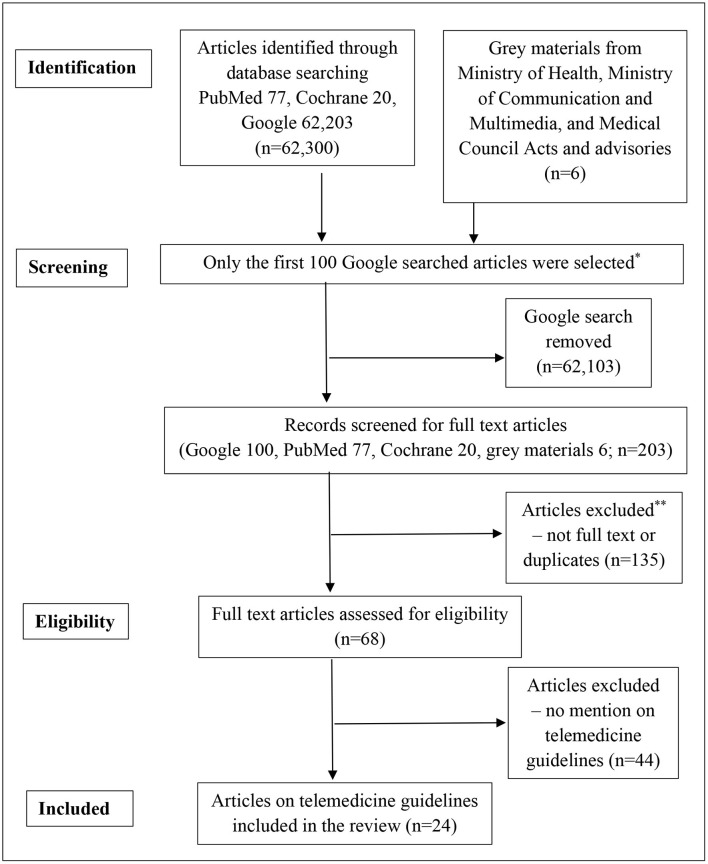
Background: Telemedicine is a useful tool to deliver healthcare to communities in low- to high-income countries, especially in the coronavirus disease 2019 pandemic era. Guidelines on telemedicine would assist healthcare providers in delivering healthcare services based on local circumstances. Objective: To explore and compare guidelines on telehealth and telemedicine in South East Asian countries. Methods: Electronic databases such as Google, PubMed, and Cochrane reviews were searched for articles using keywords such as "telemedicine" OR "telehealth" OR "eHealth" OR "telemedis" AND "guidelines" AND "South East Asia" OR "Malaysia" OR "Singapore" OR "Indonesia" OR "Thailand" OR "Vietnam" published up to 2020. Inclusion criteria were full articles and gray materials (i.e., policy statements, advisories, blueprints, executive summaries, and circulars) related to telemedicine guidelines. No language restrictions were imposed. Only the first 100 Google searches were included for eligibility based on its relevance to telemedicine guidelines. Exclusion criteria were abstracts, duplicate publications, blogs, news articles, promotional brochures, conference proceedings, and telemedicine projects unrelated to telemedicine guidelines. Results: A total of 62,300 articles were identified through the search engines (Google 62,203, PubMed 77, and Cochrane 20) and six articles from additional sources. Sixty-eight full-text articles fulfilled the inclusion criteria, but only 24 articles contained some form of guidelines on telemedicine: Indonesia (nine), Malaysia (seven), Singapore (five), Thailand (two), and Vietnam (one). There were six laws, six advisory guidelines, five policy statements, and two circulars (regulations) issued by either the Ministry of Communication and Multimedia, Ministry of Health, or Medical Councils from the respective countries. Issues addressed were clinical governance (100%); information and communication technology infrastructure (83.3%); privacy, storage, and record-keeping (77.8%, respectively); ethics and legal (77.8%); security and safety (72.2%); definitions and applications of telemedicine (72.2%); confidentiality (66.7%); licensing (66.7%); identification (55.6%); cost of information and communication technology infrastructure (55.6%); reimbursement (16.7%); mobile applications (11.1%); and feedback and choices (5.6%). The Singapore National Telemedicine Guidelines contained the most domains compared with other guidelines from South East Asia. Conclusions: Although there can be no "one-size-fits-all" telemedicine guideline, there should be a comprehensive and universal telemedicine guideline for any country to adapt based on the local context. Details on patient-identification, data ownership, back-up, and disposal; transregional cybersecurity laws and ways to overcome the limitations of telemedicine compared with face-to-face consultations should be outlined clearly to ensure uniformity of telemedicine service and patient safety.
Keywords: South East Asia; guidelines; low to high income countries; telemedicine; universal.
Copyright © 2021 Intan Sabrina and Defi.
Conflict of interest statement
The authors declare that the research was conducted in the absence of any commercial or financial relationships that could be construed as a potential conflict of interest.
Figures
Comment in
-
Interactive virtual medication counselling in outpatient pharmacy: An accessible and safe patient counselling method during the COVID-19 pandemic.Res Social Adm Pharm. 2021 Oct;17(10):1860-1862. doi: 10.1016/j.sapharm.2021.07.002. Epub 2021 Jul 3. Res Social Adm Pharm. 2021. PMID: 34272201 Free PMC article. No abstract available.
References
-
- World Health Organization (WHO) Telemedicine: Opportunities and Developments in Member States: Report on the Global Survey on eHealth. Global Observatory for eHealth Series – Vol 2. NLM Classification W 26.5. Geneva: World Health Organization : (2010).
-
- Using Telehealth to Expand Access to Essential Health Services During the Coronavirus Disease (2019). Available online at: https://www.cdc.gov
-
- Snoswell CL, Caffery LJ, Haydon HM, Wickramasinghe SI, Crumblin K, Smith AC. A cost-consequence analysis comparing patient travel, outreach and telehealth clinic models for a specialist diabetes service to Indigenous people in Queensland. J Telemed Telec. (2019) 25:537–44. 10.1177/1357633X19873239 - DOI - PubMed
Publication types
LinkOut - more resources
Full Text Sources
Other Literature Sources
