


Continuity of Care During COVID-19 Lockdown: A Survey on Stakeholders' Experience With Telerehabilitation
- PMID: 33519697
- PMCID: PMC7838679
- DOI: 10.3389/fneur.2020.617276
Continuity of Care During COVID-19 Lockdown: A Survey on Stakeholders' Experience With Telerehabilitation
Abstract
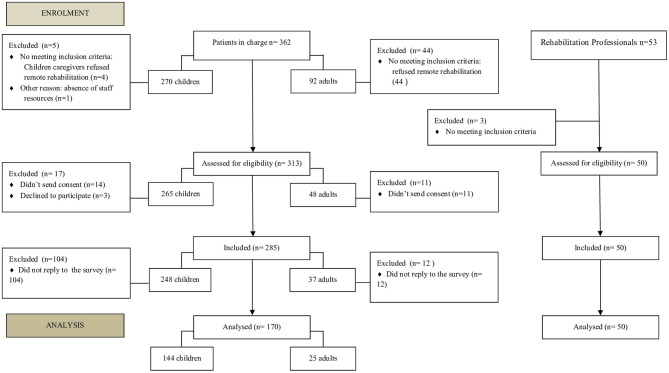
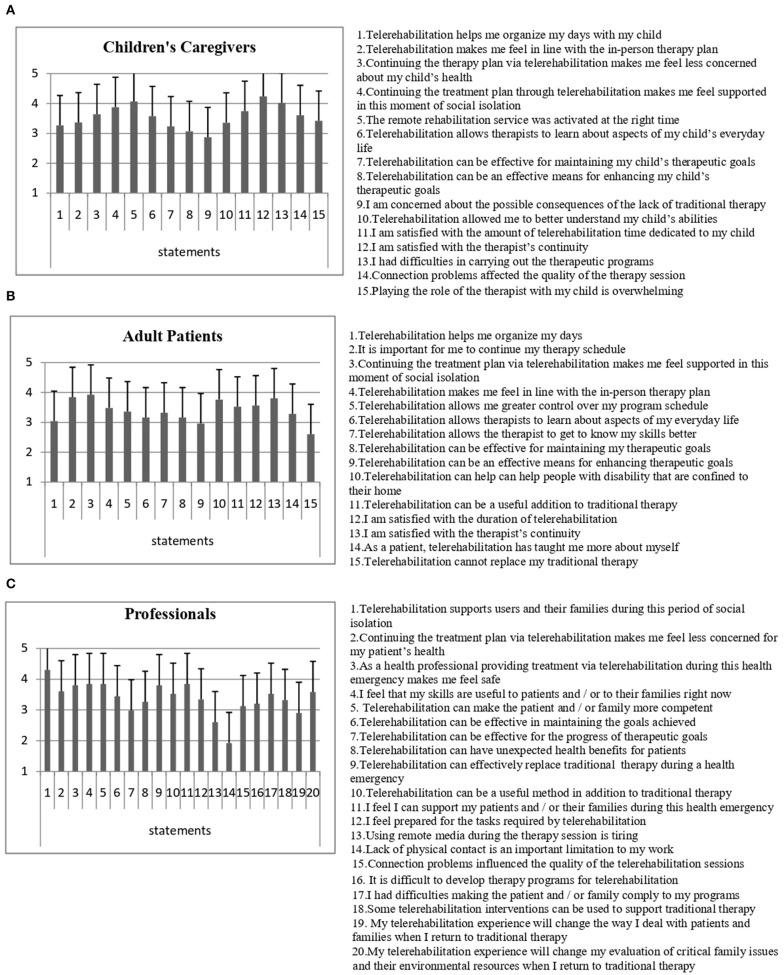
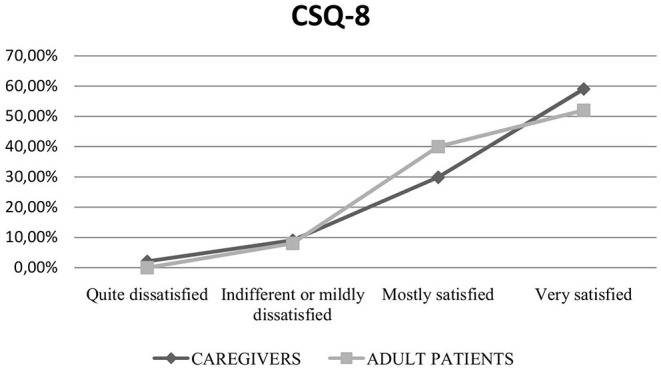
Objective: To explore professionals', adult patients', and children's caregivers' perception and satisfaction with telerehabilitation during COVID-19 lockdown. Design: An observational transversal study on a web-based survey was conducted in order to explore participants' perception and satisfaction of telerehabilitation during COVID-19 lockdown. Setting: The study was conducted at our Outpatient Neurorehabilitation Service. Subjects: All rehabilitation professionals, adult patients, and children's caregivers who accepted telerehabilitation were recruited. Interventions: Participants had to respond to the Client Satisfaction Questionnaire-8 and to a purpose-built questionnaire on their perception and satisfaction of the service provided. Main Measures: Data were analyzed by qualitative statistics and logistic regression models. Results: All 144 caregivers, 25 adult patients, and 50 professionals reported a medium-high level of perception and a high level of satisfaction. Results showed a correlation among caregivers of children aged 0-3 and feeling overwhelmed with remote care (OR = 3.27), a low perception of telerehabilitation for enhancing goals (OR = 6.51), and a high perception of feeling helped in organizing daily activity (OR = 2.96). For caregivers of children aged over 6 years, changes in the therapy plan were related to a low perception of feeling in line with the in-person therapy (OR = 2.61 and OR = 9.61) and a low satisfaction (OR = 5.54 and OR = 4.97). Changes in therapy were related to concern (OR = 4.20). Caregivers under 40 and professionals showed a high probability to perceive telerehabilitation as supportive (OR = 2.27 and OR = 5.68). Level of experience with remote media was shown to influence perception and satisfaction. Interpretation: Telerehabilitation can be a useful practice both during a health emergency and in addition to in-presence therapy.
Keywords: COVID-19; caregivers; continuity of care; perception; rehabilitation professionals; satisfaction; telerehabilitation.
Copyright © 2021 Assenza, Catania, Antenore, Gobbetti, Gentili, Paolucci and Morelli.
Conflict of interest statement
The authors declare that the research was conducted in the absence of any commercial or financial relationships that could be construed as a potential conflict of interest.
Figures
References
-
- Attkisson CC, Greenfield K. The ucsf client satisfaction scales: I. The client satisfaction questionnaire-8. In: Maruish M, editor. The Use of Psychological Testing for Treatment Planning and Outcome Assessment. 3rd ed. Mahwah, NJ: Lawrence Erlbaum Associates; (2004).
-
- Attkisson CC, Greenfield TK. The client satisfaction questionnaire (CSQ) scales and the service satisfaction scale-30 (SSS-30). In: Seder LL, Dickey B, editors. Outcome Assessment in Clinical Practice. Baltimore: Williams & Wilkins; (1996).
LinkOut - more resources
Full Text Sources
Other Literature Sources
