


Pragmatic language impairment general and specific associations to mental health symptom dimensions in a child psychiatric sample
- PMID: 33520766
- PMCID: PMC7709940
- DOI: 10.21307/sjcapp-2019-001
Pragmatic language impairment general and specific associations to mental health symptom dimensions in a child psychiatric sample
Abstract
Background: The results of several international studies indicate a high prevalence of language and communication impairments among children who are referred to child psychiatric services. However, these impairments are likely to remain undetected unless language and communication impairments are evaluated during the psychiatric assessment.
Aims: The aim of the present study is to investigate the specific association between general and specific mental health problems, as expressed by the problem scales of Child Behavior Checklist (CBCL) and Teachers Report Form (TRF), and pragmatic skills and pragmatic language impairments (PLI) as defined the Pragmatic Composite of the Child Communication Checklist (CCC-PC).
Methods: Children aged from 8 to 13 years (n = 73) were recruited in sequence following referral to a child and adolescent psychiatry (CAMHS) outpatient clinic within 12 months. Children with possible or established autism or intellectual disability were excluded. Standardized instruments measuring language, communication and mental health symptoms were distributed to parents and teachers, an intelligence test administered for clinical purposes, and demographic information was included.
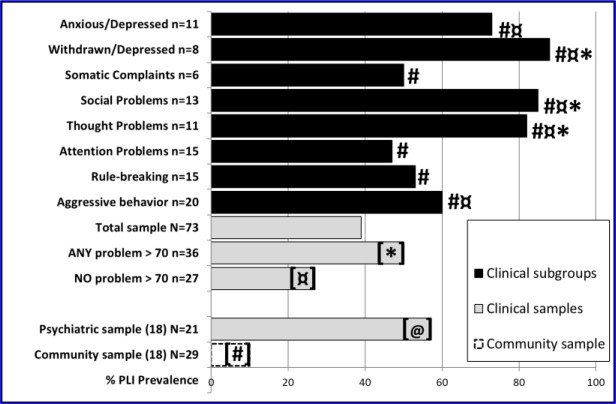
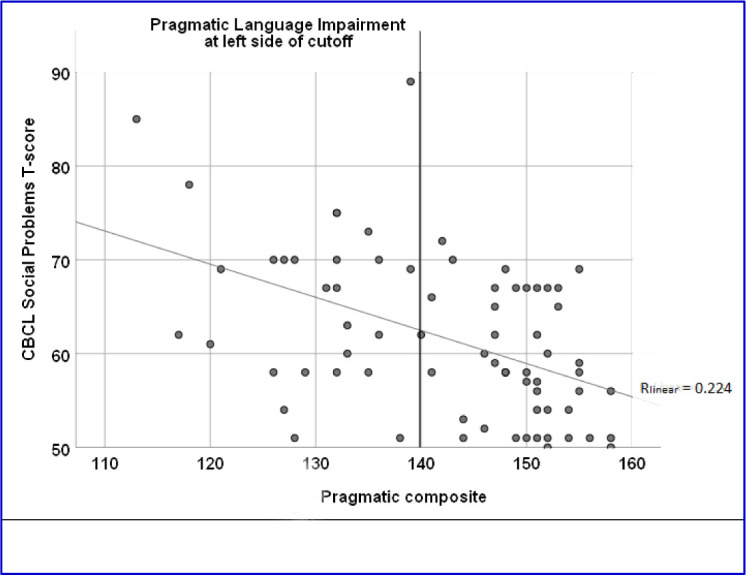
Results: The parent reports showed PLI among 38% of the children and revealed strong associations with the CBCL scales for emotional problems, thought problems and, especially, social and withdrawal symptoms, which mean more associations to internalized and non-externalized problems. PC-scores were at similar levels and PLI was reported by teachers at similar rates (compared to parent reports) with moderate agreement. Teacher PC-scores showed associations to only one TRF-scale, social problems. The CCC-PC subscale with the strongest associations to mental health symptoms was «Use of Context» («Social Relationships» do not contribute to the CCC-PC scores).
Conclusion: There was a general increase in PC-scores and increased prevalence of PLI in this clinical sample. PC-scores correlated with symptom scores for internalizing and non-externalizing problems scales. The strongest common factors appear to be related to the social aspects of mental health. Pragmatic skills should be considered as a protective factor for mental health rather than investigating pragmatic impairment as a risk or vulnerability factor.
Keywords: ASEBA; CAMHS; Pragmatic impairment; mental health problems.
Figures
References
-
- Cohen NJ. (Ed.). Unsuspected language impairments in psychiatrically disturbed children: developmental issues and associated conditions. Cambridge: University Press; 1996.
-
- Cohen NJ, Barwick MA, Horodezky NB, Vallance DD, Im N. Language, achievement, and cognitive processing in psychiatrically disturbed children with previously identified and unsuspected language impairments. J Child Psychol Psychiatry 1998;39:865-77. - PubMed
-
- St Clair MC, Pickles A, Durkin K, Conti-Ramsden G. A longitudinal study of behavioral, emotional and social difficulties in individuals with a history of specific language impairment (SLI). J Commun Disord 2011;44:186-99. - PubMed
-
- Conti-Ramsden G, Botting N. Emotional health in adolescents with and without a history of specific language impairment. J Child Psychol Psychiatry 2008;49:516-25. - PubMed
-
- Bloom LJ, Lahey M. Language development and language disorders. New York, NY: Wiley; 1978.
LinkOut - more resources
Full Text Sources
Miscellaneous