


Association Between Early Invasive Mechanical Ventilation and Day-60 Mortality in Acute Hypoxemic Respiratory Failure Related to Coronavirus Disease-2019 Pneumonia
- PMID: 33521646
- PMCID: PMC7838010
- DOI: 10.1097/CCE.0000000000000329
Association Between Early Invasive Mechanical Ventilation and Day-60 Mortality in Acute Hypoxemic Respiratory Failure Related to Coronavirus Disease-2019 Pneumonia
Abstract
Objectives: About 5% of patients with coronavirus disease-2019 are admitted to the ICU for acute hypoxemic respiratory failure. Opinions differ on whether invasive mechanical ventilation should be used as first-line therapy over noninvasive oxygen support. The aim of the study was to assess the effect of early invasive mechanical ventilation in coronavirus disease-2019 with acute hypoxemic respiratory failure on day-60 mortality.
Design: Multicenter prospective French observational study.
Setting: Eleven ICUs of the French OutcomeRea network.
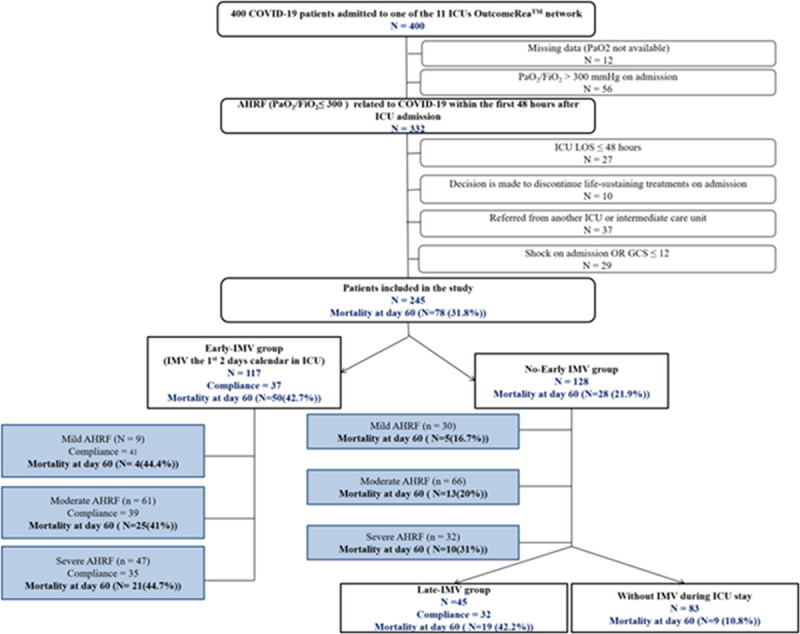
Patients: Coronavirus disease-2019 patients with acute hypoxemic respiratory failure (Pao2/Fio2 ≤ 300 mm Hg), without shock or neurologic failure on ICU admission, and not referred from another ICU or intermediate care unit were included.
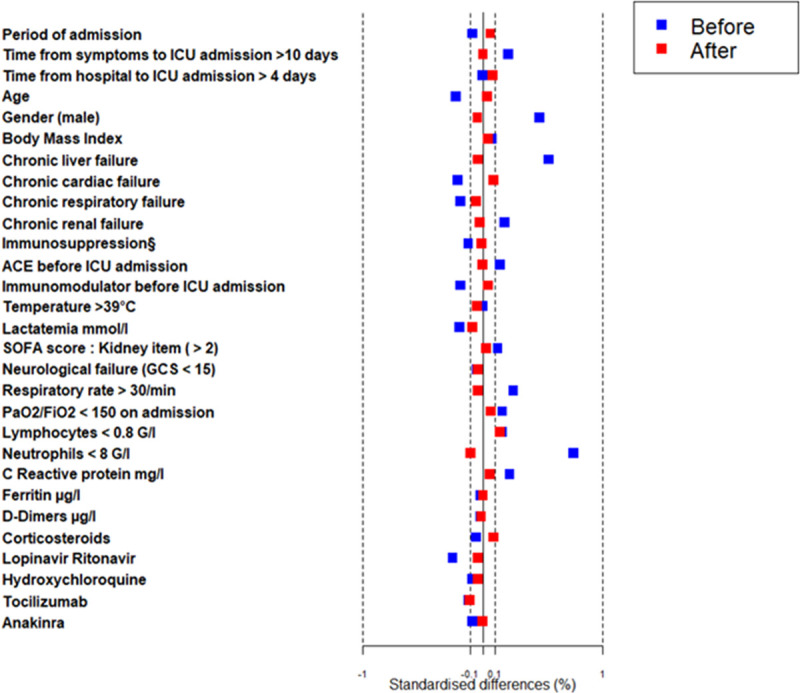
Intervention: We compared day-60 mortality in patients who were on invasive mechanical ventilation within the first 2 calendar days of the ICU stay (early invasive mechanical ventilation group) and those who were not (nonearly invasive mechanical ventilation group). We used a Cox proportional-hazard model weighted by inverse probability of early invasive mechanical ventilation to determine the risk of death at day 60.
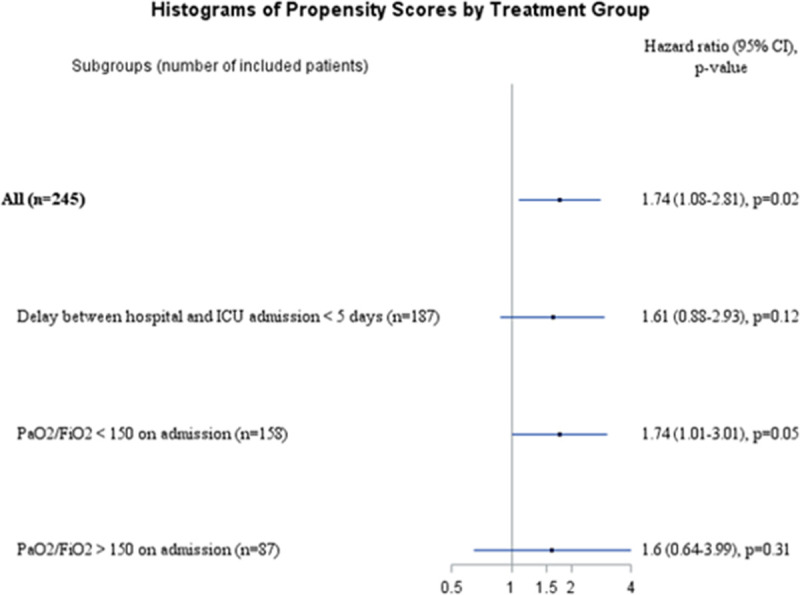
Measurement and main results: The 245 patients included had a median (interquartile range) age of 61 years (52-69 yr), a Simplified Acute Physiology Score II score of 34 mm Hg (26-44 mm Hg), and a Pao2/Fio2 of 121 mm Hg (90-174 mm Hg). The rates of ICU-acquired pneumonia, bacteremia, and the ICU length of stay were significantly higher in the early (n = 117 [48%]) than in the nonearly invasive mechanical ventilation group (n = 128 [52%]), p < 0.01. Day-60 mortality was 42.7% and 21.9% in the early and nonearly invasive mechanical ventilation groups, respectively. The weighted model showed that early invasive mechanical ventilation increased the risk for day-60 mortality (weighted hazard ratio =1.74; 95% CI, 1.07-2.83, p=0.03).
Conclusions: In ICU patients admitted with coronavirus disease-2019-induced acute hypoxemic respiratory failure, early invasive mechanical ventilation was associated with an increased risk of day-60 mortality. This result needs to be confirmed.
Keywords: acute hypoxemic respiratory failure; coronavirus disease 2019; critically ill; invasive mechanical ventilation; mortality; noninvasive oxygen support.
Copyright © 2021 The Authors. Published by Wolters Kluwer Health, Inc. on behalf of the Society of Critical Care Medicine.
Conflict of interest statement
Dr. Timsit declares no conflict of interest related to the submitted work. Outside the submitted work, he declares participation in advisory boards for Merck, Pfizer, Gilead, Nabriva, and Paratek, lecture fees from Biomerieux, Pfizer, and Merck, and research grants to his research unit from Merck, 3M, Astelas, and Thermofisher. Dr. Buetti is currently receiving a mobility grant from the Swiss National Science Foundation (grant number: P400PM_183865) and a grant from the Bangerter-Rhyner Foundation. These grants support his fellowship in Paris. The remaining authors have disclosed that they do not have any potential conflicts of interest.
Figures
References
-
- Wu Z, McGoogan JM. Characteristics of and important lessons from the coronavirus disease 2019 (COVID-19) outbreak in China: Summary of a report of 72 314 cases from the Chinese Center for Disease Control and Prevention. JAMA. 2020; 323:1239–1242 - PubMed
LinkOut - more resources
Full Text Sources
Other Literature Sources
