


Pre-pandemic psychiatric disorders and risk of COVID-19: a UK Biobank cohort analysis
- PMID: 33521769
- PMCID: PMC7832159
- DOI: 10.1016/S2666-7568(20)30013-1
Pre-pandemic psychiatric disorders and risk of COVID-19: a UK Biobank cohort analysis
Abstract
Background: Psychiatric morbidities have been associated with a risk of severe infections through compromised immunity, health behaviours, or both. However, data are scarce on the association between multiple types of pre-pandemic psychiatric disorders and COVID-19. We aimed to assess the association between pre-pandemic psychiatric disorders and the subsequent risk of COVID-19 using UK Biobank.
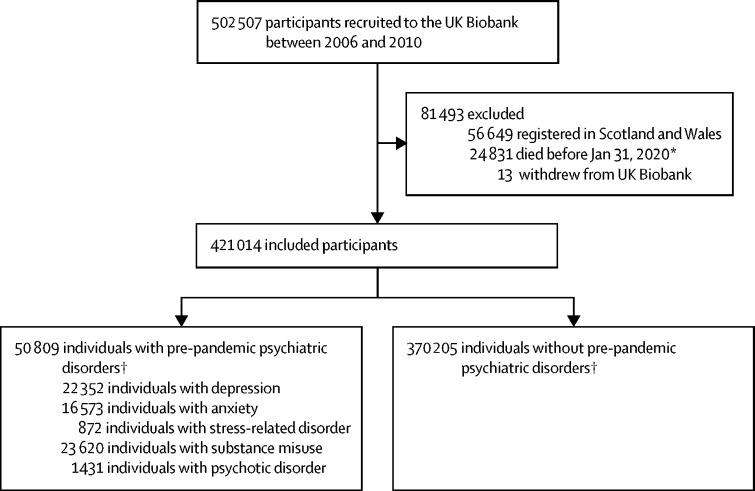
Methods: For this cohort analysis, we included participants from UK Biobank who were registered in England and excluded individuals who died before Jan 31, 2020, (the start of the COVID-19 outbreak in the UK) or had withdrawn from UK Biobank. Participants diagnosed with a psychiatric disorder before Jan 31 were included in the group of individuals with pre-pandemic psychiatric disorders, whereas participants without a diagnosis before the outbreak were included in the group of individuals without pre-pandemic psychiatric disorders. We used the Public Health England dataset, UK Biobank hospital data, and death registers to collect data on COVID-19 cases. To examine the relationship between pre-pandemic psychiatric disorders and susceptibility to COVID-19, we used logistic regression models to estimate odds ratios (ORs), controlling for multiple confounders and somatic comorbidities. Key outcomes were all COVID-19, COVID-19 specifically diagnosed in inpatient care, and COVID-19-related deaths. ORs were also estimated separately for each psychiatric disorder and on the basis of the number of pre-pandemic psychiatric disorders. As a positive disease control, we repeated analyses for hospitalisation for other infections.
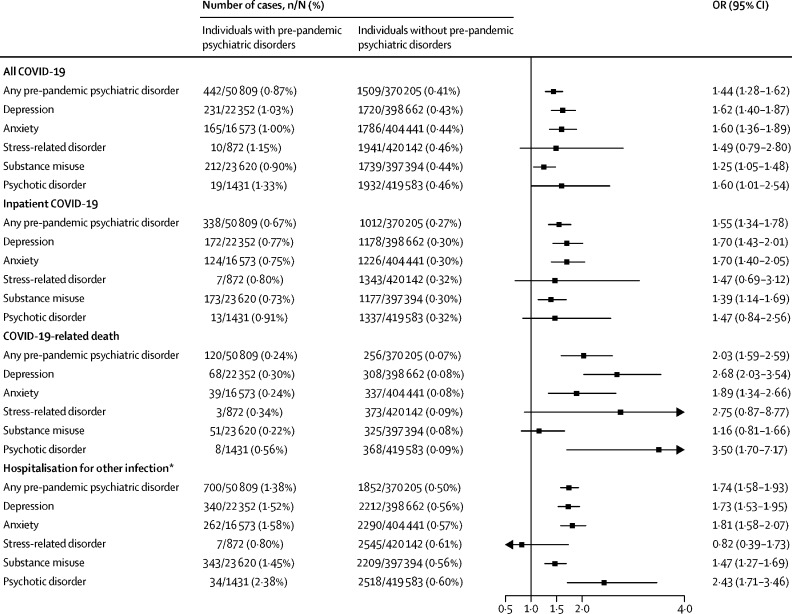
Findings: We included 421 014 UK Biobank participants in our study and assessed their COVID-19 status between Jan 31 and July 26, 2020. 50 809 participants were diagnosed with psychiatric disorders before the outbreak, while 370 205 participants had no psychiatric disorders. The mean age at outbreak was 67·80 years (SD 8·12). We observed an elevated risk of COVID-19 among individuals with pre-pandemic psychiatric disorders compared with that of individuals without such conditions. The fully adjusted ORs were 1·44 (95% CI 1·28-1·62) for All COVID-19 cases, 1·55 (1·34-1·78) for Inpatient COVID-19 cases, and 2·03 (1·59-2·59) for COVID-19-related deaths. We observed excess risk, defined as risk that increased with the number of pre-pandemic psychiatric disorders, across all diagnostic categories of pre-pandemic psychiatric disorders. We also observed an association between psychiatric disorders and elevated risk of hospitalisation due to other infections (OR 1·74, 95% CI 1·58-1·93).
Interpretation: Our findings suggest that pre-existing psychiatric disorders are associated with an increased risk of COVID-19. These findings underscore the need for surveillance of and care for populations with pre-existing psychiatric disorders during the COVID-19 pandemic.
Funding: National Natural Science Foundation of China.
© 2020 The Author(s). Published by Elsevier Ltd. This is an Open Access article under the CC BY-NC-ND 4.0 license.
Figures
Comment in
-
Psychiatric disorders and risk of infections: early lessons from COVID-19.Lancet Healthy Longev. 2020 Nov;1(2):e51-e52. doi: 10.1016/S2666-7568(20)30020-9. Epub 2020 Nov 9. Lancet Healthy Longev. 2020. PMID: 33521767 Free PMC article. No abstract available.
-
Antipsychotic use and psychiatric disorders in COVID-19.Lancet Healthy Longev. 2021 Feb;2(2):e64. doi: 10.1016/S2666-7568(20)30063-5. Epub 2021 Feb 3. Lancet Healthy Longev. 2021. PMID: 33665642 Free PMC article. No abstract available.
-
Does antipsychotic use mediate the effect of psychiatric disorders on COVID-19? - Authors' reply.Lancet Healthy Longev. 2021 Feb;2(2):e65. doi: 10.1016/S2666-7568(21)00007-6. Epub 2021 Feb 3. Lancet Healthy Longev. 2021. PMID: 33665643 Free PMC article. No abstract available.
References
-
- WHO Coronavirus disease (COVID-19) situation reports. October, 2020. 2020. http://www.who.int/emergencies/diseases/novel-coronavirus-2019/situation...
-
- Pedersen A, Zachariae R, Bovbjerg DH. Influence of psychological stress on upper respiratory infection—a meta-analysis of prospective studies. Psychosom Med. 2010;72:823–832. - PubMed
Publication types
MeSH terms
LinkOut - more resources
Full Text Sources
Medical
Research Materials
