Review
. 2021 Feb 1;21(1):257.
doi: 10.1186/s12889-021-10183-3.

Rapid review of COVID-19 epidemic estimation studies for Iran

Affiliations
Review

Rapid review of COVID-19 epidemic estimation studies for Iran

Farshad Pourmalek et al. BMC Public Health. .

Abstract

Background: To inform researchers about the methodology and results of epidemic estimation studies performed for COVID-19 epidemic in Iran, we aimed to perform a rapid review.

Methods: We searched for and included published articles, preprint manuscripts and reports that estimated numbers of cumulative or daily deaths or cases of COVID-19 in Iran. We found 131 studies and included 29 of them.

Results: The included studies provided outputs for a total of 84 study-model/scenario combinations. Sixteen studies used 3-4 compartmental disease models. At the end of month two of the epidemic (2020-04-19), the lowest (and highest) values of predictions were 1,777 (388,951) for cumulative deaths, 20,588 (2,310,161) for cumulative cases, and at the end of month four (2020-06-20), were 3,590 (1,819,392) for cumulative deaths, and 144,305 (4,266,964) for cumulative cases. Highest estimates of cumulative deaths (and cases) for latest date available in 2020 were 418,834 on 2020-12-19 (and 41,475,792 on 2020-12-31). Model estimates predict an ominous course of epidemic progress in Iran. Increase in percent population using masks from the current situation to 95% might prevent 26,790 additional deaths (95% confidence interval 19,925-35,208) by the end of year 2020.

Conclusions: Meticulousness and degree of details reported for disease modeling and statistical methods used in the included studies varied widely. Greater heterogeneity was observed regarding the results of predicted outcomes. Consideration of minimum and preferred reporting items in epidemic estimation studies might better inform future revisions of the available models and new models to be developed. Not accounting for under-reporting drives the models' results misleading.

Keywords: COVID-19; Cases; Deaths; Epidemic; Estimation; Iran; Model; Pandemic; Prediction.


Conflict of interest statement

The authors declare that they have no competing interests.

Figures
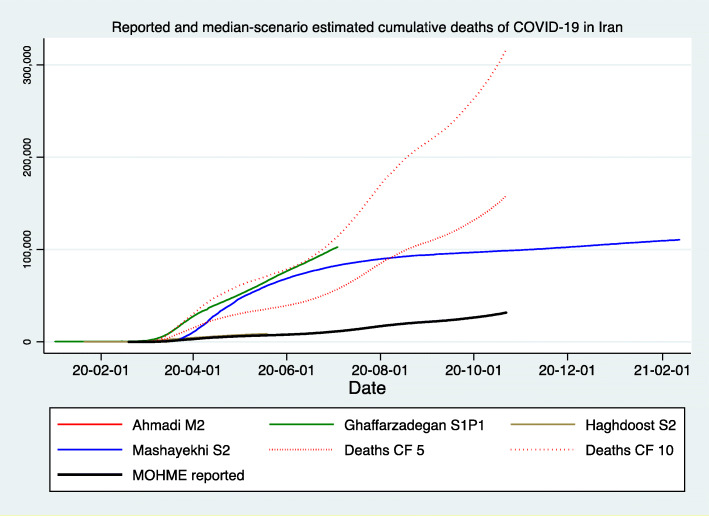
Fig. 1
Fig. 1
Reported and median-scenario estimated cumulative deaths of COVID-19 in Iran . (1) Ahmadi M2: Model 2, Von Bertalanffy (Curve lies behind MOHME reported) [44]. (2) Ghaffarzadegan S1P1: Seasonality conditions 1 (no effect or status quo) and Policy effect 2 (aggressive efforts to decrease contact rate by half of what it would be otherwise) [41]. (3) Haghdoost S2: Medium scenario, medium (32%) isolation (Curve lies behind MOHME reported) [27]. (4) Mashayekhi S2: Medium scenario, not serious distancing; People reduce their social [physical] contacts only to 20% of regular level, voluntarily, after number of cases and deaths have increased, and other settings are like scenario one [28]. (5) Deaths CF 5: Reported deaths with a Correction Factor of 5, after Dr. Rick Brennan, Director of Emergency Operations, World Health Organization [57]. (6) Deaths CF 10: Reported deaths with a Correction Factor of 10, after Russell [58]. (7) MOHME reported: Official reported deaths via [4, 5]
Fig. 2
Fig. 2
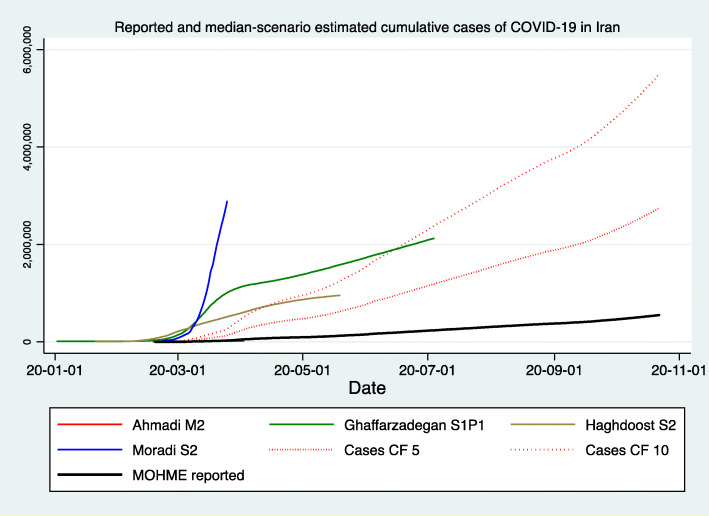
Reported and median-scenario estimated cumulative case of COVID-19 in Iran. (1) Ahmadi M2: Model 2, Von Bertalanffy (Curve lies behind MOHME reported) [44]. (2) Ghaffarzadegan S1P1: Seasonality conditions 1 (no effect or status quo) and Policy effect 2 (aggressive efforts to decrease contact rate by half of what it would be otherwise) [41]. (3) Haghdoost S2: Medium scenario, medium (32%) isolation [27]. (4) Moradi S2: Scenario 2, Case Fatality Rate, 0.5% [42]. (5) Cases CF 5: Reported cases with a Correction Factor of 5, after Dr. Rick Brennan, Director of Emergency Operations, World Health Organization [57]. (6) Cases CF 10: Reported cases with a Correction Factor of 10, after Russell [58]. (7) MOHME reported: Official reported cases via [4, 5]
Fig. 3
Fig. 3
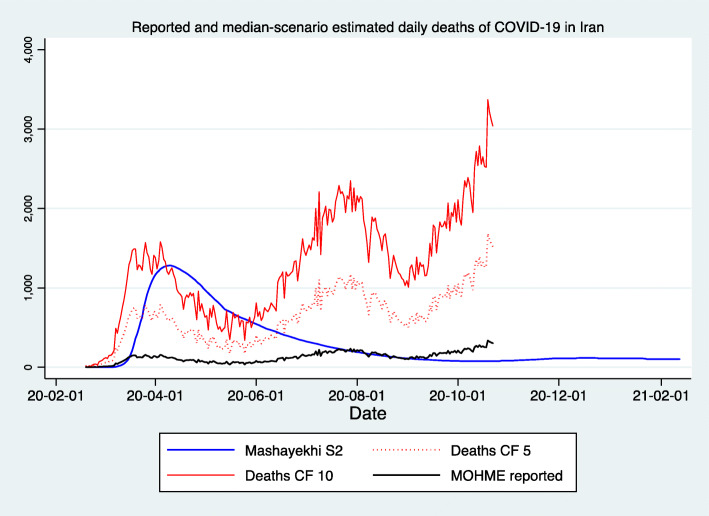
Reported and median-scenario estimated daily deaths of COVID-19 in Iran. (1) Mashayekhi S2: Medium scenario, not serious distancing; People reduce their social [physical] contacts only to 20% of regular level, voluntarily, after number of cases and deaths have increased, and other settings are like scenario 1 [28]. (2) Deaths CF 5: Reported deaths with a Correction Factor of 5, after Dr. Rick Brennan, Director of Emergency Operations, World Health Organization [57]. (3) Deaths CF 10: Reported deaths with a Correction Factor of 10, after Russell [58]. (4) MOHME reported: Official reported deaths via [4, 5]
Fig. 4
Fig. 4
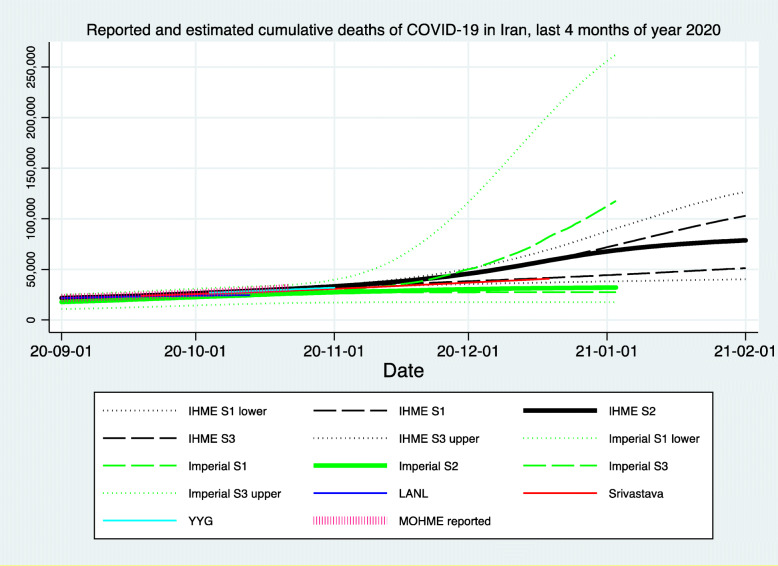
Reported and current (median) scenario cumulative deaths of COVID-19 in Iran, last 4 months of year 2020 and January 2021, International studies. (1) DELPHI: DELPHI (Differential Equations Leads to Predictions of Hospitalizations and Infections) Epidemiological Case Predictions. Mean estimate [10]. (2) IHME: Institute for Health Metrics and Evaluation (IHME) Mean estimate [12]. (3) Imperial: Imperial College COVID-19 LMIC Reports. Mean estimate [13]. (4) LANL: Los Alamos National Laboratory (LANL) COVID-19 Cases and Deaths Forecasts. Mean estimate [14]. (5) Srivastava: ReCOVER- Accurate Predictions and Resource Management for COVID-19 Epidemic Response. Mean estimate [15]. (6) YYG (Youyang Gu): COVID-19 Projections Using Machine Learning. Mean estimate [17]. (7) MOHME reported: Ministry of Health and Medical Education, Iran via [4, 5]
Fig. 5
Fig. 5
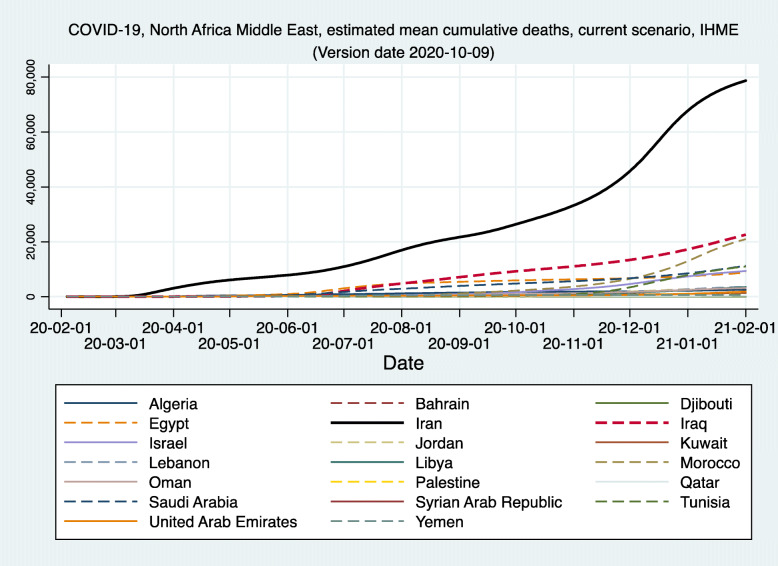
Current (median) scenario estimated cumulative deaths of COVID-19 in Iran and 20 other countries of North Africa Middle East, IHME. IHME: Institute for Health Metrics and Evaluation (IHME) Mean estimate. The Reference or ‘Current projection’ scenario assumes social distancing mandates are re-imposed for 6 weeks whenever daily deaths reach 8 per million (0.8 per 100,000) [12]

References

    1. World Health Organization. Novel coronavirus (2019-nCoV) situation report – 1. https://www.who.int/docs/default-source/coronaviruse/situation-reports/2.... Accessed 4 May 2020.
    1. World Health Organization. WHO director-general’s remarks at the media briefing on 2019-nCoV on 11 February 2020. https://www.who.int/dg/speeches/detail/who-director-general-s-remarks-at.... Accessed 4 May 2020.
    1. World Health Organization. WHO director-general’s opening remarks at the media briefing on COVID-19 - 11 March 2020. https://www.who.int/dg/speeches/detail/who-director-general-s-opening-re.... Accessed 4 May 2020.
    1. Johns Hopkins University. Coronavirus resource center. https://coronavirus.jhu.edu/map.html. Accessed 4 May 2020.
    1. Johns Hopkins University. COVID-19 data repository by the Center for Systems Science and Engineering (CSSE) at Johns Hopkins University. https://github.com/CSSEGISandData/COVID-19. Accessed 19 Oct 2020.