


Relative Contributions of All-Trans and 11-Cis Retinal to Formation of Lipofuscin and A2E Accumulating in Mouse Retinal Pigment Epithelium
- PMID: 33523199
- PMCID: PMC7862733
- DOI: 10.1167/iovs.62.2.1
Relative Contributions of All-Trans and 11-Cis Retinal to Formation of Lipofuscin and A2E Accumulating in Mouse Retinal Pigment Epithelium
Abstract
Purpose: Bis-retinoids are a major component of lipofuscin that accumulates in the retinal pigment epithelium (RPE) in aging and age-related macular degeneration (AMD). Although bis-retinoids are known to originate from retinaldehydes required for the light response of photoreceptor cells, the relative contributions of the chromophore, 11-cis retinal, and photoisomerization product, all-trans retinal, are unknown. In photoreceptor outer segments, all-trans retinal, but not 11-cis retinal, is reduced by retinol dehydrogenase 8 (RDH8). Using Rdh8-/- mice, we evaluated the contribution of increased all-trans retinal to the formation and stability of RPE lipofuscin.
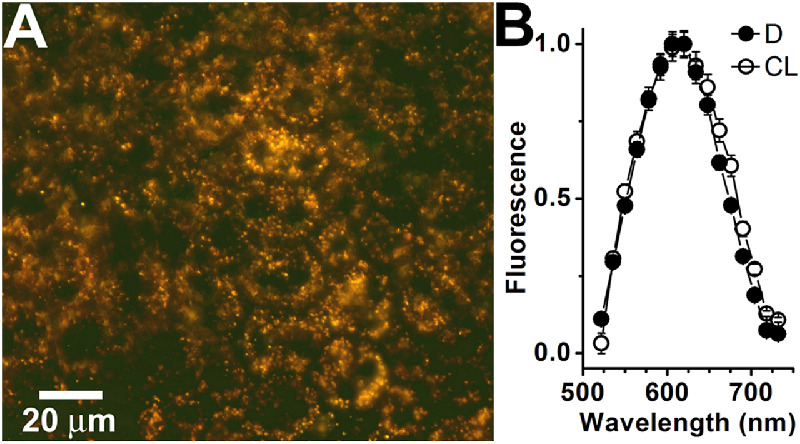
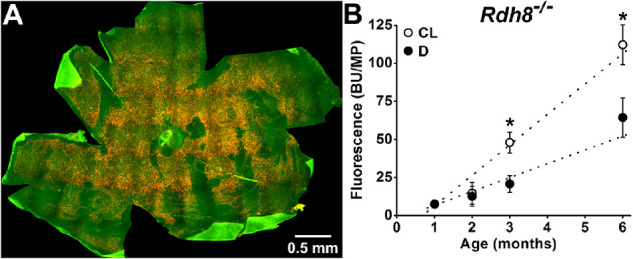
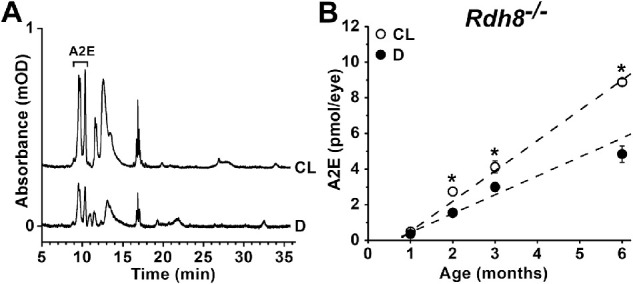
Methods: Rdh8-/- mice were reared in cyclic-light or darkness for up to 6 months, with selected light-reared cohorts switched to dark-rearing for the final 1 to 8 weeks. The bis-retinoid A2E was measured from chloroform-methanol extracts of RPE-choroid using HPLC-UV/VIS spectroscopy. Lipofuscin fluorescence was measured from whole flattened eyecups (excitation, 488 nm; emission, 565-725 nm).
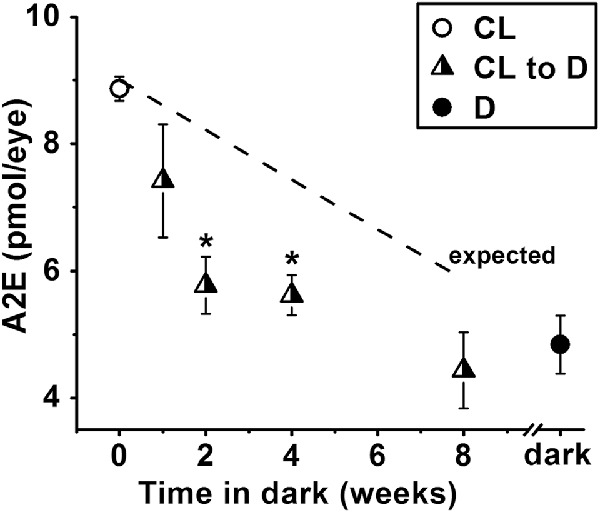
Results: Cyclic-light-reared Rdh8-/- mice accumulated A2E and RPE lipofuscin approximately 1.5 times and approximately 2 times faster, respectively, than dark-reared mice. Moving Rdh8-/- mice from cyclic-light to darkness resulted in A2E levels less than expected to have accumulated before the move.
Conclusions: Our findings establish that elevated levels of all-trans retinal present in cyclic-light-reared Rdh8-/- mice, which remain low in wild-type mice, contribute only modestly to RPE lipofuscin formation and accumulation. Furthermore, decreases in A2E levels occurring after moving cyclic-light-reared Rdh8-/- mice to darkness are consistent with processing of A2E within the RPE and the existence of a mechanism that could be a therapeutic target for controlling A2E cytotoxicity.
Conflict of interest statement
Disclosure:
Figures
References
-
- Katz ML, Robison WG Jr. What is lipofuscin? Defining characteristics and differentiation from other autofluorescent lysosomal storage bodies. Arch Gerontol Geriatr. 2002; 34: 169–184. - PubMed
-
- Terman A, Brunk UT. Lipofuscin. Int J Biochem Cell Biol. 2004; 36: 1400–1404. - PubMed
-
- Feeney L. Lipofuscin and melanin of human retinal pigment epithelium. Fluorescence, enzyme cytochemical, and ultrastructural studies. Invest Ophthalmol Vis Sci. 1978; 17: 583–600. - PubMed
-
- Katz ML, Drea CM, Eldred GE, Hess HH, Robison WG Jr. Influence of early photoreceptor degeneration on lipofuscin in the retinal pigment epithelium. Exp Eye Res. 1986; 43: 561–573. - PubMed
-
- Katz ML, Eldred GE.. Retinal light damage reduces autofluorescent pigment deposition in the retinal pigment epithelium. Invest Ophthalmol Vis Sci. 1989; 30: 37–43. - PubMed
Publication types
MeSH terms
Substances
Grants and funding
LinkOut - more resources
Full Text Sources
Other Literature Sources
Medical
Molecular Biology Databases
Miscellaneous
