Human population dynamics and Yersinia pestis in ancient northeast Asia
- PMID: 33523963
- PMCID: PMC7787494
- DOI: 10.1126/sciadv.abc4587
Human population dynamics and Yersinia pestis in ancient northeast Asia
Abstract
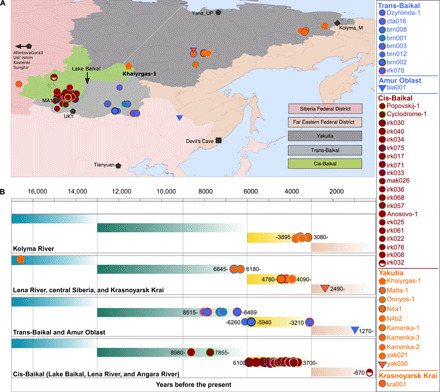
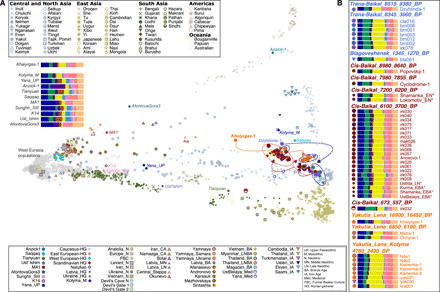
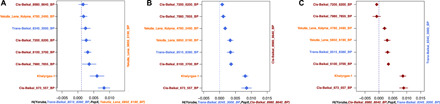
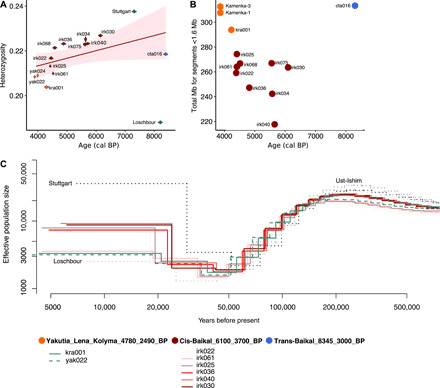
We present genome-wide data from 40 individuals dating to c.16,900 to 550 years ago in northeast Asia. We describe hitherto unknown gene flow and admixture events in the region, revealing a complex population history. While populations east of Lake Baikal remained relatively stable from the Mesolithic to the Bronze Age, those from Yakutia and west of Lake Baikal witnessed major population transformations, from the Late Upper Paleolithic to the Neolithic, and during the Bronze Age, respectively. We further locate the Asian ancestors of Paleo-Inuits, using direct genetic evidence. Last, we report the most northeastern ancient occurrence of the plague-related bacterium, Yersinia pestis Our findings indicate the highly connected and dynamic nature of northeast Asia populations throughout the Holocene.
Copyright © 2021 The Authors, some rights reserved; exclusive licensee American Association for the Advancement of Science. No claim to original U.S. Government Works. Distributed under a Creative Commons Attribution NonCommercial License 4.0 (CC BY-NC).
Figures
References
-
- J. F. Richards, The Unending Frontier: An Environmental History of the Early Modern World (University of California Press, ed. 1, 2003).
-
- Goebel T., Waters M. R., O’Rourke D. H., The late Pleistocene dispersal of modern humans in the Americas. Science 319, 1497–1502 (2008). - PubMed
-
- Fiedel S. J., Kuzmin Y. V., Radiocarbon date frequency as an index of intensity of Paleolithic occupation of Siberia: Did humans react predictably to climate oscillations? Radiocarbon. 49, 741–756 (2007).
-
- Pitulko V. V., Nikolsky P. A., Girya E. Y., Basilyan A. E., Tumskoy V. E., Koulakov S. A., Astakhov S. N., Pavlova E. Y., Anisimov M. A., The Yana RHS site: Humans in the Arctic before the last glacial maximum. Science 303, 52–56 (2004). - PubMed
-
- Sikora M., Pitulko V. V., Sousa V. C., Allentoft M. E., Vinner L., Rasmussen S., Margaryan A., de Barros Damgaard P., de la Fuente C., Renaud G., Yang M. A., Fu Q., Dupanloup I., Giampoudakis K., Nogués-Bravo D., Rahbek C., Kroonen G., Peyrot M., McColl H., Vasilyev S. V., Veselovskaya E., Gerasimova M., Pavlova E. Y., Chasnyk V. G., Nikolskiy P. A., Gromov A. V., Khartanovich V. I., Moiseyev V., Grebenyuk P. S., Fedorchenko A. Y., Lebedintsev A. I., Slobodin S. B., Malyarchuk B. A., Martiniano R., Meldgaard M., Arppe L., Palo J. U., Sundell T., Mannermaa K., Putkonen M., Alexandersen V., Primeau C., Baimukhanov N., Malhi R. S., Sjögren K.-G., Kristiansen K., Wessman A., Sajantila A., Lahr M. M., Durbin R., Nielsen R., Meltzer D. J., Excoffier L., Willerslev E., The population history of northeastern Siberia since the Pleistocene. Nature 570, 182–188 (2019). - PMC - PubMed
Publication types
LinkOut - more resources
Full Text Sources
Other Literature Sources