. 2021 Feb 1;17(2):e1009243.
doi: 10.1371/journal.ppat.1009243. eCollection 2021 Feb.

Metabolomic/lipidomic profiling of COVID-19 and individual response to tocilizumab

Affiliations

Metabolomic/lipidomic profiling of COVID-19 and individual response to tocilizumab

Gaia Meoni et al. PLoS Pathog. .

Abstract

The current pandemic emergence of novel coronavirus disease (COVID-19) poses a relevant threat to global health. SARS-CoV-2 infection is characterized by a wide range of clinical manifestations, ranging from absence of symptoms to severe forms that need intensive care treatment. Here, plasma-EDTA samples of 30 patients compared with age- and sex-matched controls were analyzed via untargeted nuclear magnetic resonance (NMR)-based metabolomics and lipidomics. With the same approach, the effect of tocilizumab administration was evaluated in a subset of patients. Despite the heterogeneity of the clinical symptoms, COVID-19 patients are characterized by common plasma metabolomic and lipidomic signatures (91.7% and 87.5% accuracy, respectively, when compared to controls). Tocilizumab treatment resulted in at least partial reversion of the metabolic alterations due to SARS-CoV-2 infection. In conclusion, NMR-based metabolomic and lipidomic profiling provides novel insights into the pathophysiological mechanism of human response to SARS-CoV-2 infection and to monitor treatment outcomes.


Conflict of interest statement

The authors have declared that no competing interests exist.

Figures
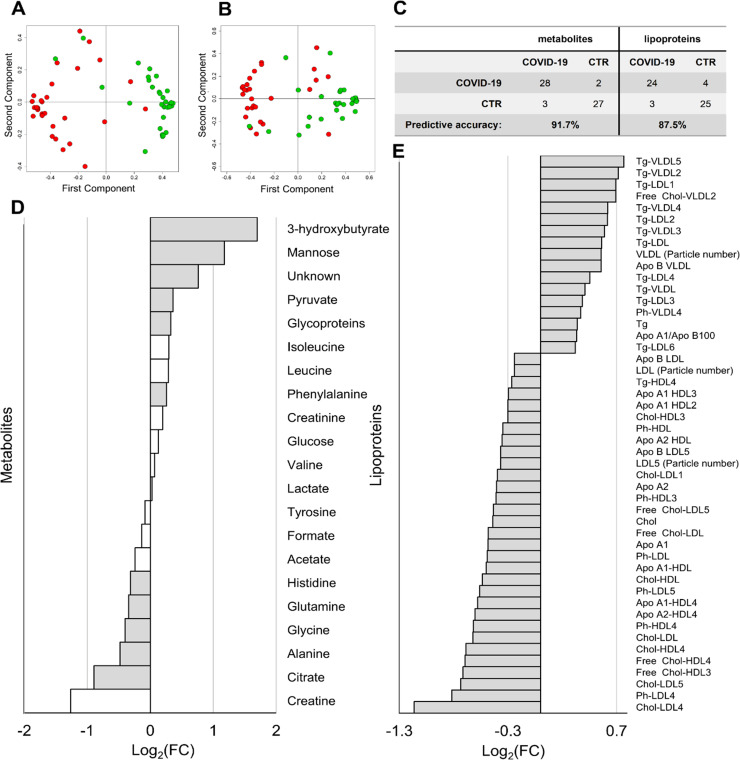
Fig 1
Fig 1. Metabolomic/lipidomic alterations in COVID-19 patients.
(A-B) Proximity plots of the RF model discriminating COVID-19 patients (red dots), and CTR subjects (green dots) using A) the 21 quantified metabolites and B) the lipoprotein-related parameters. (C) Confusion matrices with predictive accuracy values of each model. (D) Values of Log2 Fold Change (FC) of quantified metabolites. Grey bars represent p-values < 0.05 after FDR correction. (E) Values of Log2(FC) of lipoprotein-related parameters significantly different (p-value < 0.05 after FDR correction) between COVID-19 patients and controls. Metabolites/lipoproteins with Log2(FC) positive/negative values have higher/lower concentration in plasma samples from COVID-19 patients with respect to controls.
Fig 2
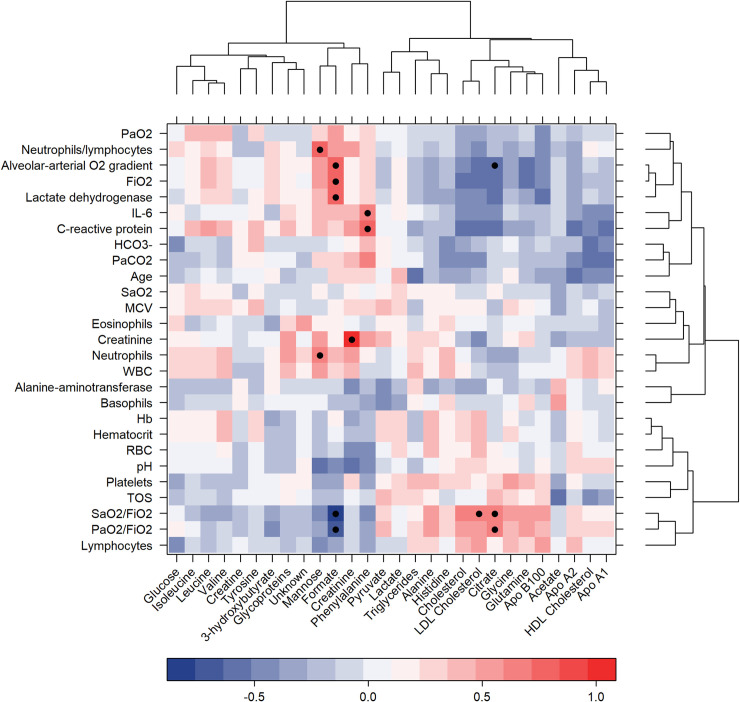
Fig 2. Heatmap correlations between clinical and metabolomic parameters.
R values are shown as different degree of color intensity (red, positive correlations; blue, negative correlation). R values are reported in the plot only for statistically significant correlations (p-value < 0.05 after FDR correction).
Fig 3
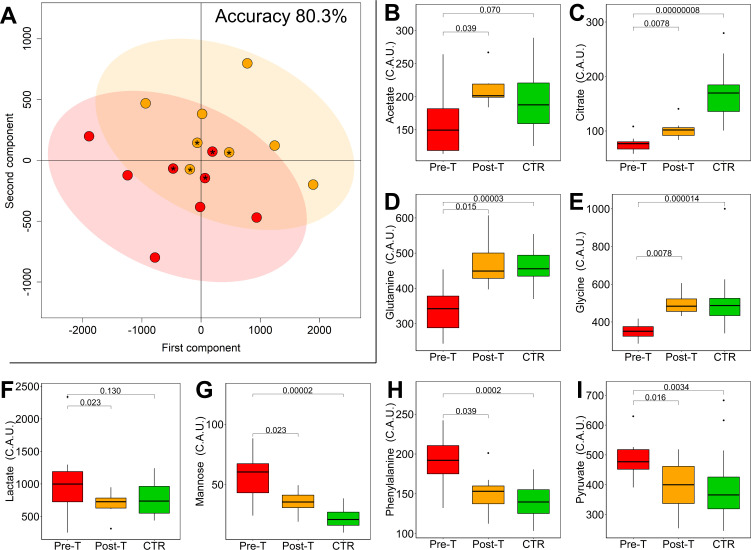
Fig 3. Tocilizumab treatment reverts metabolomic/lipidomic alterations in COVID-19 patients.
(A) Score plot (of the first two principal components) and accuracy of the mPLS-DA model discriminating COVID-19 patients at pre- (red dots) and post- (orange dots) tocilizumab treatment using the 21 quantified metabolites. Patients 18, 20 and 21 are marked with *. (B-I) Boxplots of the statistically significant metabolites discriminating of pre- (red) and post- (orange) tocilizumab samples, p-values obtained using Wilcoxon signed-rank test are also reported. Boxplots of controls (green) and the p-values (Wilcoxon-Mann-Whitney test) for the comparison between pre-treatment and CTR are reported. P-values adjusted for FDR are reported in S5 Table.

References

    1. WHO Director-General’s opening remarks at the media briefing on COVID-19–2 October 2020. [cited 9 Oct 2020]. Available: https://www.who.int/dg/speeches/detail/who-director-general-s-opening-re...
    1. Zhou P, Yang X-L, Wang X-G, Hu B, Zhang L, Zhang W, et al. A pneumonia outbreak associated with a new coronavirus of probable bat origin. Nature. 2020;579: 270–273. 10.1038/s41586-020-2012-7 - DOI - PMC - PubMed
    1. Coronavirus Disease (COVID-19) Situation Reports. [cited 9 Oct 2020]. Available: https://www.who.int/emergencies/diseases/novel-coronavirus-2019/situatio...
    1. Wu Z, McGoogan JM. Characteristics of and Important Lessons From the Coronavirus Disease 2019 (COVID-19) Outbreak in China: Summary of a Report of 72 314 Cases From the Chinese Center for Disease Control and Prevention. JAMA. 2020;323: 1239–1242. 10.1001/jama.2020.2648 - DOI - PubMed
    1. Zhou F, Yu T, Du R, Fan G, Liu Y, Liu Z, et al. Clinical course and risk factors for mortality of adult inpatients with COVID-19 in Wuhan, China: a retrospective cohort study. Lancet (London, England). 2020;395: 1054–1062. 10.1016/S0140-6736(20)30566-3 - DOI - PMC - PubMed

Publication types