Outcomes after liver transplantation in Korea: Incidence and risk factors from Korean transplantation registry
- PMID: 33525077
- PMCID: PMC8273644
- DOI: 10.3350/cmh.2020.0292
Outcomes after liver transplantation in Korea: Incidence and risk factors from Korean transplantation registry
Abstract
Background/aims: To analyze the incidence and risk factors of outcomes after liver transplantation (LT) in the Korean population.
Methods: This study analyzed data from the liver cohort of Korean Organ Transplantation Registry (KOTRY) who had LT between May 2014 and December 2017. Study measures included the incidence of post-LT outcomes in recipients of living donor LT (LDLT) and deceased donor LT (DDLT). Cox multivariate proportional hazards model was used to determine the potential risk factors predicting the outcomes.
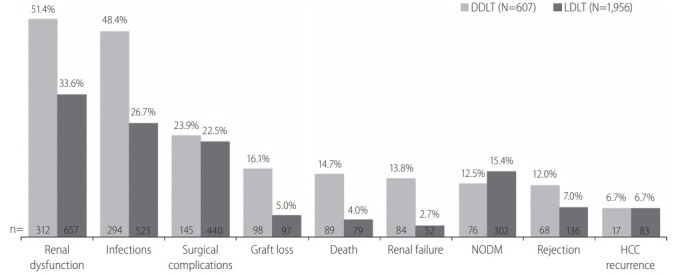
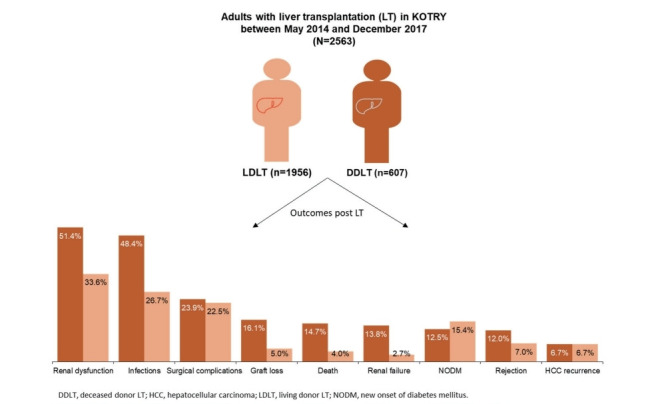
Results: A total of 2,563 adult recipients with LT (LDLT, n=1,956; DDLT, n=607) were included, with mean±standard deviation age of 53.9±8.9 years, and 72.2% were male. The post-LT outcomes observed in each LDLT and DDLT recipients were death (4.0% and 14.7%), graft loss (5.0% and 16.1%), rejection (7.0% and 12.0%), renal failure (2.7% and 13.8%), new onset of diabetes (12.5% and 15.4%), and hepatocellular carcinoma (HCC) recurrence (both 6.7%). In both LDLT and DDLT recipients, the most common post-LT complications were renal dysfunction (33.6% and 51.4%), infection (26.7% and 48.4%), and surgical complication (22.5% and 23.9%). Incidence of these outcomes were generally higher among recipients of DDLT than LDLT. Multivariate analysis indicated recipient age and DDLT as significant risk factors associated with death and graft loss. DDLT and ABO incompatible transplant were prognostic factors for rejection, and HCC beyond Milan criteria at pre-transplant was a strong predictor of HCC recurrence.
Conclusion: This study is a good indicator of the post-LT prognosis in the Korean population and suggests a significant burden of post-LT complications.
Keywords: Incidence; Liver transplantation; Renal insufficiency; Risk factors.
Conflict of interest statement
JM Kim, DG Kim and MS Kim received grants from Novartis Korea Ltd., South Korea for the conduct of this study. KS Lee employees of Novartis Korea Ltd., South Korea. JH Kim was an employee of Novartis Korea Ltd., South Korea at the time of conduct of this study, and left. Authors declare that they have no other conflicts of interest regarding the content of this manuscript.
Figures
References
-
- Wong MCS, Huang JLW, George J, Huang J, Leung C, Eslam M, et al. The changing epidemiology of liver diseases in the Asia-Pacific region. Nat Rev Gastroenterol Hepatol. 2019;16:57–73. - PubMed
-
- Statistics Korea Causes of death statistics in 2017. Statistics Korea web site, < https://www.kostat.go.kr/portal/korea/kor_nw/1/6/2/index.board?bmode=rea...>. Accessed 24 May 2019.
-
- Lee SG, Moon DB, Hwang S, Ahn CS, Kim KH, Song GW, et al. Liver transplantation in Korea: past, present, and future. Transplant Proc. 2015;47:705–708. - PubMed
-
- Lee JG, Lee KW, Kwon CHD, Chu CW, Kim BW, Choi DL, et al. Donor safety in living donor liver transplantation: the Korean organ transplantation registry study. Liver Transpl. 2017;23:999–1006. - PubMed
MeSH terms
Grants and funding
- 2014-ER6301-00/Korea Centers for Disease Control and Prevention/Republic of Korea
- 2014-ER6301-01/Korea Centers for Disease Control and Prevention/Republic of Korea
- 2014-ER6301-02/Korea Centers for Disease Control and Prevention/Republic of Korea
- 2017-ER6301-00/Korea Centers for Disease Control and Prevention/Republic of Korea
- 2017-ER6301-01/Korea Centers for Disease Control and Prevention/Republic of Korea
LinkOut - more resources
Full Text Sources
Other Literature Sources
Medical