Review
. 2021 Jan 28;3(1):115-131.
doi: 10.3390/clockssleep3010008.

Light, Sleep and Performance in Diurnal Birds

Affiliations
Review

Light, Sleep and Performance in Diurnal Birds

Anne E Aulsebrook et al. Clocks Sleep. .

Abstract

Sleep has a multitude of benefits and is generally considered necessary for optimal performance. Disruption of sleep by extended photoperiods, moonlight and artificial light could therefore impair performance in humans and non-human animals alike. Here, we review the evidence for effects of light on sleep and subsequent performance in birds. There is accumulating evidence that exposure to natural and artificial sources of light regulates and suppresses sleep in diurnal birds. Sleep also benefits avian cognitive performance, including during early development. Nevertheless, multiple studies suggest that light can prolong wakefulness in birds without impairing performance. Although there is still limited research on this topic, these results raise intriguing questions about the adaptive value of sleep. Further research into the links between light, sleep and performance, including the underlying mechanisms and consequences for fitness, could shed new light on sleep evolution and urban ecology.

Keywords: EEG; artificial light at night; avian; circadian; cognition; learning; memory; performance; photoperiod; sleep.


Conflict of interest statement

The authors declare no conflict of interest.

Figures
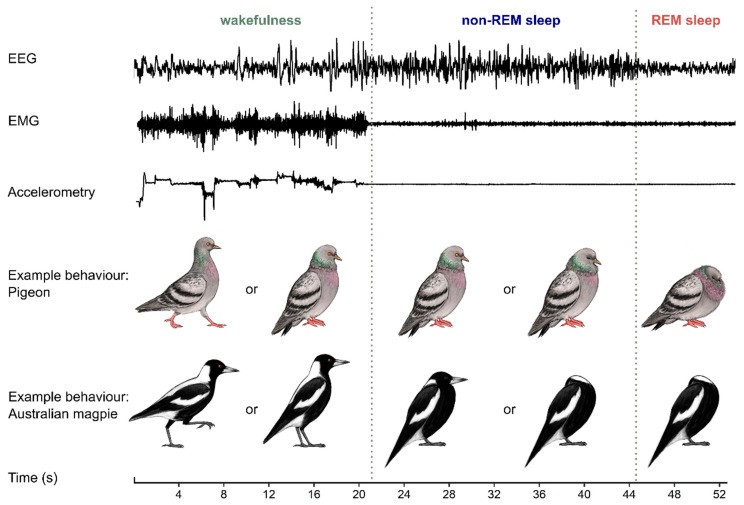
Figure 1
Figure 1
Birds can quickly transition between states of wakefulness, non-rapid eye movement (non-REM) sleep and REM sleep. When birds are awake, the electroencephalogram (EEG) is activated, muscle tone is typically high and variable (shown by the electromyogram or EMG), and the bird is often moving (shown by recordings of accelerometry or video). Non-REM sleep is characterized by slow (<4 Hz) large waves in the EEG, typically accompanied by relaxed skeletal musculature and quiescent behavior; many birds (including pigeons) can also have one or both eyes open. REM sleep is characterized by wake-like patterns in the EEG, often (but not always) relaxed skeletal musculature from the preceding non-REM sleep level, eye movements behind closed eyelids and behavioral restfulness. As illustrated by the example postures of pigeons and Australian magpies, behavior can give some insights into a bird’s state, but it can be difficult to distinguish between sleep states or even between sleep and wakefulness [42]. These EEG, EMG and accelerometry traces are representative examples recorded from an Australian magpie. Illustrations by Laura X. Tan.
Figure 2
Figure 2
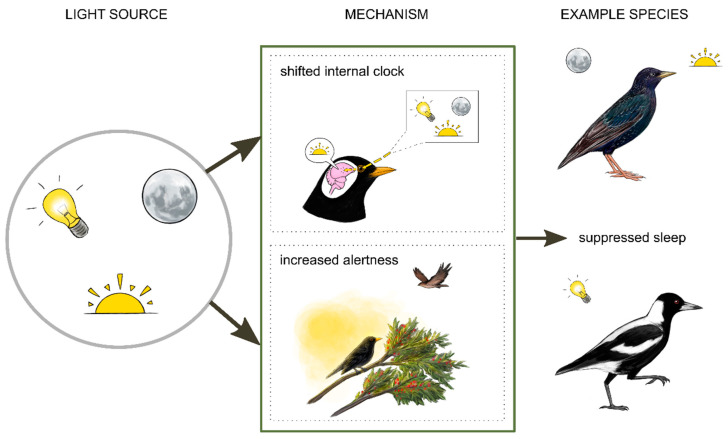
Exposure to light can suppress sleep in birds. European starlings sleep less in summer and during a full moon [53]. Australian magpies show disrupted sleep under artificial light at night [54]. There are two broad mechanisms by which these effects might occur. Light might influence sleep indirectly by shifting the timing of the circadian clock. In European blackbirds, increased activity at night during light exposure has been linked to reduced melatonin, a hormone important for regulating circadian timing [55]. Light might also directly increase alertness by masking natural light cues and facilitating foraging or vigilance [51]. Illustrations by Laura X. Tan.
Figure 3
Figure 3
Multiple cognitive processes in birds depend on sleep, including: (A) imprinting in domestic chicks, (B) developmental song learning and neuronal replay in zebra finches, (C) auditory discrimination learning in European starlings and (D) spatial learning in Indian house crows. Illustrations by Laura X. Tan.
Figure 4
Figure 4
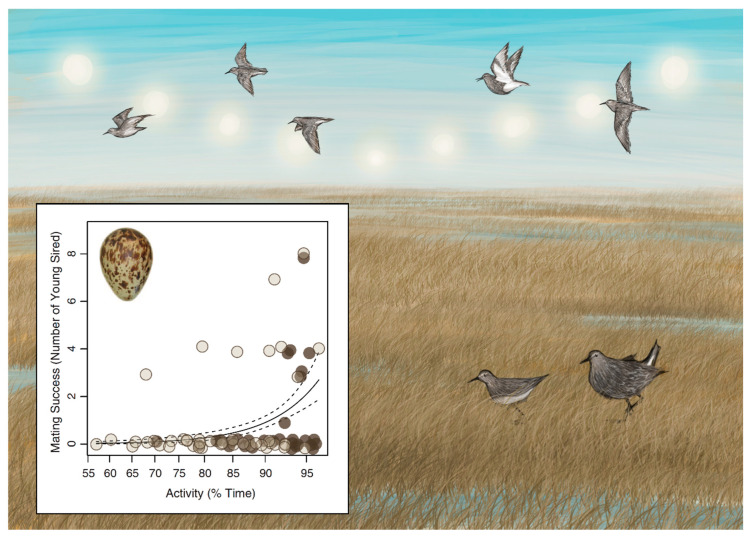
The sun never sets during summer in the high Arctic. In this environment, some male pectoral sandpipers sleep little and are extremely active during the three-week breeding season. Although there was substantial male–male variation in the level of activity, males that slept the least ultimately sired the most offspring (inset from Lesku et al. [6]). Illustrations by Laura X. Tan.

References

    1. Kanaya H.J., Park S., Kim J.-H., Kusumi J., Krenenou S., Sawatari E., Sato A., Lee J., Bang H., Kobayakawa Y., et al. A sleep-like state in Hydra unravels conserved sleep mechanisms during the evolutionary development of the central nervous system. Sci. Adv. 2020;6:eabb9415. doi: 10.1126/sciadv.abb9415. - DOI - PMC - PubMed
    1. Ungurean G., van der Meij J., Rattenborg N.C., Lesku J.A. Evolution and plasticity of sleep. Curr. Opin. Physiol. 2020;15:111–119. doi: 10.1016/j.cophys.2019.12.013. - DOI
    1. Lesku J.A., Roth T.C., Rattenborg N.C., Amlaner C.J., Lima S.L. Phylogenetics and the correlates of mammalian sleep: A reappraisal. Sleep Med. Rev. 2008;12:229–244. doi: 10.1016/j.smrv.2007.10.003. - DOI - PubMed
    1. Tefft B.C. Acute sleep deprivation and culpable motor vehicle crash involvement. Sleep. 2018;41:zsy144. doi: 10.1093/sleep/zsy144. - DOI - PubMed
    1. Lima S.L., Rattenborg N.C., Lesku J.A., Amlaner C.J. Sleeping under the risk of predation. Anim. Behav. 2005;70:723–736. doi: 10.1016/j.anbehav.2005.01.008. - DOI

LinkOut - more resources