. 2017 Nov 30;1(4):385-400.
doi: 10.1042/ETLS20170047.

Organoids, organs-on-chips and other systems, and microbiota

Affiliations

Organoids, organs-on-chips and other systems, and microbiota

Stephanie May et al. Emerg Top Life Sci. .

Abstract

The human gut microbiome is considered an organ in its entirety and has been the subject of extensive research due to its role in physiology, metabolism, digestion, and immune regulation. Disequilibria of the normal microbiome have been associated with the development of several gastrointestinal diseases, but the exact underlying interactions are not well understood. Conventional in vivo and in vitro modelling systems fail to faithfully recapitulate the complexity of the human host-gut microbiome, emphasising the requirement for novel systems that provide a platform to study human host-gut microbiome interactions with a more holistic representation of the human in vivo microenvironment. In this review, we outline the progression and applications of new and old modelling systems with particular focus on their ability to model and to study host-microbiome cross-talk.

Keywords: biological models; biotechnology; host–microbe interactions.


Conflict of interest statement

The Authors declare that there are no competing interests associated with the manuscript information.

Figures
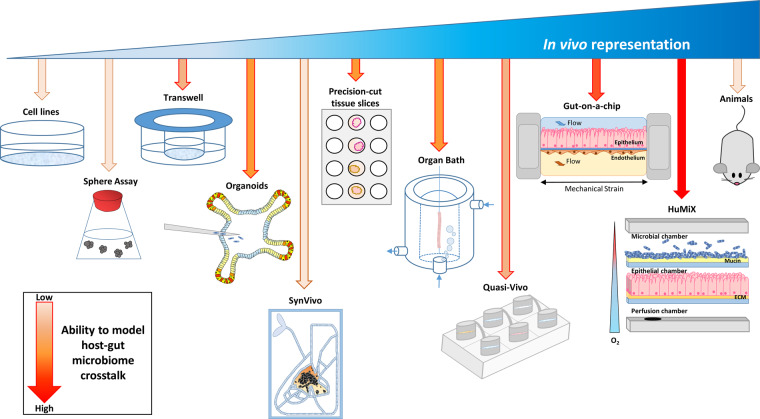
Figure 1.
Figure 1.. Current cell modelling systems and their potential to model host-microbiome cross-talk.
Schematic representation of current cell culturing techniques available and their ability to model host–microbiome interactions.
Figure 2.
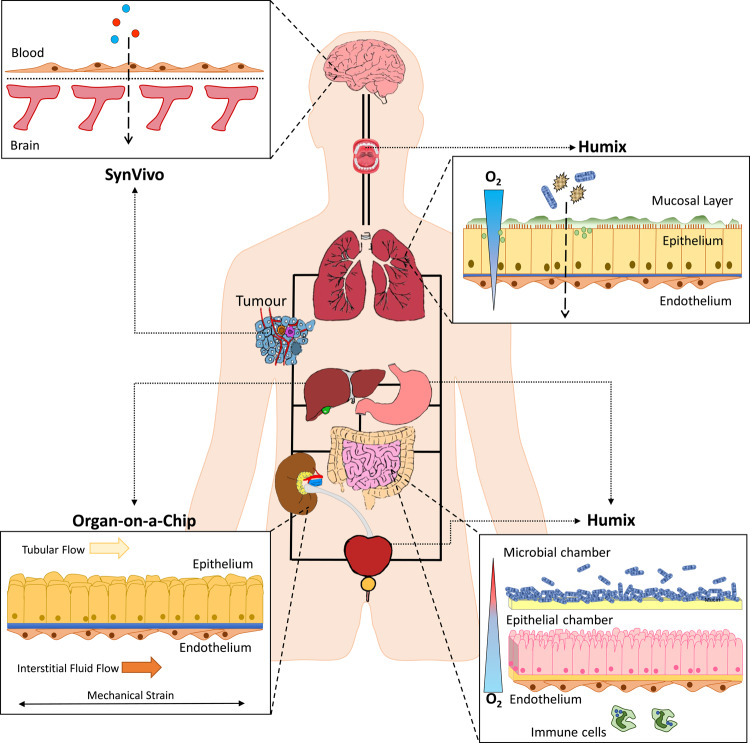
Figure 2.. A proposed microfluidic chip to model host–microbiome cross-talk.
An amalgamation of SynVivo, organ-on-a-chip, and HuMiX culturing systems has the potential to model the host–microbiome interactions within the entire human body, in the presence of flow and shear stresses (representative of a circulatory system).

References

    1. Yissachar N., Zhou Y., Ung L., Lai N.Y., Mohan J.F., Ehrlicher A. et al. (2017) An intestinal organ culture system uncovers a role for the nervous system in microbe-immune crosstalk. Cell 168, 1135–1148.e12 10.1016/j.cell.2017.02.009 - DOI - PMC - PubMed
    1. Pflughoeft K.J. and Versalovic J. (2011) Human microbiome in health and disease. Ann. Rev. Pathol. 7, 99–122 10.1146/annurev-pathol-011811-132421 - DOI - PubMed
    1. Park G.-S., Park M.H., Shin W., Zhao C., Sheikh S., Oh S.J. et al. (2017) Emulating host-microbiome ecosystem of human gastrointestinal tract in vitro. Stem Cell Rev. Rep. 13, 321–334 10.1007/s12015-017-9739-z - DOI - PubMed
    1. Shreiner A.B., Kao J.Y. and Young V.B. (2015) The gut microbiome in health and in disease. Curr. Opin. Gastroenterol. 31, 69–75 10.1097/MOG.0000000000000139 - DOI - PMC - PubMed
    1. Round J.L. and Mazmanian S.K. (2009) The gut microbiota shapes intestinal immune responses during health and disease. Nat. Rev. Immunol. 9, 313–323 10.1038/nri2515 - DOI - PMC - PubMed

LinkOut - more resources