


Molecular neuroscience at its "high": bibliometric analysis of the most cited papers on endocannabinoid system, cannabis and cannabinoids
- PMID: 33526099
- PMCID: PMC7815052
- DOI: 10.1186/s42238-019-0004-y
Molecular neuroscience at its "high": bibliometric analysis of the most cited papers on endocannabinoid system, cannabis and cannabinoids
Abstract
Background: Cannabis, cannabinoids and endocannabinoids are heavily investigated topics with many articles published every year. We aimed to identify the 100 most cited manuscripts among the vast literature and analyze their contents.
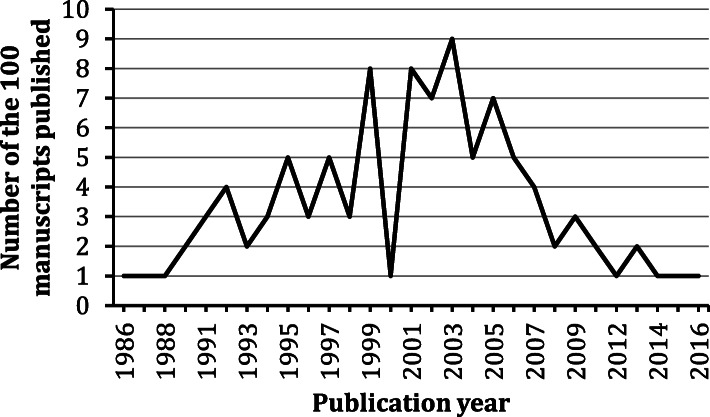
Methods: Web of Science (WoS) Core Collection was searched to identify the 100 most cited relevant manuscripts, which were analyzed with reference to (1) authorship, (2) institution, (3) country, (4) document type, (5) journal, (6) publication year, (7) WoS category, and (8) citation count. Semantic content and citation data of the manuscripts were analyzed with VOSviewer.
Results: The most cited manuscripts were published between 1986 and 2016, with the majority being published in the 2000s (n = 51). The number of citations for the top 100 articles ranged from 469 to 3651, with a median citation count of 635.5. The most prolific authors were Vincenzo Di Marzo (n = 11) and Daniele Piomelli (n = 11). The major contributing countries were USA (n = 49), Italy (n = 22), UK (n = 19), and France (n = 11). The most prolific institutions were University of California (n = 14), National Research Council of Italy (n = 12) and National Institutes of Health USA (n = 12). The manuscripts consisted of original articles (n = 75), reviews (n = 24) and a note (n = 1). The most dominant journal was Nature (n = 15). The major WoS categories associated were Multidisciplinary sciences (n = 31), Neurosciences (n = 20), Pharmacology / Pharmacy (n = 16), and General / Internal Medicine (n = 11).
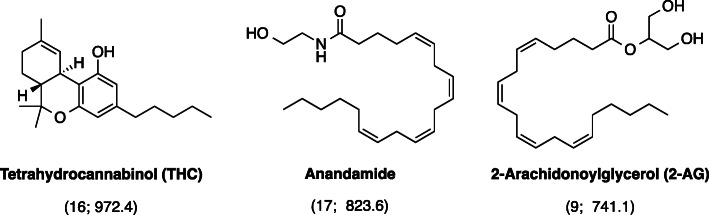
Conclusions: The top-ranked manuscripts among the 100 were concerning analgesia, weight loss, long-term potentiation, depolarization-induced suppression of inhibition, opiates and other topics. Cannabinoid type 1 (CB1) receptor was studied by more of the top 100 papers in comparison to cannabinoid type 2 (CB2) receptor. The most frequently mentioned chemicals in these publications were 2-arachidonoylglycerol, tetrahydrocannabinol, and anandamide. Together, these manuscripts comprise the most highly cited publications in the topic, literally the molecular neuroscience at its "high".
Keywords: Bibliometrics; Cannabis; Citation analysis; Endocannabinoid; Molecular neuroscience; VOSviewer.
Conflict of interest statement
Author Nicolas Arkells was employed by Wrazel and on the Board of Directors for C3 International Inc. He has received no funding or resources from either of these employers to in anyway facilitate or otherwise assist him in his contributions to this manuscript. The other authors declare no competing interest.
Figures


References
-
- Bisogno T, Melck D, Bobrov MY, Gretskaya NM, Bezuglov VV, De Petrocellis L, Di Marzo V. N-acyl-dopamines: novel synthetic CB1 cannabinoid-receptor ligands and inhibitors of anandamide inactivation with cannabimimetic activity in vitro and in vivo. Biochem J. 2000;351:817–824. doi: 10.1042/bj3510817. - DOI - PMC - PubMed
LinkOut - more resources
Full Text Sources
