


Medical cannabis use in the United States: a retrospective database study
- PMID: 33526110
- PMCID: PMC7819290
- DOI: 10.1186/s42238-020-00038-w
Medical cannabis use in the United States: a retrospective database study
Abstract
Introduction: Growing interest in the medicinal properties of cannabis has led to an increase in its use to treat medical conditions, and the establishment of state-specific medical cannabis programs. Despite medical cannabis being legal in 33 states and the District of Colombia, there remains a paucity of data characterizing the patients accessing medical cannabis programs.
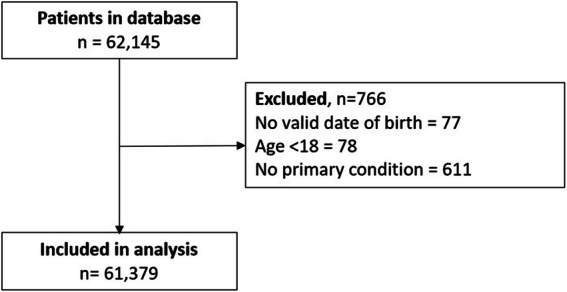
Methods: We retrospectively reviewed a registry with data from 33 medical cannabis evaluation clinics in the United States, owned and operated by CB2 Insights. Data were collected primarily by face-to-face interviews for patients seeking medical cannabis certification between November 18, 2018 and March 18, 2020. Patients were removed from the analysis if they did not have a valid date of birth, were less than 18, or did not have a primary medical condition reported; a total of 61,379 patients were included in the analysis. Data were summarized using descriptive statistics expressed as a mean (standard deviation (SD)) or median (interquartile range (IQR)) as appropriate for continuous variables, and number (percent) for categorical variables. Statistical tests performed across groups included t-tests, chi-squared tests and regression.
Results: The average age of patients was 45.5, 54.8% were male and the majority were Caucasian (87.5%). Female patients were significantly older than males (47.0 compared to 44.6). Most patients reported cannabis experience prior to seeking medical certification (66.9%). The top three mutually exclusive primary medical conditions reported were unspecified chronic pain (38.8%), anxiety (13.5%) and post-traumatic stress disorder (PTSD) (8.4%). The average number of comorbid conditions reported was 2.7, of which anxiety was the most common (28.3%). Females reported significantly more comorbid conditions than males (3.1 compared to 2.3).
Conclusion: This retrospective study highlighted the range and number of conditions for which patients in the US seek medical cannabis. Rigorous clinical trials investigating the use of medical cannabis to treat pain conditions, anxiety, insomnia, depression and PTSD would benefit a large number of patients, many of whom use medical cannabis to treat multiple conditions.
Keywords: Anxiety; Chronic pain; Gender; Medical cannabis; Post-traumatic stress disorder.
Conflict of interest statement
The authors declare that they have no competing interests aside from being employees of CB2 Insights. All authors contributed to the manuscript as part of an internally guided project. CB2 Insights owns the data, and the authors are all employees of CB2 Insights. No external companies had input on the content of the manuscript, and all data were analyzed in an unbiased fashion. Apart from the authors, CB2 Insights did not play any role in the conduct or analysis of the study, the writing of the manuscript or the decision to publish.
References
-
- 2018 NSDUH Detailed Tables | CBHSQ Data. 2019 https://www.samhsa.gov/data/report/2018-nsduh-detailed-tables. Accessed 27 Mar 2020.
-
- Bertakis K, Azari R, Helms L, Callahan E, Robbins J. Gender differences in the utilization of health care services. J Fam Pr 2000;49(2):147–152. https://pubmed.ncbi.nlm.nih.gov/10718692/. Accessed 9 June 2020. - PubMed
Publication types
LinkOut - more resources
Full Text Sources
