Review
. 2021 Apr 22;41(5):e00660-20.
doi: 10.1128/MCB.00660-20. Print 2021 Apr 22.

The Cell Biology of LRRK2 in Parkinson's Disease

Affiliations
Review

The Cell Biology of LRRK2 in Parkinson's Disease

Ahsan Usmani et al. Mol Cell Biol. .

Abstract

Point mutations in leucine-rich repeat kinase 2 (LRRK2) are the most common cause of familial Parkinson's disease (PD) and are implicated in a significant proportion of apparently sporadic PD cases. Clinically, LRRK2-driven PD is indistinguishable from sporadic PD, making it an attractive genetic model for the much more common sporadic PD. In this review, we highlight recent advances in understanding LRRK2's subcellular functions using LRRK2-driven PD models, while also considering some of the limitations of these model systems. Recent developments of particular importance include new evidence of key LRRK2 functions in the endolysosomal system and LRRK2's regulation of and by Rab GTPases. Additionally, LRRK2's interaction with the cytoskeleton allowed elucidation of the LRRK2 structure and appears relevant to LRRK2 protein degradation and LRRK2 inhibitor therapies. We further discuss how LRRK2's interactions with other PD-driving genes, such as the VPS35, GBA1, and SNCA genes, may highlight cellular pathways more broadly disrupted in PD.

Keywords: LRRK2; Parkinson's disease; endolysosome; kinase; microtubule.


Figures

FIG 1
FIG 1
LRRK2 domain structure. LRRK2 is a multidomain kinase with two enzymatic domains, a Roc GTPase and a serine-threonine kinase of the TKL family, linked by a COR domain. LRRK2’s N and C termini are composed of protein-protein interaction domains, including N-terminal armadillo (ARM), ankyrin (ANK), and LRR domains and a C-terminal WD40 domain. Indicated at the top are the seven known LRRK2 point mutations that drive autosomal dominant PD.
FIG 2
FIG 2
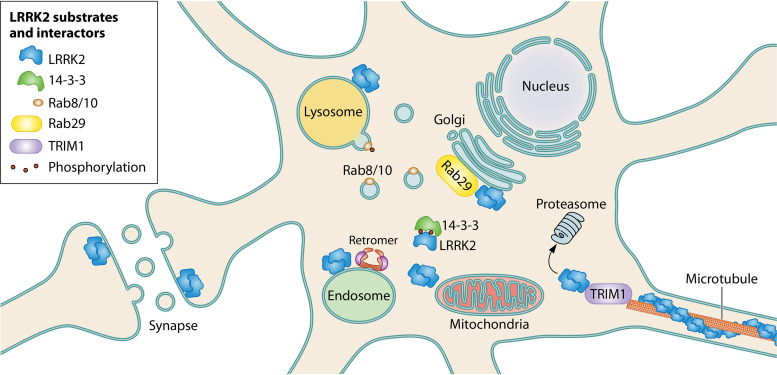
LRRK2’s subcellular localizations and key interacting partners. LRRK2 is found in the cytoplasm, where it binds to 14-3-3 proteins in a phosphorylation-dependent manner, and at cell membranes, where it forms a homodimer. LRRK2 function appears particularly important to the endolysosomal system and trans-Golgi network. Here, LRRK2 is activated by and phosphorylates Rab29 and also recruits and phosphorylates Rab8A/10 (as well as other Rab proteins) to initiate downstream pathways. In overexpression, LRRK2 binds the microtubule in an ordered helix, and we have found that LRRK2 proteasomal degradation is regulated by TRIM1, a microtubule-bound protein. LRRK2 also appears to have important roles in normal retromer and mitochondrial function.
FIG 3
FIG 3
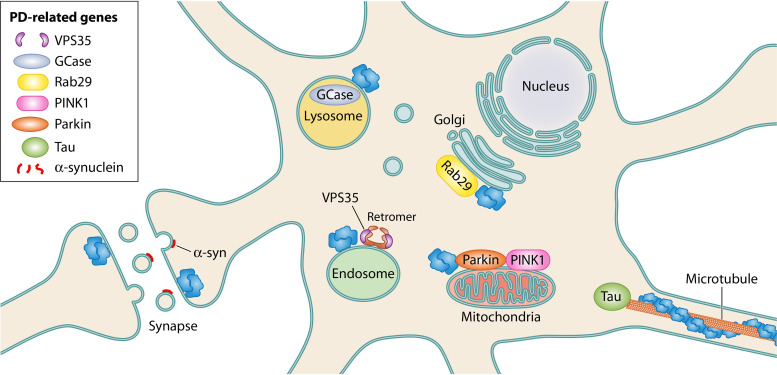
LRRK2’s interactions with key PD-related genes. LRRK2 has been shown to physically or genetically interact with a number of other PD genes. Rab29 and VPS35 appear to be upstream regulators of LRRK2, leading to LRRK2 endolysosomal recruitment and activation. GCase, a lysosomal enzyme whose dysfunction causes Gaucher’s disease, is likely to be regulated through LRRK2-mediated Rab10 activity. Parkin and PINK1 drive mitophagy, which appears to be disrupted by hyperphosphorylation of Rab10 by LRRK2. Mutant LRRK2 can cause synucleinopathies, with abnormal aggregation of α-synuclein, as well as tauopathies, with abnormal aggregation of the microtubule-associated protein tau. How LRRK2 mutations drive α-synuclein and tau aggregation requires further investigation.

References

    1. de Lau LM, Breteler MM. 2006. Epidemiology of Parkinson's disease. Lancet Neurol 5:525–535. 10.1016/S1474-4422(06)70471-9. - DOI - PubMed
    1. Schapira AHV, Chaudhuri KR, Jenner P. 2017. Non-motor features of Parkinson disease. Nat Rev Neurosci 18:435–450. 10.1038/nrn.2017.62. - DOI - PubMed
    1. Schulz-Schaeffer WJ. 2010. The synaptic pathology of α-synuclein aggregation in dementia with Lewy bodies, Parkinson's disease and Parkinson's disease dementia. Acta Neuropathol 120:131–143. 10.1007/s00401-010-0711-0. - DOI - PMC - PubMed
    1. Klein C, Westenberger A. 2012. Genetics of Parkinson's disease. Cold Spring Harb Perspect Med 2:a008888. 10.1101/cshperspect.a008888. - DOI - PMC - PubMed
    1. Corti O, Lesage S, Brice A. 2011. What genetics tells us about the causes and mechanisms of Parkinson's disease. Physiol Rev 91:1161–1218. 10.1152/physrev.00022.2010. - DOI - PubMed

MeSH terms

Substances

LinkOut - more resources