


The Feasibility of High-Intensity Interval Training in Patients with Intensive Care Unit-Acquired Weakness Syndrome Following Long-Term Invasive Ventilation
- PMID: 33527199
- PMCID: PMC7849616
- DOI: 10.1186/s40798-021-00299-6
The Feasibility of High-Intensity Interval Training in Patients with Intensive Care Unit-Acquired Weakness Syndrome Following Long-Term Invasive Ventilation
Abstract
Background: Intensive care unit-acquired weakness syndrome (ICUAWS) can be a consequence of long-term mechanical ventilation. Despite recommendations of early patient mobilisation, little is known about the feasibility, safety and benefit of interval training in early rehabilitation facilities (ERF) after long-term invasive ventilation.
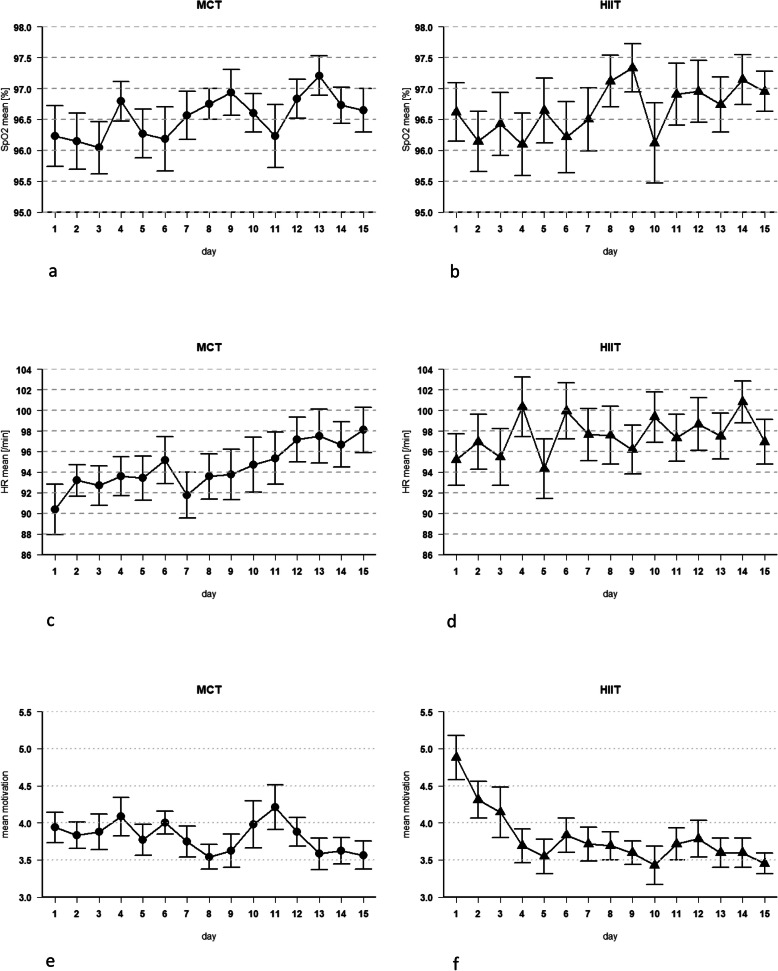
Methods and results: We retrospectively analysed two established training protocols of bicycle ergometry in ERF patients after long-term (> 7 days) invasive ventilation (n = 46). Patients conducted moderate continuous (MCT, n = 24, mean age 70.3 ± 10.1 years) or high-intensity interval training (HIIT, n = 22, mean age 63.6 ± 12.6 years). The intensity of training was monitored with the BORG CR10 scale (intense phases ≥ 7/10 and moderate phases ≤ 4/10 points). The primary outcome was improvement (∆-values) of six-minute-walk-test (6 MWT), while the secondary outcomes were improvement of vital capacity (VCmax), forced expiratory volume in 1 s (FEV1), maximal inspiratory pressure (PImax) and functional capabilities (functional independence assessment measure, FIM/FAM and Barthel scores) after 3 weeks of training. No adverse events were observed. There was a trend towards a greater improvement of 6 MWT in HIIT than MCT (159.5 ± 64.9 m vs. 120.4 ± 60.4 m; p = .057), despite more days of invasive ventilation (39.6 ± 16.8 days vs. 26.8 ± 16.2 days; p = .009). VCmax (∆0.5l ± 0.6 vs. ∆0.5l ± 0.3; p = .462), FEV1 (∆0.2l ± 0.3 vs. ∆0.3l ± 0.2; p = .218) PImax (∆0.8 ± 1.1 kPa vs. ∆0.7 ± 1.3pts; p = .918) and functional status (FIM/FAM: ∆29.0 ± 14.8pts vs. ∆30.9 ± 16.0pts; p = .707; Barthel: ∆28.9 ± 16.0 pts vs. ∆25.0 ± 10.5pts; p = .341) improved in HIIT and MCT.
Conclusions: We demonstrate the feasibility and safety of HIIT in the early rehabilitation of ICUAWS patients. Larger trials are necessary to find adequate dosage of HIIT in ICUAWS patients.
Keywords: Early rehabilitation facility; ICUAWS; MCT vs. HIIT in critically ill patients.
Conflict of interest statement
The authors, Simon Wernhart, Jürgen Hedderich, Svenja Wunderlich, Kunigunde Schauerte, Dominic Dellweg, Eberhard Weihe, and Karsten Siemon, declare that they have no competing interests.
Figures



References
-
- Eggmann S, Luder G, Verra ML, Irincheeva I, Bastiaenen CHG, Jakob SM. Functional ability and quality of life in critical illness survivors with intensive care unit acquired weakness: A secondary analysis of a randomised controlled trial. PLoS One. 2020;15(3):e0229725. doi: 10.1371/journal.pone.0229725. - DOI - PMC - PubMed
-
- Henriksson H, Henriksson P, Tynelius P, Ekstedt M, Berglind D, Labayen I, et al. Cardiorespiratory fitness, muscular strength, and obesity in adolescence and later chronic disability due to cardiovascular disease: a cohort study of 1 million men. Eur Heart J. 2020;41(15):1503–1510. doi: 10.1093/eurheartj/ehz774. - DOI - PMC - PubMed
LinkOut - more resources
Full Text Sources
Other Literature Sources
Research Materials
Miscellaneous
