


Genome-Scale Profiling Reveals Noncoding Loci Carry Higher Proportions of Concordant Data
- PMID: 33528497
- PMCID: PMC8136493
- DOI: 10.1093/molbev/msab026
Genome-Scale Profiling Reveals Noncoding Loci Carry Higher Proportions of Concordant Data
Abstract
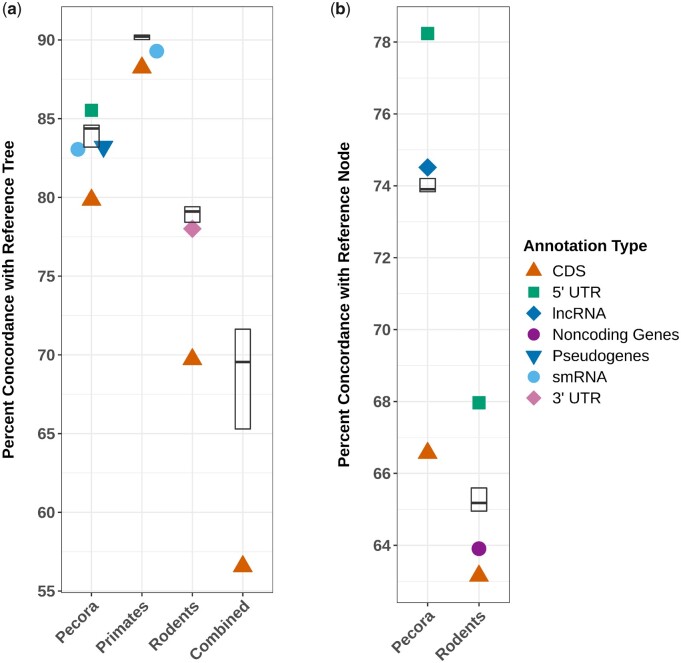
Many evolutionary relationships remain controversial despite whole-genome sequencing data. These controversies arise, in part, due to challenges associated with accurately modeling the complex phylogenetic signal coming from genomic regions experiencing distinct evolutionary forces. Here, we examine how different regions of the genome support or contradict well-established relationships among three mammal groups using millions of orthologous parsimony-informative biallelic sites (PIBS) distributed across primate, rodent, and Pecora genomes. We compared PIBS concordance percentages among locus types (e.g. coding sequences (CDS), introns, intergenic regions), and contrasted PIBS utility over evolutionary timescales. Sites derived from noncoding sequences provided more data and proportionally more concordant sites compared with those from CDS in all clades. CDS PIBS were also predominant drivers of tree incongruence in two cases of topological conflict. PIBS derived from most locus types provided surprisingly consistent support for splitting events spread across the timescales we examined, although we find evidence that CDS and intronic PIBS may, respectively and to a limited degree, inform disproportionately about older and younger splits. In this era of accessible wholegenome sequence data, these results:1) suggest benefits to more intentionally focusing on noncoding loci as robust data for tree inference and 2) reinforce the importance of accurate modeling, especially when using CDS data.
Keywords: bioinformatics; genomics; phylogenetics.
© The Author(s) 2021. Published by Oxford University Press on behalf of the Society for Molecular Biology and Evolution.
Figures


References
-
- Aguileta G, Marthey S, Chiapello H, Lebrun M-H, Rodolphe F, Fournier E, Gendrault-Jacquemard A, Giraud T.. 2008. Assessing the performance of single-copy genes for recovering robust phylogenies. Syst Biol 57(4):613–627. - PubMed
-
- Bejerano G. 2004. Ultraconservedelements in the human genome. Science 304(5675):1321–1325. - PubMed
-
- Bleidorn C. 2017. Sources of error and incongruence in phylogenomic analyses. Phylogenomics 173–193, doi:10.1007/978-3-319-54064-1_9
Publication types
MeSH terms
Substances
LinkOut - more resources
Full Text Sources
Other Literature Sources
