


Disease stability and extended dosing under anti-VEGF treatment of exudative age-related macular degeneration (AMD) - a meta-analysis
- PMID: 33528645
- PMCID: PMC8352813
- DOI: 10.1007/s00417-020-05048-1
Disease stability and extended dosing under anti-VEGF treatment of exudative age-related macular degeneration (AMD) - a meta-analysis
Abstract
Purpose: To assess disease stability (absence of intra- and/or subretinal fluid) and the portion of eyes being capable to extend their treatment interval to ≥ 12 weeks in exudative age-related macular degeneration (AMD).
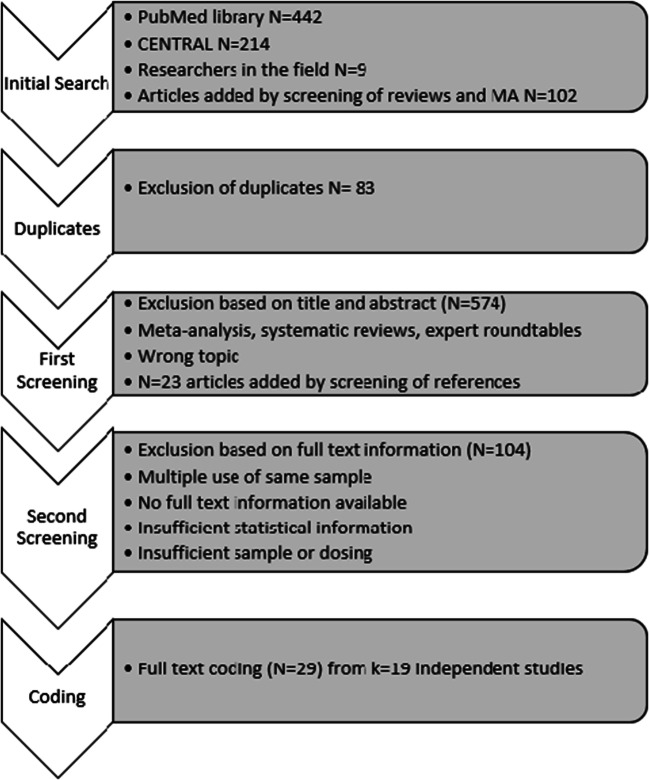
Methods: A systematic literature search was performed in NCBI, PubMed, CENTRAL, and ClinicalTrials.gov to identify clinical studies reporting treatment outcomes for ranibizumab, aflibercept, and brolucizumab in exudative AMD under a treat-and-extend protocol and a follow-up of ≥ 12 months. Weighted mean differences and subgroup comparisons were used to integrate the different studies.
Results: This meta-analysis refers to 29 published series, including 27 independent samples and 5629 patients. In the pooled group, disease stability was reported in 62.9% and 56.0%, respectively, after 12 and 24 months of treatment, whereas treatment intervals were extended to ≥ 12 weeks in 37.7% and 42.6%, respectively. Ranibizumab, aflibercept, and brolucizumab differed regarding their potential to achieve disease stability (56.3%, 64.5%, and 71.5% after 12, and 50.0%, 52.7% and 75.7% after 24 months; p = < 0.001) and to allow an interval extension to ≥ 12 weeks (28.6%, 34.2%, and 53.3% after 12, and 34.2%, 47.7%, and 41.7% after 24 months; p = < 0.001).
Conclusion: The portion of eyes achieving disease stability regressed in the second year, whereas the portion of eyes under a ≥ 12-week interval increased. This discrepancy may reflect the challenges in balancing between under-treatment and a reduced treatment burden.
Keywords: Aflibercept; Age-related macular degeneration (AMD); Brolucizumab; Neovascular AMD; Ranibizumab; Treat-and-extend.
© 2021. The Author(s).
Conflict of interest statement
JGG acts as an advisor for several pharmaceutical companies (AbbVie, Alcon, Allergan, Bayer, Kanghong, Novartis) and contributes to several international industry-sponsored clinical studies. The underlying manuscript is independent of these activities. The author received no direct or indirect support for this study, nor has he conflicting interests with the data that are presented herein. CG has no conflicting interests as well.
References
-
- Dadgostar H, Waheed N. The evolving role of vascular endothelial growth factor inhibitors in the treatment of neovascular age-related macular degeneration. Eye. 2008;22:761–767. - PubMed
-
- Rosenfeld PJ, Brown DM, Heier JS, Boyer DS, Kaiser PK, Chung CY, Kim RY, MARINA Study Group Ranibizumab for neovascular age-related macular degeneration. N Engl J Med. 2006;355:1419–1431. - PubMed
-
- Brown DM, Kaiser PK, Michels M, Soubrane G, Heier JS, Kim RY, Sy JP, Schneider S, ANCHOR Study Group Ranibizumab versus verteporfin for neovascular age-related macular degeneration. N Engl J Med. 2006;355:1432–1444. - PubMed
-
- Rosenfeld PJ, Moshfeghi AA, Puliafito CA. Optical coherence tomography findings after an intravitreal injection of bevacizumab (avastin) for neovascular age-related macular degeneration. Ophthalmic Surg Lasers Imaging. 2005;36:331–335. - PubMed
Publication types
MeSH terms
Substances
LinkOut - more resources
Full Text Sources
Other Literature Sources
Medical
