


Progenitors in prostate development and disease
- PMID: 33529704
- PMCID: PMC7987809
- DOI: 10.1016/j.ydbio.2020.11.012
Progenitors in prostate development and disease
Abstract
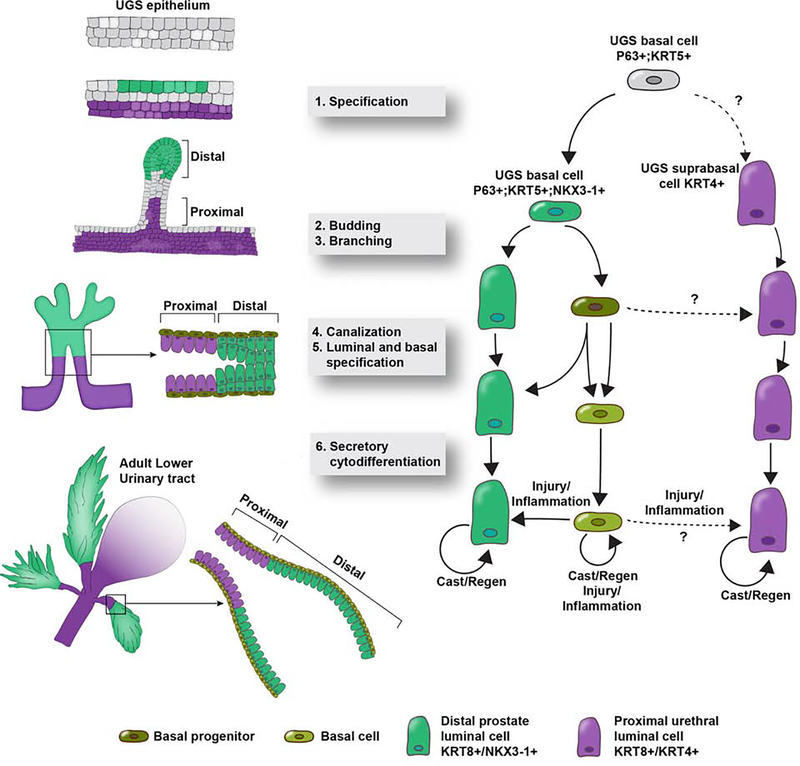
The prostate develops by epithelial budding and branching processes that occur during fetal and postnatal stages. The adult prostate demonstrates remarkable regenerative capacity, with the ability to regrow to its original size over multiple cycles of castration and androgen administration. This capacity for controlled regeneration prompted the search for an androgen-independent epithelial progenitor in benign prostatic hyperplasia (BPH) and prostate cancer (PCa). BPH is hypothesized to be a reawakening of ductal branching, resulting in the formation of new proximal glands, all while androgen levels are decreasing in the aging male. Advanced prostate cancer can be slowed with androgen deprivation, but resistance eventually occurs, suggesting the existence of an androgen-independent progenitor. Recent studies indicate that there are multiple castration-insensitive epithelial cell types in the proximal area of the prostate, but not all act as progenitors during prostate development or regeneration. This review highlights how recent cellular and anatomical studies are changing our perspective on the identity of the prostate progenitor.
Keywords: Androgen independent; Development; Lineage tracing; Morphogenesis; Progenitor; Prostate; Urethra.
Copyright © 2021 Elsevier Inc. All rights reserved.
Conflict of interest statement
Declaration of competing interest None.
Figures
References
-
- Barros-Silva JD, Linn DE, Steiner I, Guo G, Ali A, Pakula H, Ashton G, Peset I, Brown M, Clarke NW, Bronson RT, Yuan GC, Orkin SH, Li Z, Baena E, 2018. “Single-Cell Analysis Identifies LY6D as a Marker Linking Castration-Resistant Prostate Luminal Cells to Prostate Progenitors and Cancer.” Cell Rep 25, 3504–3518 e3506. - PMC - PubMed
-
- Berry SJ, Coffey DS, Walsh PC, Ewing LL, 1984. “The development of human benign prostatic hyperplasia with age.” J Urol 132, 474–479. - PubMed
-
- Bierhoff E, Walljasper U, Hofmann D, Vogel J, Wernert N, Pfeifer U, 1997. “Morphological analogies of fetal prostate stroma and stromal nodules in BPH.” Prostate 31, 234–240. - PubMed
-
- Braun KM, Watt FM, 2004. “Epidermal label-retaining cells: background and recent applications.” J Investig Dermatol Symp Proc 9, 196–201. - PubMed
Publication types
MeSH terms
Substances
Grants and funding
LinkOut - more resources
Full Text Sources
Other Literature Sources
Medical
