Review
. 2021 Jan 26;22(3):1185.
doi: 10.3390/ijms22031185.

Cognitive Decline in Rheumatoid Arthritis: Insight into the Molecular Pathogenetic Mechanisms

Affiliations
Review

Cognitive Decline in Rheumatoid Arthritis: Insight into the Molecular Pathogenetic Mechanisms

Maria Sofia Basile et al. Int J Mol Sci. .

Abstract

Cognitive decline refers to a deterioration of intellectual and learning abilities and related memory problems, and is often associated with behavioral alterations, which prevents sufferers from carrying out the most common daily activities, such as maintaining normal productive interpersonal relationships, communicating, and leading an autonomous life. Numerous studies have highlighted the association between cognitive decline and autoimmune disorders, including rheumatoid arthritis (RA). RA is a chronic, inflammatory, autoimmune disease that involves systems and organs other than the bones and joints, with varying severity among patients. Here, we review the studies investigating the link between cognitive decline and RA, focusing on the main molecular pathogenetic mechanisms involved. The emerging body of data suggests that clinical, psychological, and biological factors may contribute to the pathogenesis of cognitive decline in RA, including cardiovascular complications, chronic pain, depression, inflammatory factors, changes in hormone levels, drug side effects, and genetics. Further studies are warranted in order to fully clarify the basis underlying the association between cognitive decline and RA and to find new possible diagnostic strategies and therapeutic targets for RA patients.

Keywords: cognitive decline; pathogenesis; rheumatoid arthritis.


Conflict of interest statement

The authors declare no conflict of interest. The funders had no role in the design of the study; in the collection, analyses, or interpretation of data; in the writing of the manuscript, or in the decision to publish the results.

Figures
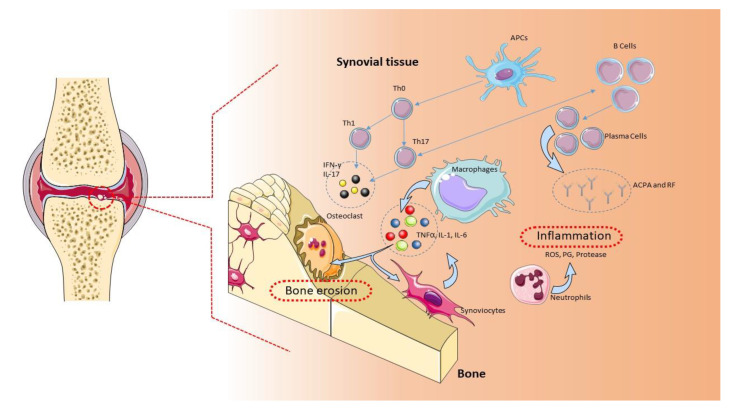
Figure 1
Figure 1
Pathogenic role of immune cells in rheumatoid arthritis (RA). The immune cells mainly involved in the pathogenesis of RA are B cells, T cells, and macrophages. These cells are normally present in the synovial tissue. B cells release proteins, such as rheumatoid factor (RF), protein antibodies (ACPAs), and proinflammatory cytokines, that support the establishment of RA. B cells also mediate the activation of T lymphocytes through the expression of costimulatory molecules. In RA, the main function of T lymphocytes is to activate macrophages. Activated T lymphocytes and macrophages release proinflammatory molecules, such as cytokines and chemokines, which keep the osteoarticular tissue inflamed. This condition favors the activation of synoviocytes and osteoclasts, with consequent damage to the osteoarticular tissue and pannus formation [1]. APCs: antigen-presenting cells, ROS: reactive oxygen species.
Figure 2
Figure 2
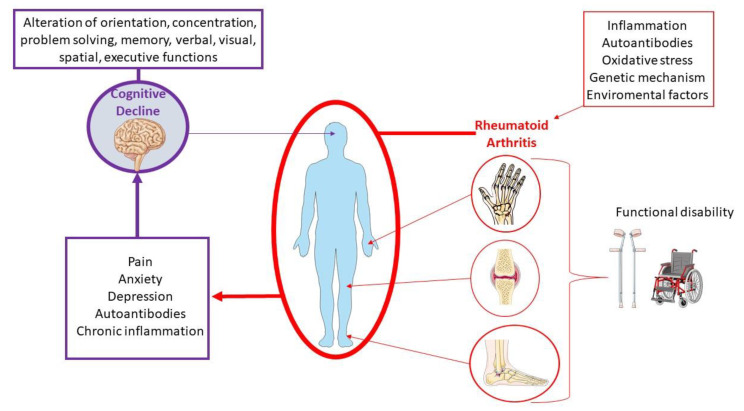
Multistep progression of rheumatoid arthritis to cognitive dysfunction.
Figure 3
Figure 3
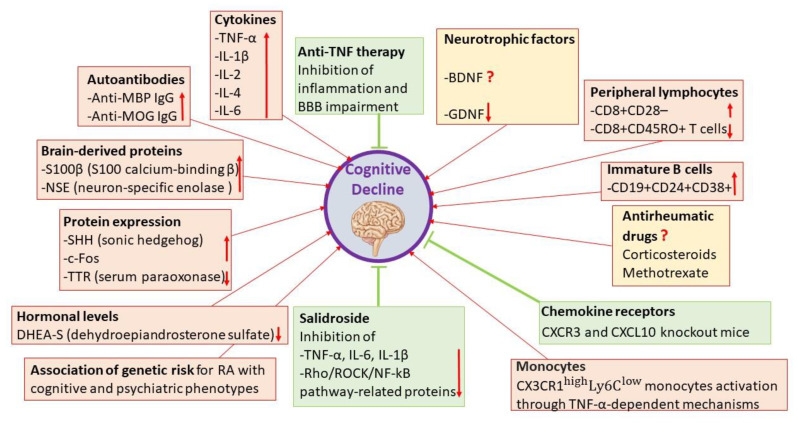
Overview of the possible biological factors involved in the pathogenesis of cognitive decline in rheumatoid arthritis.

References

    1. McInnes I.B., Schett G. The Pathogenesis of Rheumatoid Arthritis. N. Engl. J. Med. 2011;365:2205–2219. doi: 10.1056/NEJMra1004965. - DOI - PubMed
    1. Smolen J.S., Aletaha D., McInnes I.B. Rheumatoid arthritis. Lancet. 2016;388:2023–2038. doi: 10.1016/S0140-6736(16)30173-8. - DOI - PubMed
    1. Bullock J., Rizvi S.A.A., Saleh A.M., Ahmed S.S., Do D.P., Ansari R.A., Ahmed J. Rheumatoid Arthritis: A Brief Overview of the Treatment. Med. Princ. Pract. 2018;27:501–507. doi: 10.1159/000493390. - DOI - PMC - PubMed
    1. Van der Woude D., van der Helm-van Mil A.H.M. Update on the epidemiology, risk factors, and disease outcomes of rheumatoid arthritis. Best Pract. Res. Clin. Rheumatol. 2018;32:174–187. doi: 10.1016/j.berh.2018.10.005. - DOI - PubMed
    1. Deane K.D., Demoruelle M.K., Kelmenson L.B., Kuhn K.A., Norris J.M., Holers V.M. Genetic and environmental risk factors for rheumatoid arthritis. Best Pract. Res. Clin. Rheumatol. 2017;31:3–18. doi: 10.1016/j.berh.2017.08.003. - DOI - PMC - PubMed

LinkOut - more resources