Review
. 2021 Jan 26;14(3):569.
doi: 10.3390/ma14030569.

3D Scaffolds to Model the Hematopoietic Stem Cell Niche: Applications and Perspectives

Affiliations
Review

3D Scaffolds to Model the Hematopoietic Stem Cell Niche: Applications and Perspectives

Ada Congrains et al. Materials (Basel). .

Abstract

Hematopoietic stem cells (HSC) are responsible for the production of blood and immune cells during life. HSC fate decisions are dependent on signals from specialized microenvironments in the bone marrow, termed niches. The HSC niche is a tridimensional environment that comprises cellular, chemical, and physical elements. Introductorily, we will revise the current knowledge of some relevant elements of the niche. Despite the importance of the niche in HSC function, most experimental approaches to study human HSCs use bidimensional models. Probably, this contributes to the failure in translating many in vitro findings into a clinical setting. Recreating the complexity of the bone marrow microenvironment in vitro would provide a powerful tool to achieve in vitro production of HSCs for transplantation, develop more effective therapies for hematologic malignancies and provide deeper insight into the HSC niche. We previously demonstrated that an optimized decellularization method can preserve with striking detail the ECM architecture of the bone marrow niche and support HSC culture. We will discuss the potential of this decellularized scaffold as HSC niche model. Besides decellularized scaffolds, several other methods have been reported to mimic some characteristics of the HSC niche. In this review, we will examine these models and their applications, advantages, and limitations.

Keywords: 3D culture; HSC; bone marrow niche; scaffold.


Conflict of interest statement

The authors declare no conflict of interest.

Figures
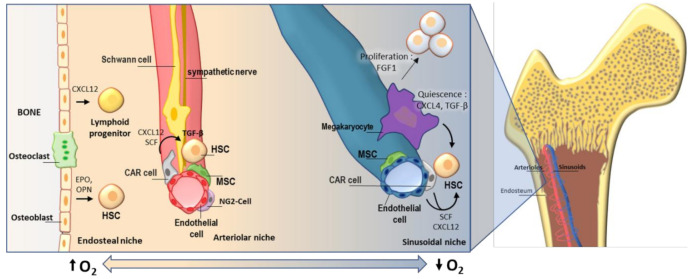
Figure 1
Figure 1
A graphical overview of the bone marrow components and cellular interactions taking place in the bone marrow niche.
Figure 2
Figure 2
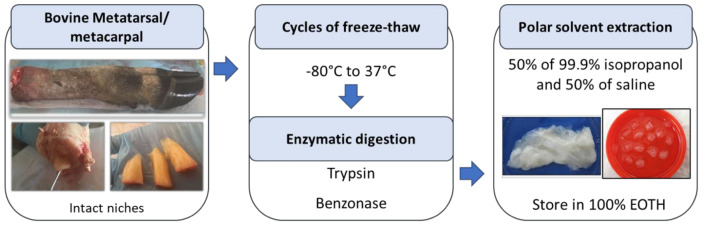
Graphical summary of the decellularization process. More details of the protocol in Bianco et al. [18].
Figure 3
Figure 3
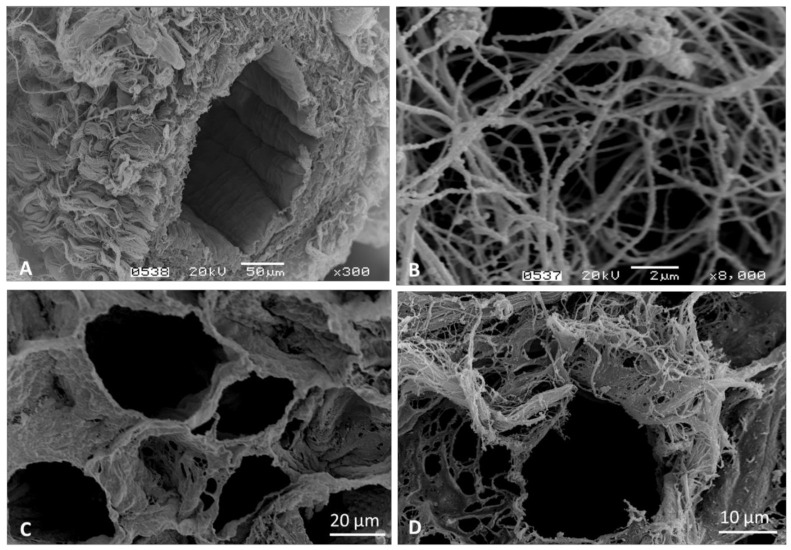
Scanning electron microscopy imaging of the bovine decellularized bone marrow. (A) Intact vascular structure, (B) Reticular fibers in connective tissue, (C) Adipose tissue ECM, preserved cellular niches, (D) Individual cell niche. The images are part of the Hematology and Hemotherapy Center archive of the characterization of the decellularized bone marrow (DeBM) [18]; however, these images have not been published elsewhere.
Figure 4
Figure 4
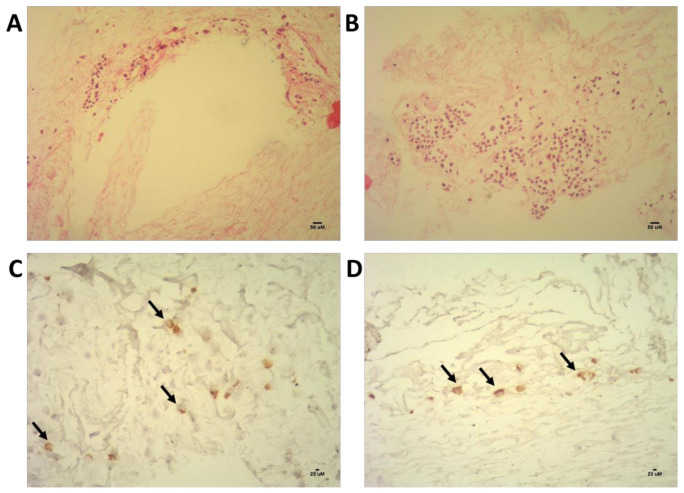
Non-hematopoietic niche cells (CD34 cells) from a human donor adhered to specific regions of the bone marrow niche model and proliferated in the decellularized scaffold (panels A,B). Lower panels (C,D) showed the CD90+ cells (marker of mesenchymal cells). The images are part of recent characterization of the decellularized bone marrow (DeBM) and have not been published elsewhere.

References

    1. Ding L., Morrison S.J. Haematopoietic stem cells and early lymphoid progenitors occupy distinct bone marrow niches. Nature. 2013;495:231–235. doi: 10.1038/nature11885. - DOI - PMC - PubMed
    1. Chen J.Y., Miyanishi M., Wang S.K., Yamazaki S., Kao K.S., Nakauchi H., Weissman I.L. Hoxb5 marks long-term haematopoietic stem cells revealing a homogenous perivascular niche. Nature. 2016;530:223–227. doi: 10.1038/nature16943. - DOI - PMC - PubMed
    1. Kunisaki Y., Bruns I., Scheiermann C., Ahmed J., Pinho S., Zhang D. Arteriolar niches maintain haematopoietic stem cell quiescence. Nature. 2013;502:637–643. doi: 10.1038/nature12612. - DOI - PMC - PubMed
    1. Bruns I., Lucas D., Pinho S., Ahmed J., Lambert M.P., Kunisaki Y., Frenette P.S. Megakaryocytes regulate hematopoietic stem cell quiescence through CXCL4 secretion. Nat. Med. 2014;20:1315–1321. doi: 10.1038/nm.3707. - DOI - PMC - PubMed
    1. Arai F., Hirao A., Ohmura M., Sato H., Matsuoka S., Takubo K., Suda T. Tie2/Angiopoietin-1 Signaling Regulates Hematopoietic Stem Cell Quiescence in the Bone Marrow Niche. Cell. 2004;118:149–161. doi: 10.1016/j.cell.2004.07.004. - DOI - PubMed