


Hormone seasonality in medical records suggests circannual endocrine circuits
- PMID: 33531344
- PMCID: PMC7896322
- DOI: 10.1073/pnas.2003926118
Hormone seasonality in medical records suggests circannual endocrine circuits
Abstract
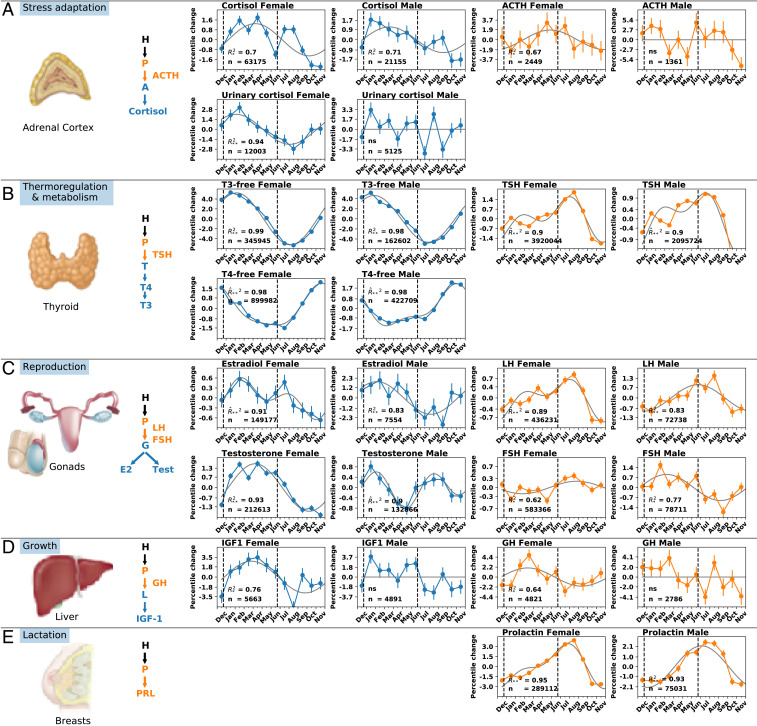
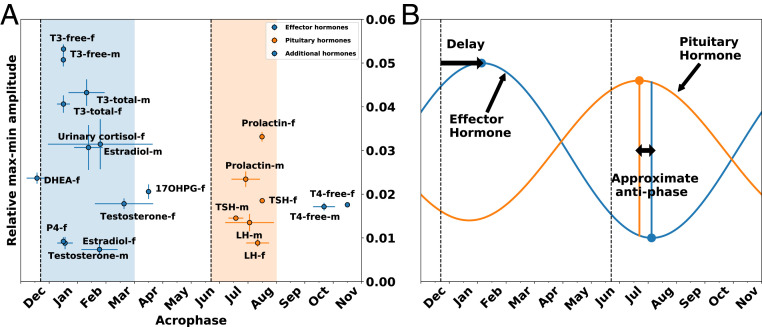
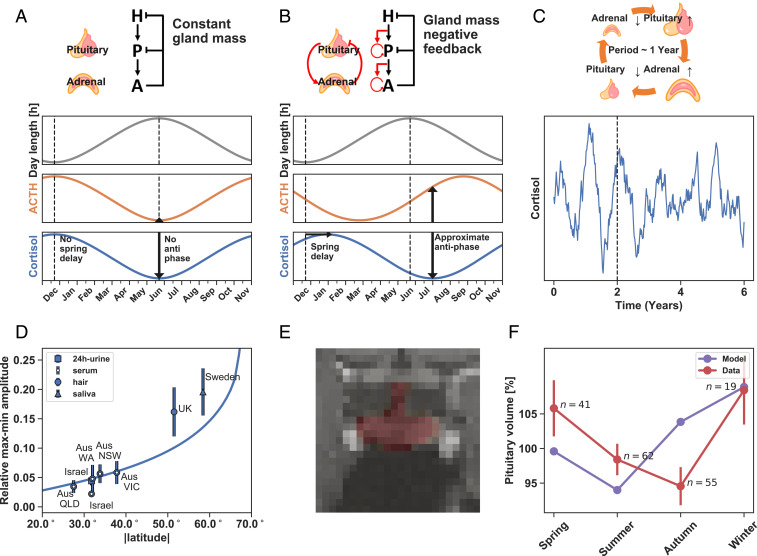
Hormones control the major biological functions of stress response, growth, metabolism, and reproduction. In animals, these hormones show pronounced seasonality, with different set-points for different seasons. In humans, the seasonality of these hormones remains unclear, due to a lack of datasets large enough to discern common patterns and cover all hormones. Here, we analyze an Israeli health record on 46 million person-years, including millions of hormone blood tests. We find clear seasonal patterns: The effector hormones peak in winter-spring, whereas most of their upstream regulating pituitary hormones peak only months later, in summer. This delay of months is unexpected because known delays in the hormone circuits last hours. We explain the precise delays and amplitudes by proposing and testing a mechanism for the circannual clock: The gland masses grow with a timescale of months due to trophic effects of the hormones, generating a feedback circuit with a natural frequency of about a year that can entrain to the seasons. Thus, humans may show coordinated seasonal set-points with a winter-spring peak in the growth, stress, metabolism, and reproduction axes.
Keywords: HPA axis; gonadal axis; growth axis; systems endocrinology; thyroid axis.
Copyright © 2021 the Author(s). Published by PNAS.
Conflict of interest statement
The authors declare no competing interest.
Figures
References
-
- Mrosovsky N., Rheostasis: The Physiology of Change (Oxford University Press, New York, NY, 1990).
-
- Gwinner E., Circannual Rhythms: Endogenous Annual Clocks in the Organization of Seasonal Processes (Zoophysiology, Springer Science & Business Media, 2012), vol. 18.
-
- Jacobs J. D., Wingfield J. C., Endocrine control of life-cycle stages: A constraint on response to the environment? Condor 102, 35–51 (2000).
-
- Dufty A. M. Jr, Clobert J., Møller A. P., “Hormones, developmental plasticity and adaptation. Trends Ecol. Evol. 17, 190–196 (2002).
-
- Zucker I., “Circannual rhythms mammals” in Circadian Clocks , Takahashi J. S., Ed. (Springer, Boston, MA, 2001), pp. 509–528.
Publication types
MeSH terms
Substances
Grants and funding
LinkOut - more resources
Full Text Sources
Other Literature Sources
Medical
