


Clinical implications of serum hepatitis B virus RNA quantitation in untreated chronic hepatitis B virus-infected patients
- PMID: 33532032
- PMCID: PMC7847497
Clinical implications of serum hepatitis B virus RNA quantitation in untreated chronic hepatitis B virus-infected patients
Abstract
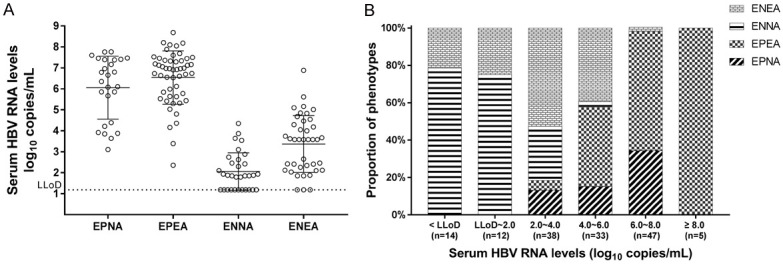
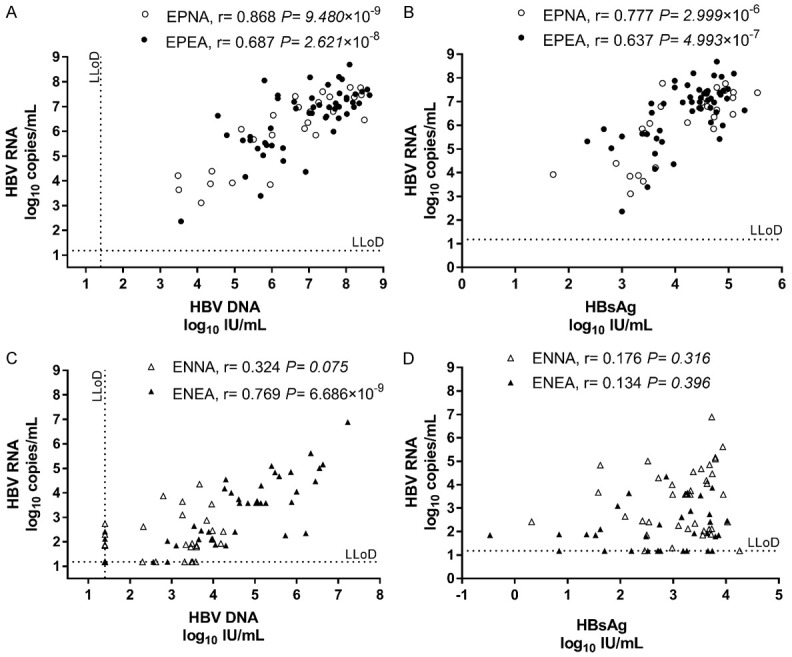
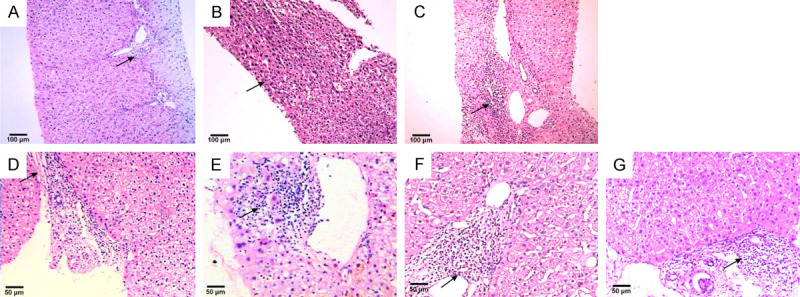
Serum hepatitis B virus (HBV) RNA quantitation may be useful for managing untreated chronic HBV-infected patients, but its distribution characteristics and relationship to HBV DNA are unclear. A retrospective cohort including 149 untreated HBV-infected patients was divided into four clinical phenotypes: hepatitis B envelope antigen (HBeAg) positive with normal alanine transaminase (ALT; EPNA) or with elevated ALT (EPEA), HBeAg-negative with normal ALT (ENNA) or with elevated ALT (ENEA). Serum HBV RNA levels were quantified by a high-sensitivity real-time fluorescent quantitative PCR method and liver biopsy was performed in those with undetectable serum HBV DNA or RNA. The detectable serum HBV RNA levels (log10 copies/mL) in EPNA, EPEA, ENNA, and ENEA were 6.02±1.48, 6.54±1.27, 2.51±0.78 and 3.54±1.25, respectively. The low level (< 2.0 log10 copies/mL) comprised mainly of ENNA phenotype (76.9%), while the high level (> 6.0 log10 copies/mL) was HBeAg-positive patients (98.1%). Serum HBV RNA level were significantly correlated with serum HBV DNA and HBsAg in HBeAg-positive phenotypes, but a correlation only with HBV DNA was observed in ENEA patients. Serum HBV DNA and RNA were both independent risk factors associated with elevated ALT in HBeAg-negative patients. Seven serum HBV DNA-undetectable but RNA-detectable patients underwent liver biopsy, showing moderate or severe liver inflammation. Varying serum HBV RNA levels can reflect natural disease phases in untreated HBV-infected patients, indicating that this biomarker could reflect liver inflammation in untreated HBeAg-negative patients as successfully as serum HBV DNA. Serum HBV RNA can complement clinical management strategies when serum HBV DNA is undetectable.
Keywords: HBV RNA; HBeAg negative; antiviral initiation; liver inflammation; untreated.
IJCEP Copyright © 2021.
Conflict of interest statement
None.
Figures
References
-
- Schweitzer A, Horn J, Mikolajczyk RT, Krause G, Ott JJ. Estimations of worldwide prevalence of chronic hepatitis B virus infection: a systematic review of data published between 1965 and 2013. Lancet. 2015;386:1546–1555. - PubMed
-
- Maini MK, Gehring AJ. The role of innate immunity in the immunopathology and treatment of HBV infection. J Hepatol. 2016;64:S60–S70. - PubMed
-
- Chu CM, Liaw YF. Hepatitis B surface antigen seroclearance during chronic HBV infection. Antivir Ther. 2010;15:133–143. - PubMed
-
- Lai CL, Wong D, Ip P, Kopaniszen M, Seto WK, Fung J, Huang FY, Lee B, Cullaro G, Chong CK, Wu R, Cheng C, Yuen J, Ngai V, Yuen MF. Reduction of covalently closed circular DNA with long-term nucleos(t)ide analogue treatment in chronic hepatitis B. J Hepatol. 2017;66:275–281. - PubMed
-
- Werle-Lapostolle B, Bowden S, Locarnini S, Wursthorn K, Petersen J, Lau G, Trepo C, Marcellin P, Goodman Z, Delaney WE 4th, Xiong S, Brosgart CL, Chen SS, Gibbs CS, Zoulim F. Persistence of cccDNA during the natural history of chronic hepatitis B and decline during adefovir dipivoxil therapy. Gastroenterology. 2004;126:1750–1758. - PubMed
LinkOut - more resources
Full Text Sources