


Clinical Features and Outcomes of Neuropsychiatric Systemic Lupus Erythematosus in China
- PMID: 33532504
- PMCID: PMC7834780
- DOI: 10.1155/2021/1349042
Clinical Features and Outcomes of Neuropsychiatric Systemic Lupus Erythematosus in China
Abstract
Objective: To identify the clinical characteristics, magnetic resonance imaging (MRI) results, and prognostic factors of neuropsychiatric (NP) systemic lupus erythematosus (SLE; NPSLE) in a relatively large patient series in China.
Methods: Data of patients with NPSLE at Peking Union Medical College Hospital (PUMCH) were collected retrospectively from June 2012 to June 2016. NPSLE patients were compared with 220 non-NPSLE patients. Survival rates were evaluated using the Kaplan-Meier curves, log-rank test, and Cox proportional hazards modeling. Cranial MRI results were also studied.
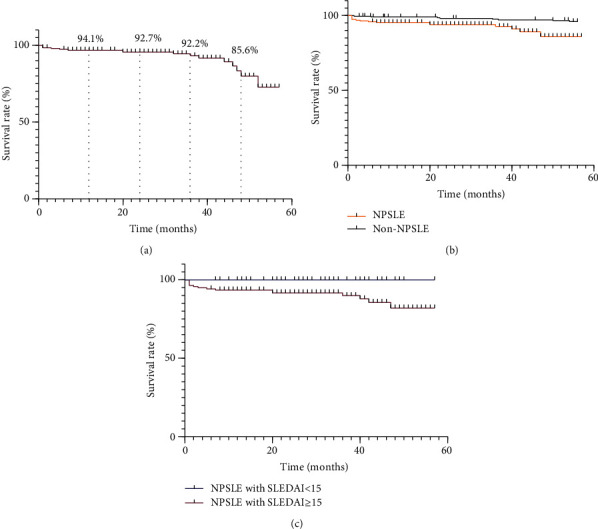
Results: Of the 194 included patients, sixteen subtypes of NPSLE were identified, and the most common manifestations were seizure (36.6%), acute confusional state (25.3%), and cerebral vascular disease (15.5%). Compared with the non-NPSLE group, NPSLE patients were significantly more likely to have typical lupus symptoms, higher Systemic Lupus Erythematosus Disease Activity Index 2000 (SLEDAI-2K) scores (P = 0.002), and positive rate of anti-ribosomal P protein antibodies (P = 0.008). Patients with seizure were more likely to have higher SLEDAI-2K scores and positive anti-β2GP1 than non-NPSLE patients. Sixteen patients died during follow-up. The most common cause of death was infection (37.5%). NPSLE significantly decreased survival rates of SLE patients. Patients with elevated serum creatinine (P = 0.001), hypocomplementemia (P = 0.031), and SLEDAI - 2K scores ≥ 15 (P = 0.014) had shorter survival periods. Eighty-two patients underwent detailed cranial MRI analysis; of these, 50 (61.0%) had abnormal results. Small vessel disease was the most common abnormal finding, followed by inflammatory-like lesions and large vessel disease.
Conclusions: High disease activity and positive rate of anti-ribosomal P protein antibodies may be risk factors for NPSLE. NPSLE decreases survival rates of SLE patients. Renal insufficiency and high disease activity are predictive of poor prognoses for NPSLE patients.
Copyright © 2021 Shangzhu Zhang et al.
Conflict of interest statement
The authors declare that there is no conflict of interest.
Figures
References
MeSH terms
Substances
LinkOut - more resources
Full Text Sources
Other Literature Sources
Miscellaneous
