Identification of Coronaviruses, Paramyxoviruses, Reoviruses, and Rotaviruses among Bats in Nigeria
- PMID: 33534762
- PMCID: PMC7941819
- DOI: 10.4269/ajtmh.19-0872
Identification of Coronaviruses, Paramyxoviruses, Reoviruses, and Rotaviruses among Bats in Nigeria
Abstract
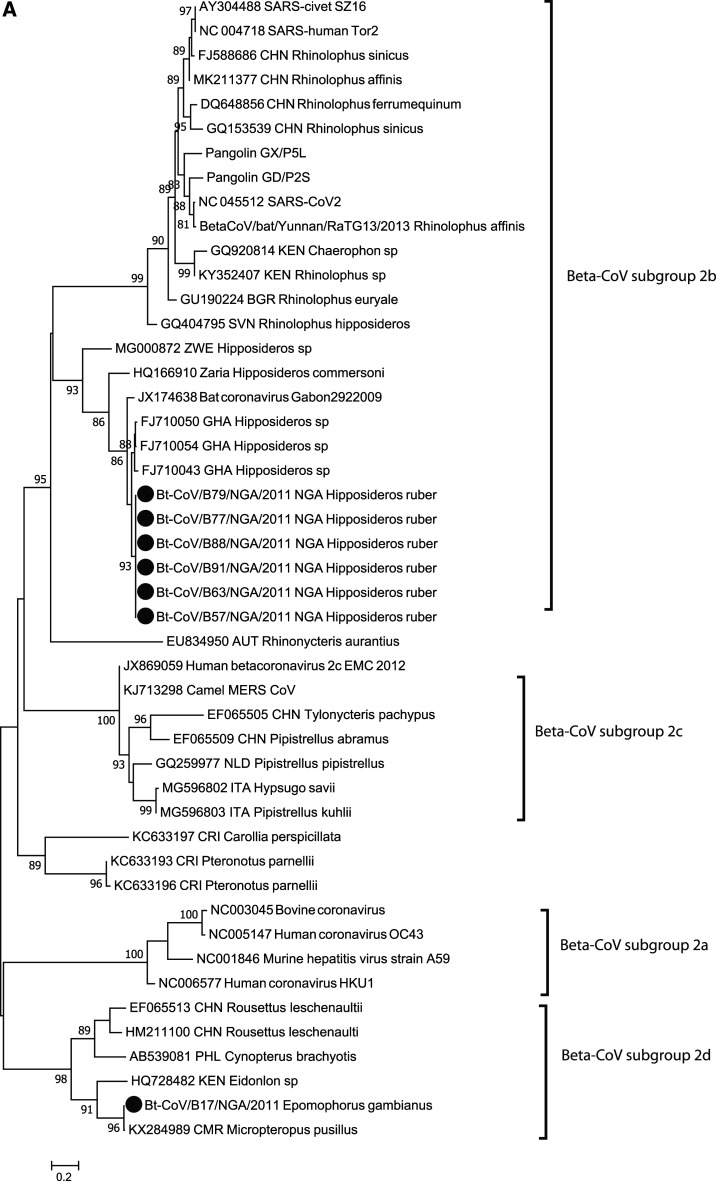
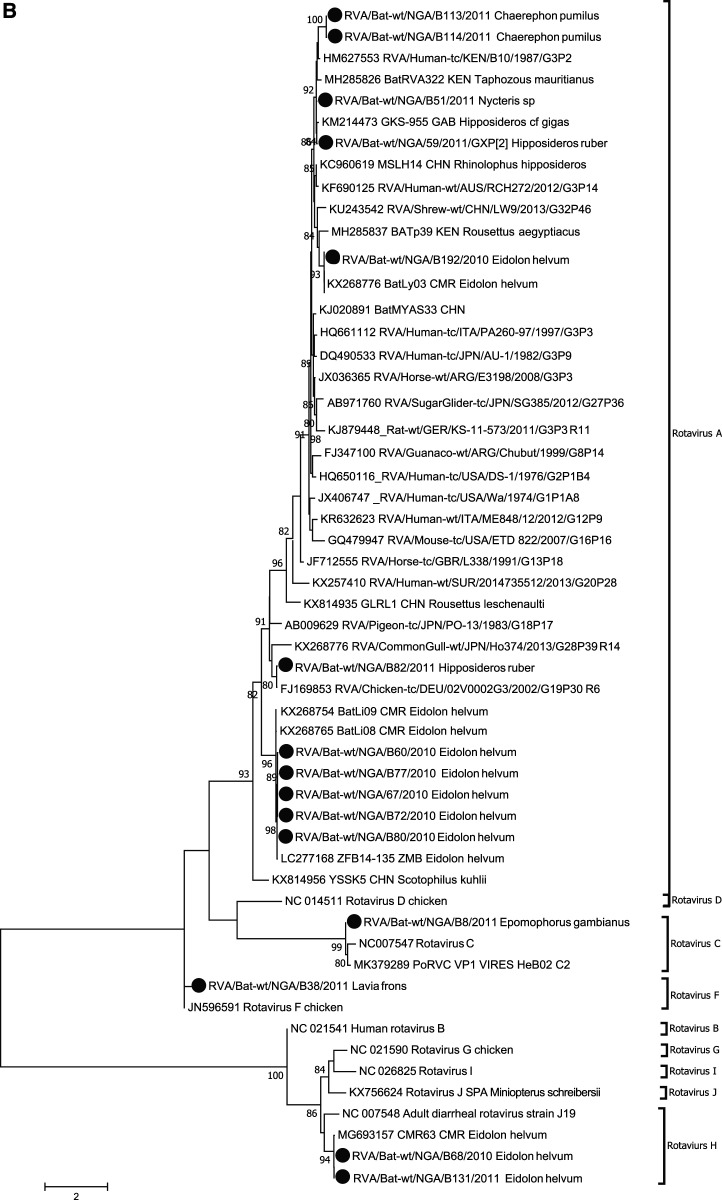
Bats are often consumed by some ethnic groups in Nigeria despite association of bats with many important emerging viruses. More than 300 bats representing eight species were captured during 2010-2011 in eight locations of northern Nigeria. Available fecal swabs (n = 95) were screened for the presence of arenaviruses, CoVs, paramyxoviruses (PMVs), reoviruses, rhabdoviruses, and influenza viruses using generic reverse transcription-polymerase chain reaction assays. Here, we document the detection of CoVs, PMVs, reoviruses, and rotaviruses (RVs) in Nigerian bats. The Nigerian bat CoVs are grouped within other bat SARS-CoV-like viruses identified from Ghana in a sister clade next to the human SARS-CoV clade. The phylogenetic analysis indicated a broad range of RVs present in Nigerian bats, some cluster with human RVs and some represent novel species. Our study adds that continuing global surveillance for viruses in bats to understand their origin, adaptation, and evolution is important to prevent and control future zoonotic disease outbreaks.
Conflict of interest statement
Financial support: The study was supported in part by the Tertiary Education Trust Fund TETF/DESS/AST&D/UNIV/ABU/ZARIA/VOL.2 (G. S. N. K.) and Science and Technology Education Post Basic (STEP-B) Project, Innovators of Tomorrow Grants HME STEP-B/IOT/33/Vol.1/22 (G. S. N. K.).
Disclaimers: The opinions expressed by authors contributing to this journal do not necessarily reflect the opinions of the Centers for Disease Control and Prevention or the institutions with which the authors are affiliated.
Figures
References
-
- Happold D, 1987. Bats. The Mammals of Nigeria. Oxford, United Kingdom: Clarendon, Oxford University Press, 34–82.
-
- Kia GSN, Kuzmin IV, Umoh JU, Kwaga JK, Kazeem HM, Osinubi MO, Rupprecht CE, 2014. Detection of some lyssaviruses from fruigivorous and insectivorous bats in Nigeria. Online J Public Health Inform 6: e31.
MeSH terms
LinkOut - more resources
Full Text Sources
Other Literature Sources
Medical
Miscellaneous