


Mental health and psychosocial support strategies in highly contagious emerging disease outbreaks of substantial public concern: A systematic scoping review
- PMID: 33534786
- PMCID: PMC7857635
- DOI: 10.1371/journal.pone.0244748
Mental health and psychosocial support strategies in highly contagious emerging disease outbreaks of substantial public concern: A systematic scoping review
Abstract
Background: Acute disease outbreaks such as the COVID-19 pandemic cause a high burden of psychological distress in people worldwide. Interventions to enable people to better cope with such distress should be based on the best available evidence. We therefore performed a scoping review to systematically identify and summarize the available literature of interventions that target the distress of people in the face of highly contagious disease outbreaks.
Methods: MEDLINE, Cochrane CENTRAL, Web of Science (January 2000 to May 7, 2020), and reference lists were systematically searched and screened by two independent reviewers. Quantitative and qualitative studies investigating the effects of psychological interventions before, during, and after outbreaks of highly contagious emerging infectious diseases, such as SARS, MERS, Ebola, or COVID-19 were included. Study effects were grouped (e.g. for healthcare professionals, community members, people at risk) and intervention contents at the individual and organizational level summarized. We assessed the level of evidence using a modified scheme from the Oxford Centre for Evidence-based Medicine and the Australian National Health and Medical Research Council.
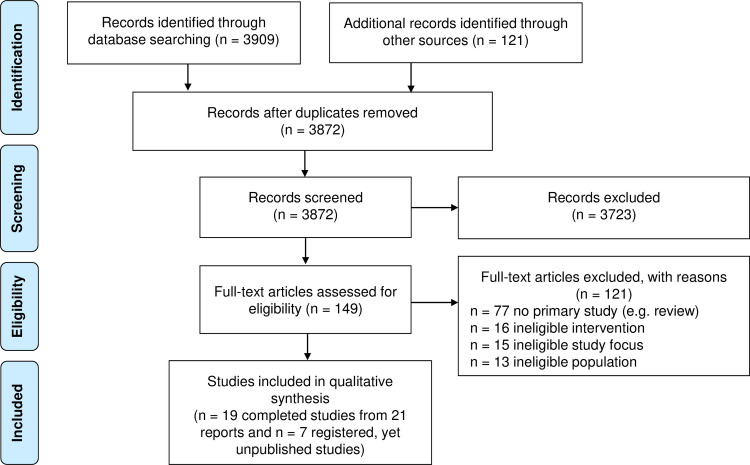
Results: Of 4030 records found, 19 studies were included (two RCTs). Most interventions were delivered during-exposure and face-to-face, focused on healthcare workers and crisis personnel, and combined psychoeducation with training of coping strategies. Based on two high-quality studies, beneficial effects were reported for resilience factors (e.g. positive cognitive appraisal) and professional attitudes of healthcare workers, with mixed findings for mental health (e.g. depression). Across all studies, there was positive qualitative feedback from participants and facilitators. We identified seven ongoing studies mostly using online- and mobile-based deliveries.
Conclusions: There is preliminary evidence for beneficial effects of interventions to enable people to better cope with the distress of highly contagious emerging disease outbreaks. Besides the need for more high-quality studies, the summarized evidence may inform decision makers to plan interventions during the current pandemic and to develop pandemic preparedness plans.
Conflict of interest statement
AMK, MS, ALM, MB, and SL have no conflicts of interest. DG is in training as a board-certified cognitive-behavior (CB) therapist. JSW and IH are board-certified CB therapists. FH is board-certified in medical microbiology and virology and a specialist in tropical medicine (DTM&H) with a special interest in POCT-based rapid viral diagnostics. KL is a board-certified CB therapist with a special interest in schema therapy; he is also an Editor with the Cochrane Developmental, Psychosocial and Learning Problems Group. This does not alter our adherence to PLOS ONE policies on sharing data and materials.
Figures
References
-
- Dai Y, Hu G, Xiong H, Qiu H, Yuan X. Psychological impact of the coronavirus disease 2019 (COVID-19) outbreak on healthcare workers in China. medrxiv: 2020.03.03.20030874 [Preprint]. 2020. [posted 2020 March 6]. Available from: https://www.medrxiv.org/content/10.1101/2020.03.03.20030874v1 - DOI
Publication types
MeSH terms
LinkOut - more resources
Full Text Sources
Other Literature Sources
Medical
Miscellaneous
