. 2021 Feb 2;34(5):108707.
doi: 10.1016/j.celrep.2021.108707.

Whole-genome characterization of lung adenocarcinomas lacking the RTK/RAS/RAF pathway

Collaborators, Affiliations

Whole-genome characterization of lung adenocarcinomas lacking the RTK/RAS/RAF pathway

Jian Carrot-Zhang et al. Cell Rep. .

Erratum in

  • Whole-genome characterization of lung adenocarcinomas lacking alterations in the RTK/RAS/RAF pathway.
    Carrot-Zhang J, Yao X, Devarakonda S, Deshpande A, Damrauer JS, Silva TC, Wong CK, Choi HY, Felau I, Robertson AG, Castro MAA, Bao L, Rheinbay E, Liu EM, Trieu T, Haan D, Yau C, Hinoue T, Liu Y, Shapira O, Kumar K, Mungall KL, Zhang H, June-Koo Lee J, Berger A, Gao GF, Zhitomirsky B, Liang WW, Zhou M, Moorthi S, Berger AH, Collisson EA, Zody MC, Ding L, Cherniack AD, Getz G, Elemento O, Benz CC, Stuart J, Zenklusen JC, Beroukhim R, Chang JC, Campbell JD, Hayes DN, Yang L, Laird PW, Weinstein JN, Kwiatkowski DJ, Tsao MS, Travis WD, Khurana E, Berman BP, Hoadley KA, Robine N; TCGA Research Network; Meyerson M, Govindan R, Imielinski M. Carrot-Zhang J, et al. Cell Rep. 2021 Feb 23;34(8):108784. doi: 10.1016/j.celrep.2021.108784. Cell Rep. 2021. PMID: 33626341 Free PMC article. No abstract available.

Abstract

RTK/RAS/RAF pathway alterations (RPAs) are a hallmark of lung adenocarcinoma (LUAD). In this study, we use whole-genome sequencing (WGS) of 85 cases found to be RPA(-) by previous studies from The Cancer Genome Atlas (TCGA) to characterize the minority of LUADs lacking apparent alterations in this pathway. We show that WGS analysis uncovers RPA(+) in 28 (33%) of the 85 samples. Among the remaining 57 cases, we observe focal deletions targeting the promoter or transcription start site of STK11 (n = 7) or KEAP1 (n = 3), and promoter mutations associated with the increased expression of ILF2 (n = 6). We also identify complex structural variations associated with high-level copy number amplifications. Moreover, an enrichment of focal deletions is found in TP53 mutant cases. Our results indicate that RPA(-) cases demonstrate tumor suppressor deletions and genome instability, but lack unique or recurrent genetic lesions compensating for the lack of RPAs. Larger WGS studies of RPA(-) cases are required to understand this important LUAD subset.

Keywords: TCGA; driver; genome analysis; lung adenocarcinoma; noncoding; oncogene; precision oncology; structural variation; tumor suppressor; whole genome sequencing.


Conflict of interest statement

Declaration of interests M.M. is listed as the inventor on the patent for the EGFR mutation analysis for lung cancer diagnosis licensed to LabCorp; holds research support from Bayer, Janssen, and Ono; and serves as scientific advisory board chair for OrigiMed. P.W.L. serves on the scientific advisory boards of AnchorDx and Progenity. D.J.K. has research support from Revolution Medicines and Genentech and is a consultant to AADi.

Figures
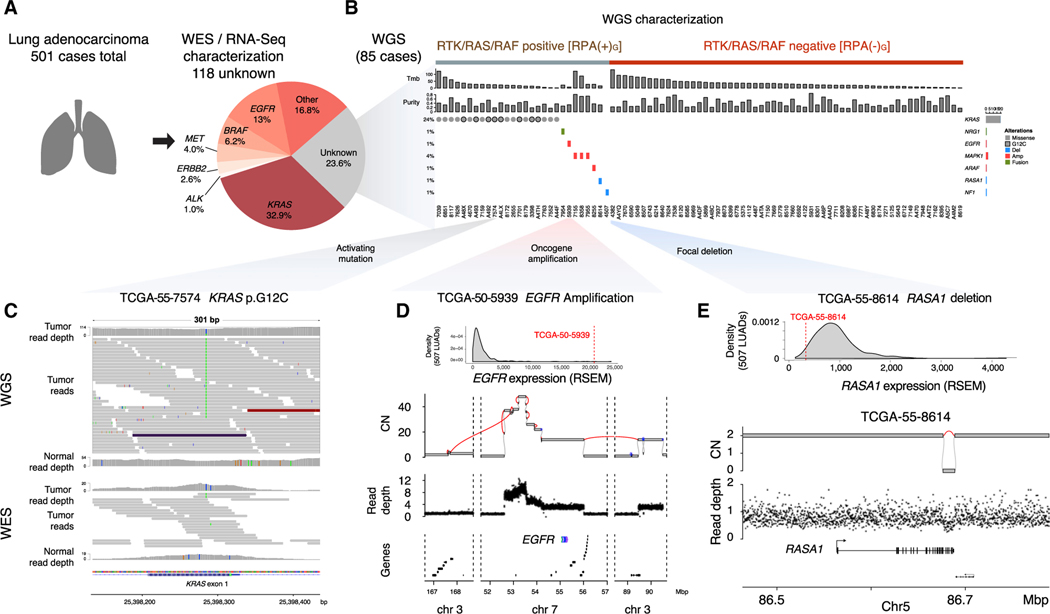
Figure 1.
Figure 1.. Identification of RPA(–) LUADs
(A) Identification of 118 RPA(–)E LUAD cases from the 501 TCGA LUAD cohort, defined by WES or RNA-seq analysis. Eighty-five of the 118 samples were sent for WGS. The RTK/RAS/RAF pathway alterations used to define the RPA(+) or RPA(–) cases are listed in Table S1. (B) WGS uncovered genomic alterations in the RTK/RAS/RAF pathway in 28/85 samples; 57/85 samples remain as RPA(–) after WGS analysis. (C) Visualization of sequencing reads covering a KRAS p.G12C mutation in WGS (upper panel) and WES (lower panel) for sample (TCGA-55–7574). Both read depth and the number of reads supporting the mutation are higher in WGS than in WES. (D) An example of EGFR amplification coupled with EGFR overexpression in TCGA-50–5939. In the second panel, purity-adjusted copy number and SV junctions (red lines) support a BFBC event underlying the amplification. Lower panels indicate WGS read depth and gene location in the region. CN, copy number. (E) Example of a RASA1 simple deletion spanning from exon 21 to the end of the gene (12 kbp) coupled with RASA1 loss of expression in TCGA-55–8614. See also Figure S1.
Figure 2.
Figure 2.. Recurrent coding alterations in RPA(–)G LUADs
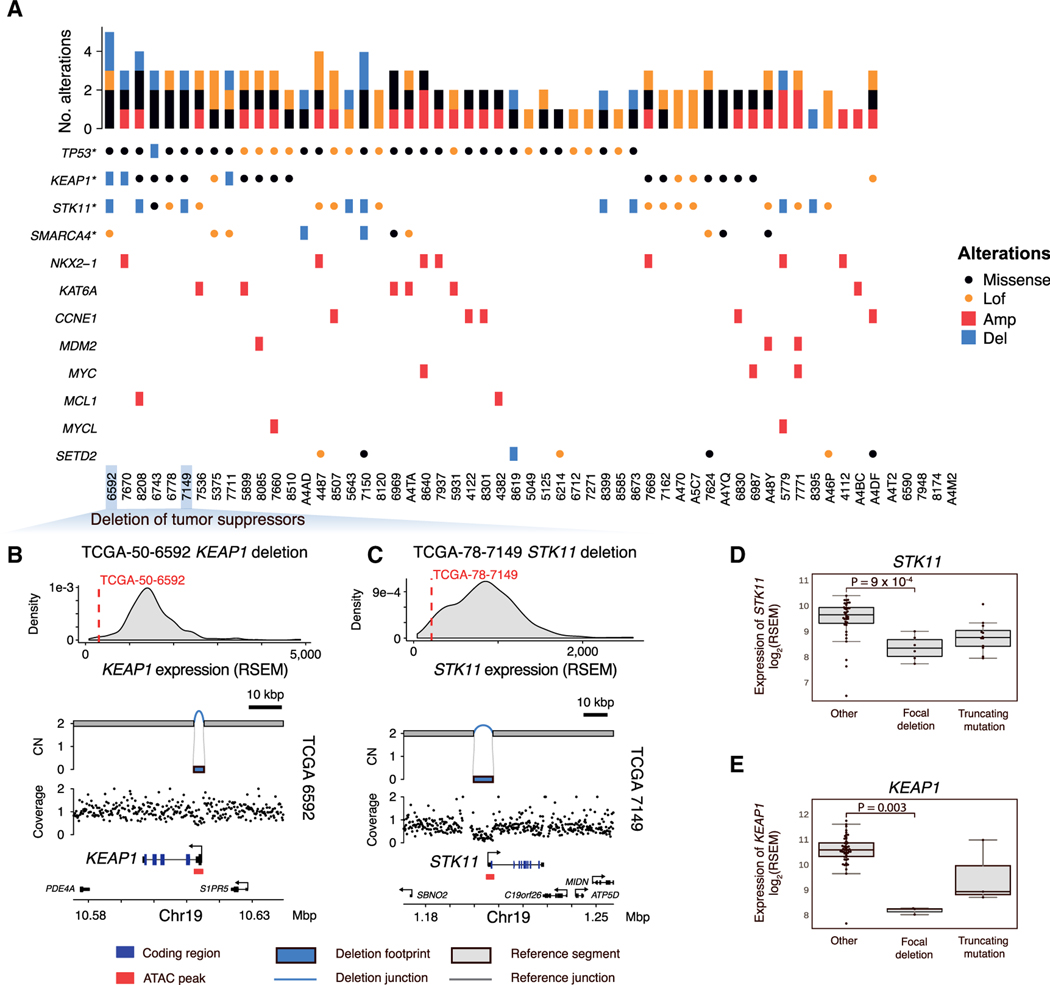
(A) Overview of genomic alterations in 57 RPA(–)G LUADs. Genes significantly mutated (*) or significantly amplified/deleted in the RPA(–)G samples are listed. (B and C) Example of KEAP1 (3 kbp length) (B) and (C) STK11 (8 kbp length) simple, homozygous deletion (CN = 0), resulting in loss of expression. The distribution of the KEAP1 or STK11 expression is plotted based on the full TCGA LUAD cohort. (D) Expression comparison of samples with loss-of-function alterations in STK11 and (E) KEAP1 to other RPA(–)G LUAD samples. p values are calculated from Mann-Whitney U tests. Boxplots show median, interquartile range, and 1.5 times the interquartile range. See also Figure S1.
Figure 3.
Figure 3.. Identification of ILF2 promoter mutations in RPA(–)G LUADs
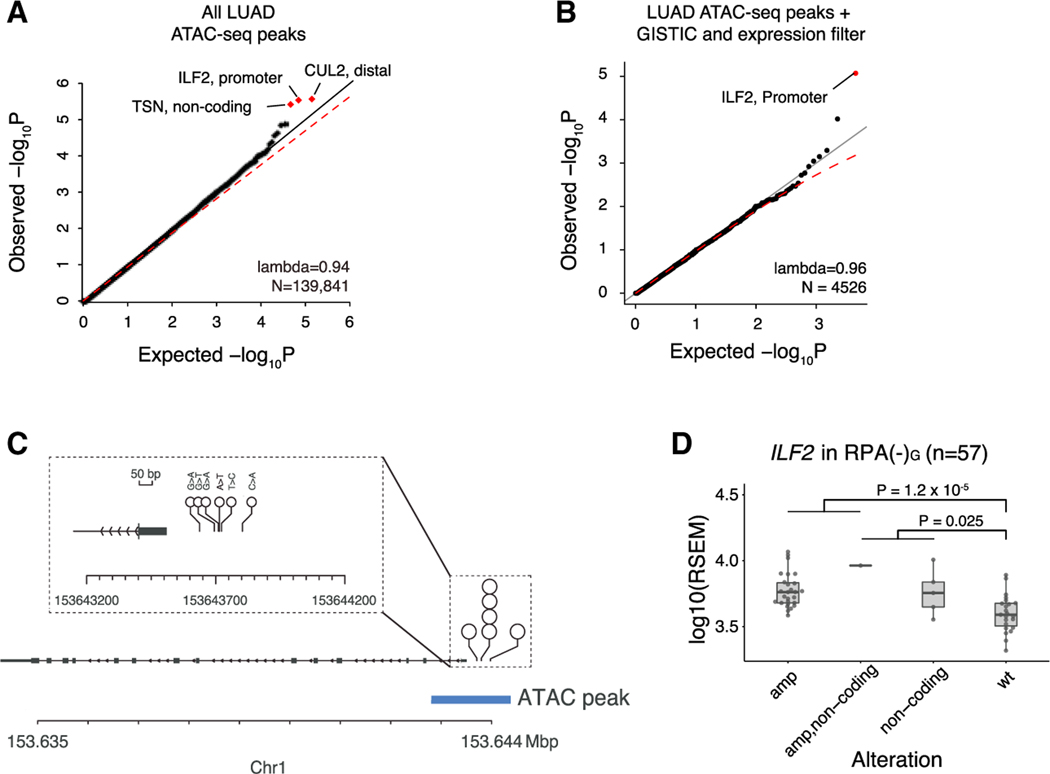
(A) Three genes with non-coding mutations nominated through recurrence analysis across LUAD-related ATAC peaks (left). Red dots indicate loci with FDR < 0.25. (B) Same as (A), but restricted to ATAC-seq peaks in genes with RSEM ≥ 10 across TCGA LUAD and recurrently amplified in RPA(–)G samples. Red dots indicate FDR < 0.1. (C) Among 57 RPA(–)G samples, 6 SNVs are observed in the promoter region of ILF2; all are located within ATAC-seq peaks. (D) Expression comparison of RPA(–)G samples with ILF2 promoter mutations and amplifications. p values are calculated from linear regression analysis correlating expression, adjusting for the local copy number of ILF2 and purity. Boxplot shows median, interquartile range, and 1.5 times the interquartile range. See also Figure S3.
Figure 4.
Figure 4.. Classification of SVs in RPA(–)G LUADs
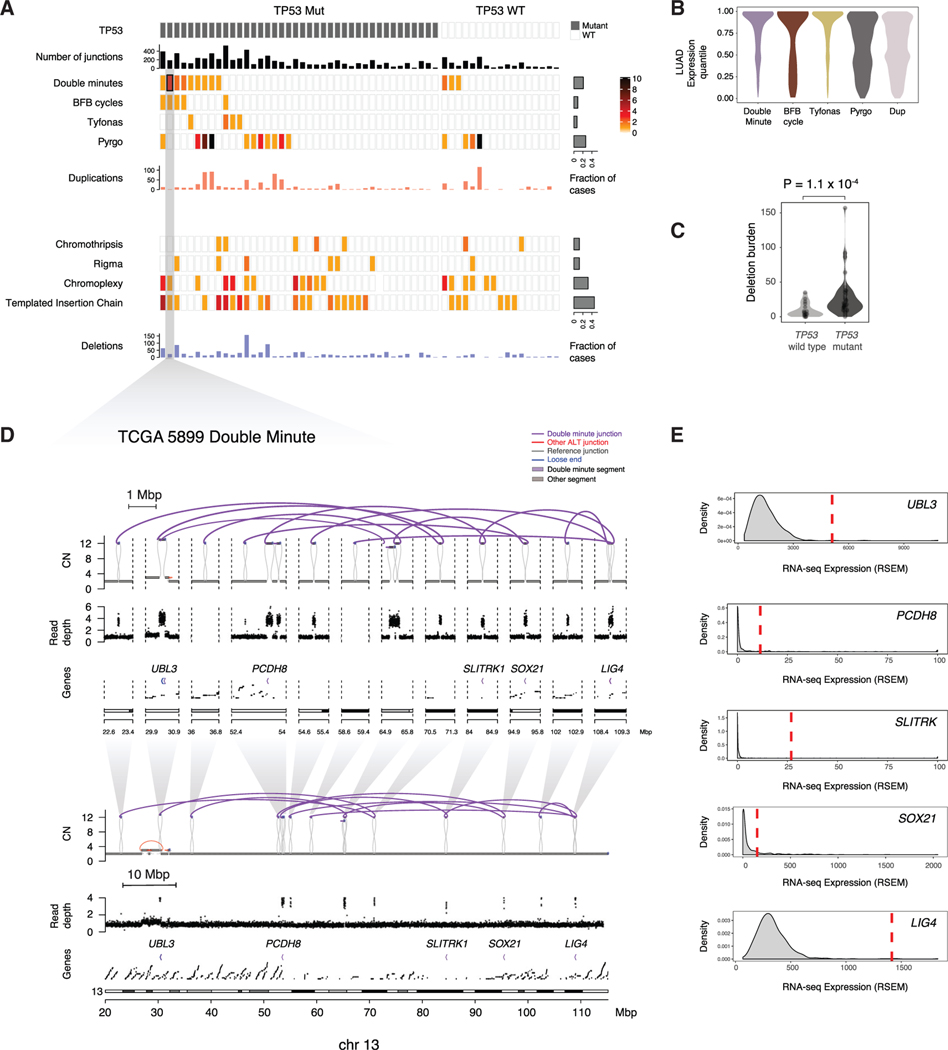
(A) Identification of simple and complex SV events. Upper panel: SVs resulting in copy-number gain (double minute, BFBC, tyfonas, pyrgo, simple duplication). Lower panel: SVs resulting in copy-number loss (chromothripsis, rigma, chromoplexy, templated insertion chain, simple deletion). Key indicates the range of event count of SV types observed in each sample. (B) Expression quantile of genes located in SV types with copy-number gain. (C) Simple deletion count is more significantly enriched in the TP53 mutant RPA(–)G samples than in the TP53-wild-type RPA(–)G samples. p value is obtained from Mann-Whitney U test. Violin plots reflect kernel density estimations. (D and E) Example of a double minute in TCGA-55–5899 spanning 3 genes (D), and (E) 2 of which (UBL3 and LIG4) showed marked overexpression relative to RNA-seq data for the full TCGA LUAD cohort. See also Figure S4.

References

    1. Arbour KC, Jordan E, Kim HR, Dienstag J, Yu HA, Sanchez-Vega F, Lito P, Berger M, Solit DB, Hellmann M, et al. (2018). Effects of Co-occurring Genomic Alterations on Outcomes in Patients with KRAS-Mutant Non-Small Cell Lung Cancer. Clin. Cancer Res. 24, 334–340. - PMC - PubMed
    1. Auton A, Brooks LD, Durbin RM, Garrison EP, Kang HM, Korbel JO, Marchini JL, McCarthy S, McVean GA, and Abecasis GR; 1000 Genomes Project Consortium (2015). A global reference for human genetic variation. Nature 526, 68–74. - PMC - PubMed
    1. Cai D, Choi PS, Gelbard M, and Meyerson M. (2019). Identification and Characterization of Oncogenic SOS1 Mutations in Lung Adenocarcinoma. Mol. Cancer Res. 17, 1002–1012. - PMC - PubMed
    1. Campbell JD, Alexandrov A, Kim J, Wala J, Berger AH, Pedamallu CS, Shukla SA, Guo G, Brooks AN, Murray BA, et al.; Cancer Genome Atlas Research Network (2016). Distinct patterns of somatic genome alterations in lung adenocarcinomas and squamous cell carcinomas. Nat. Genet. 48, 607–616. - PMC - PubMed
    1. Cancer Genome Atlas Research Network (2014). Comprehensive molecular profiling of lung adenocarcinoma. Nature 511, 543–550. - PMC - PubMed

Publication types

MeSH terms