


Association between Physical Activity and Fundamental Movement Skills in Preschool-Aged Children: Does Perceived Movement Skill Competence Mediate This Relationship?
- PMID: 33535462
- PMCID: PMC7908079
- DOI: 10.3390/ijerph18031289
Association between Physical Activity and Fundamental Movement Skills in Preschool-Aged Children: Does Perceived Movement Skill Competence Mediate This Relationship?
Abstract
Objectives: The purpose of this research is to examine whether perceived fundamental movement skills (FMS) competence mediated the relationship between actual FMS and physical activity (PA) in Hong Kong preschool-aged children.
Design: A cross-sectional study.
Methods: 148 preschool-aged children (43% girls; mean age = 4.52 ± 0.67 years) from five preschools/childcare centres completed all assessments. Actual FMS was rated using the Test of Gross Motor Development-2, whilst perceived FMS was assessed via the Pictorial Scale for Perceived Movement Skill Competence. PA was measured through accelerometry. A bootstrap method was used to assess the potential mediating effect of perceived movement skill competence on the relationship between actual FMS and PA. All mediation models were adjusted for sex and age.
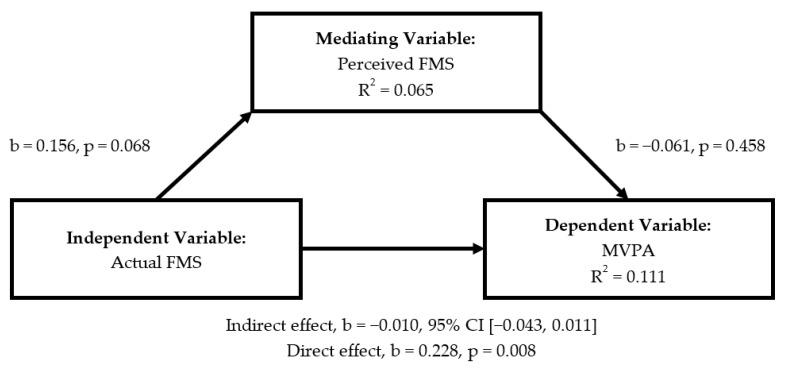
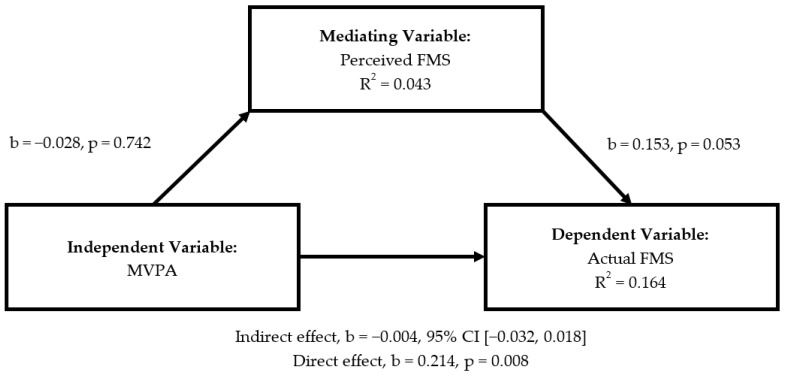
Results: Mediation analyses showed that the direct path between actual FMS and moderate-to-vigorous physical activity (MVPA) was significant (b = 0.228, p = 0.008), as was the path between MVPA and actual FMS (b = 0.214, p = 0.008). However, perceived FMS competence did not mediate the association between actual FMS and MVPA in the models.
Conclusions: Our results showed evidence of reciprocal pathways between actual FMS and MVPA, reinforcing the need to simultaneously target both domains as part of broader developmental strategies, initiated in early childhood. Unlike emergent adolescence, perceptions of movement skill competence do not play a significant role in influencing the relationship between actual FMS proficiency and MVPA in this developmental period.
Keywords: accelerometry; early childhood; fundamental movement skills; perceived movement skill competence; physical activity.
Conflict of interest statement
The authors declare no conflict of interest.
Figures
References
-
- Carson V., Lee E.Y., Hewitt L., Jennings C., Hunter S., Kuzik N., Stearns J.A., Unrau S.P., Poitras V.J., Gray S., et al. Systematic review of the relationships between physical activity and health indicators in the early years (0-4 years) BMC Public Health. 2017;17:854. doi: 10.1186/s12889-017-4860-0. - DOI - PMC - PubMed
-
- Community Sports Committee of the Sports Commission The Government of the Hong Kong Special Administrative Region. Healthy Exercise for All Campaign-Physical Fitness Test for the Community. [(accessed on 18 February 2013)]; Available online: https://www.lcsd.gov.hk/en/healthy/physical_fitness_test/common/physical....
-
- Stodden D.F., Goodway J.D., Langendorfer S.J., Roberton M.A., Rudisill M.E., Garcia C., Garcia L.E. A developmental perspective on the role of motor skill competence in physical activity: An emergent relationship. Quest. 2008;60:290–306. doi: 10.1080/00336297.2008.10483582. - DOI
Publication types
MeSH terms
LinkOut - more resources
Full Text Sources
Other Literature Sources
Medical
Miscellaneous
