. 2021 Feb 1;10(2):146.
doi: 10.3390/pathogens10020146.

Interspecies Metabolic Complementation in Cystic Fibrosis Pathogens via Purine Exchange

Affiliations

Interspecies Metabolic Complementation in Cystic Fibrosis Pathogens via Purine Exchange

Hafij Al Mahmud et al. Pathogens. .

Abstract

Cystic fibrosis (CF) is a genetic disease frequently associated with chronic lung infections caused by a consortium of pathogens. It is common for auxotrophy (the inability to biosynthesize certain essential metabolites) to develop in clinical isolates of the dominant CF pathogen Pseudomonas aeruginosa, indicating that the CF lung environment is replete in various nutrients. Many of these nutrients are likely to come from the host tissues, but some may come from the surrounding polymicrobial community within the lungs of CF patients as well. To assess the feasibility of nutrient exchange within the polymicrobial community of the CF lung, we selected P. aeruginosa and Staphylococcus aureus, two of the most prevalent species found in the CF lung environment. By comparing the polymicrobial culture of wild-type strains relative to their purine auxotrophic counterparts, we were able to observe metabolic complementation occurring in both P. aeruginosa and S. aureus when grown with a purine-producing cross-species pair. While our data indicate that some of this complementation is likely derived from extracellular DNA freed by lysis of S. aureus by the highly competitive P. aeruginosa, the partial complementation of S. aureus purine deficiency by P. aeruginosa demonstrates that bidirectional nutrient exchange between these classic competitors is possible.

Keywords: Pseudomonas aeruginosa; Staphylococcus aureus; auxotrophy; cross feeding; cystic fibrosis infection; polymicrobial interactions; purine.


Conflict of interest statement

The authors declare no conflict of interest.

Figures
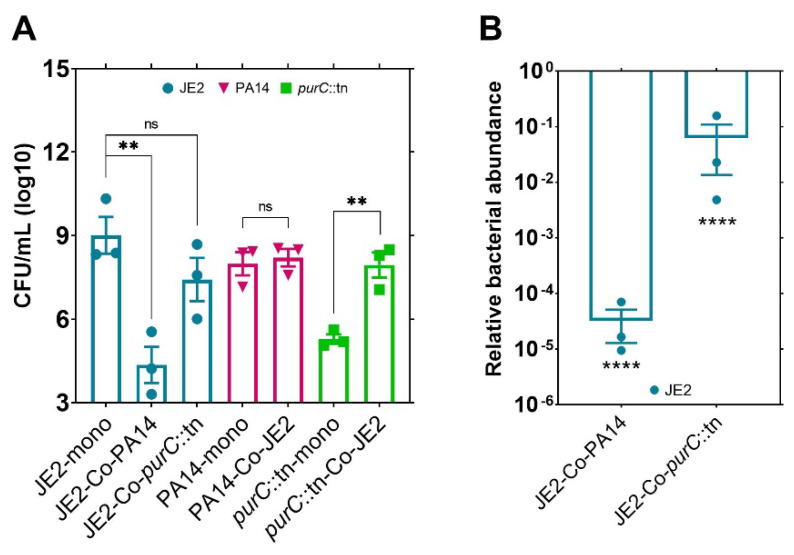
Figure 1
Figure 1
Growth of a purine-deficient mutant of P. aeruginosa can be rescued in the presence of S. aureus. (A) Purine complementation in purine-deficient mutant (purC::tn) of P. aeruginosa by an expected/a probable purine-producing strain of S. aureus (JE2) in co-culture. (B) Relative bacterial abundance of JE2 in co-culture with PA14 or purC::tn mutant strain of P. aeruginosa compared to JE2 monoculture. Error bars represent SEM of data derived from three biological replicates on different days, and experiments were performed in technical triplicates each day. Here, ‘’**’’ designates p < 0.005, ‘’****’’ designates p < 0.0001 as depicted by two-tailed unpaired Student’s t-test, and ns denotes not significant (p > 0.05).
Figure 2
Figure 2
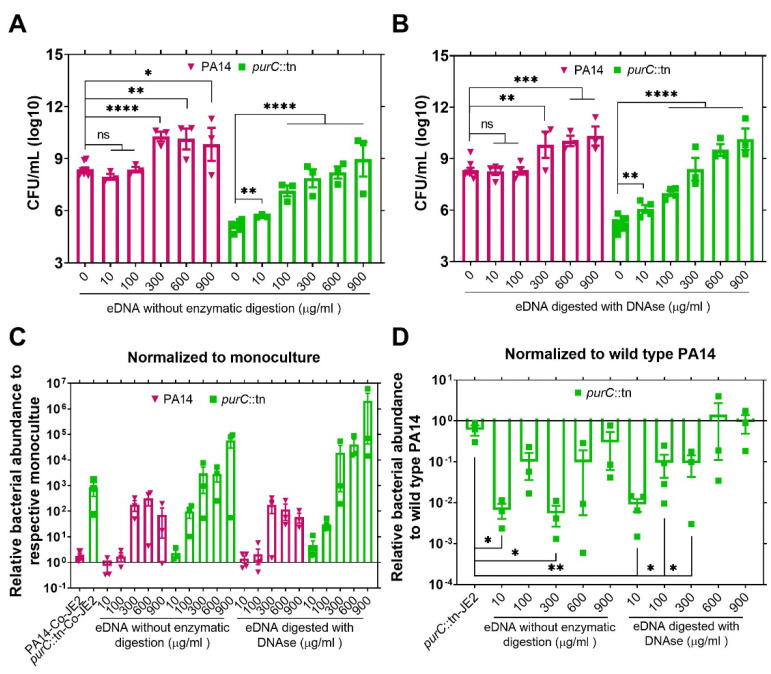
Exogenous DNA provides a nutrient source for P. aeruginosa and can rescue the growth of a purine-deficient mutant. (A) Bacterial cells were incubated with 10 to 900 µg/mL herring DNA, as an exogenous purine source, without enzymatic digestion. (B) Bacterial cells were incubated with 10 to 900 µg/mL herring DNA with enzymatic digestion. (C) Relative bacterial abundance of wild-type and purine-deficient mutant (purC::tn) of P. aeruginosa in co-culture with JE2 or exogenous DNA. Cells in co-culture with JE2 or eDNA were normalized to the respective numbers in monoculture. (D) Relative fitness of purine-deficient mutant (purC::tn) of P. aeruginosa in co-culture with JE2 or eDNA compared to the growth of wildtype P. aeruginosa, PA14, in co-culture with JE2 or eDNA, respectively. Here, the relative numbers of purC::tn mutant were calculated by normalizing to the wild-type PA numbers in respective co-culture conditions. Error bars represent SEM of data derived from at least three biological replicates on different days, and experiments were performed in technical triplicates each day. The statistical comparison was done between the purC::tn mutant and PA14 strains (not shown here) in their respective co-culture conditions. Here, ‘’*’’ designates p < 0.05, ‘’**’’ designates p < 0.005, ‘’***’’ designates p < 0.0005, ‘’****’’ designates p < 0.0001 depicted by two-tailed unpaired Student’s t-test, and ns denotes not significant. The concentration of the exogenous DNA is in µg/mL.
Figure 3
Figure 3
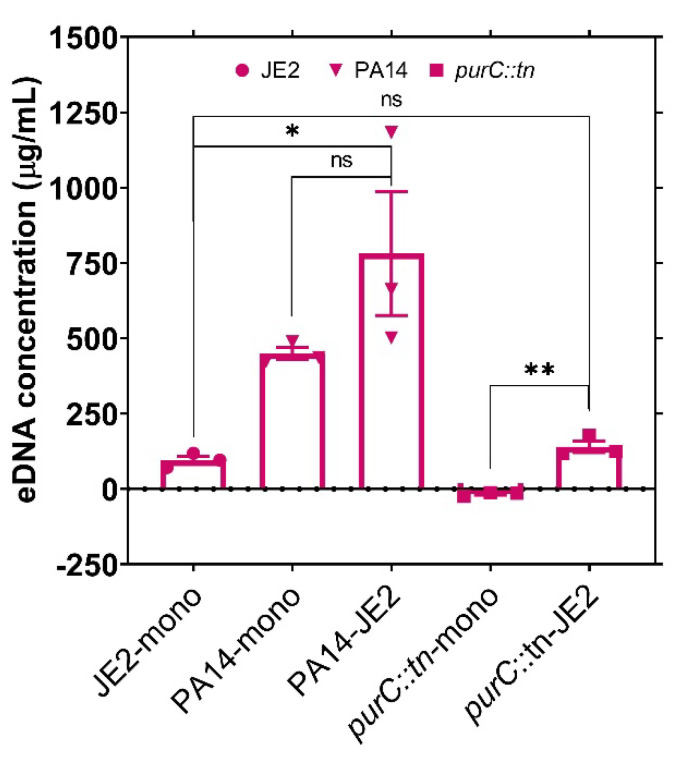
The concentration of exogenous DNA in culture medium after bacterial growth. Bacterial cells were grown as monoculture or co-culture in RPMI (Roswell Park Memorial Institute) media. The concentration (µg/mL) of exogenous DNA was measured by PicoGreen dsDNA (double stranded DNA) reagent following 48 h of incubation. Error bars represent SEM of data derived from three biological replicates on different days, and experiments were performed in technical triplicates each day. Here, ‘’*’’ designates p < 0.05, ‘’**’’ designates p < 0.005 as depicted by two-tailed unpaired Student’s t-test, and ns denotes not significant.
Figure 4
Figure 4
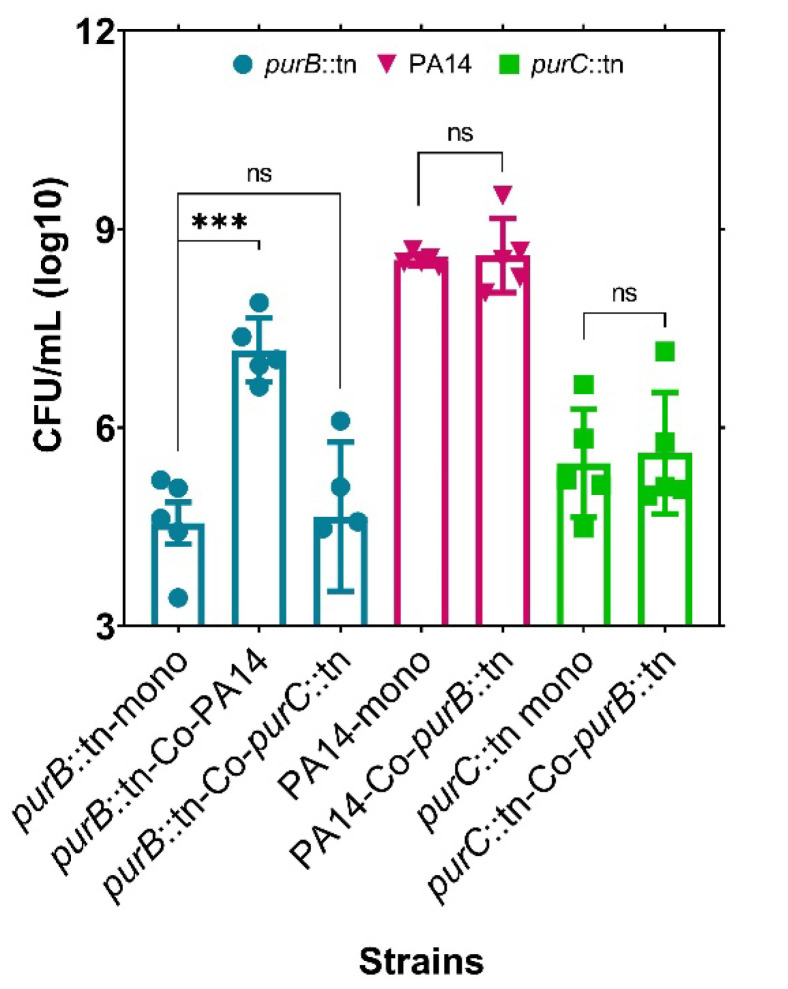
Purine complementation in purine mutant, purB::tn of S. aureus, by PA14 in co-culture. Growth of a purine-deficient mutant of S. aureus can be rescued by the wild-type P. aeruginosa cells but not by a P. aeruginosa purine-deficient mutant. The purB::tn mutant growth cannot be recovered when grown with a purine mutant of PA14, suggesting absence of cross feeding between the mutant species. Error bars represent SEM of data derived from five biological replicates on different days, and experiments were performed in technical triplicates each day. Here, ‘***’ designates p < 0.0005 as depicted by two-tailed unpaired Student’s t-test and ns denotes not significant.
Figure 5
Figure 5
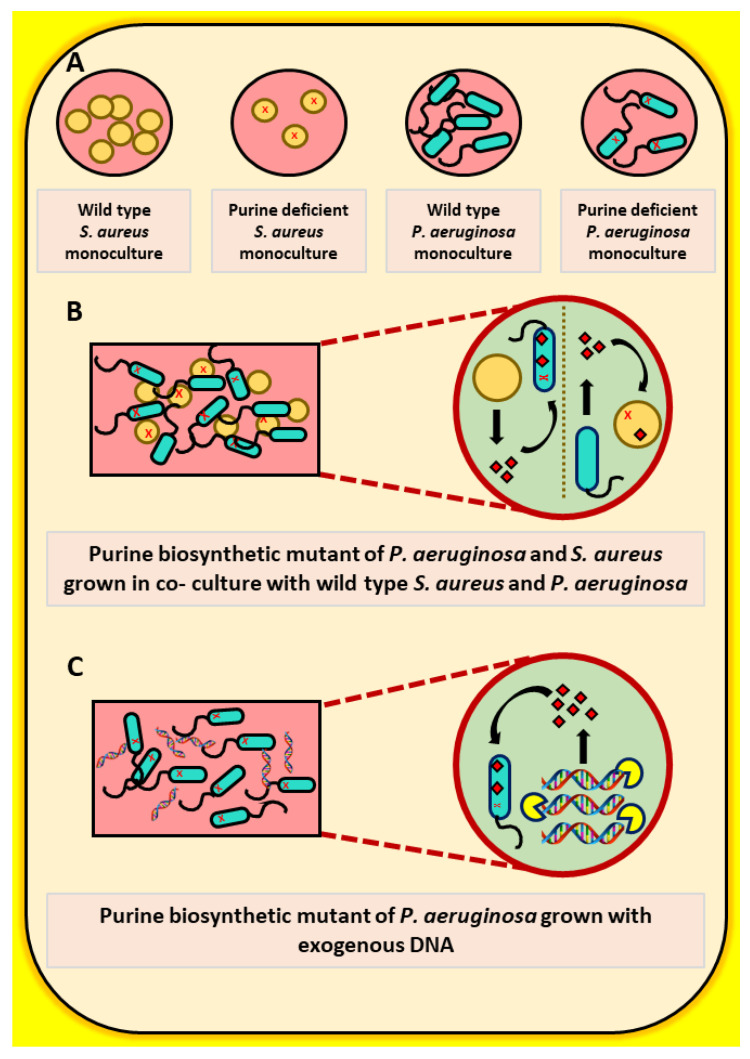
Cross feeding of purines by wild-type P. aeruginosa or S. aureus and exogenous DNA. (A) Monocultures of wild-type as well as purine-deficient mutants of P. aeruginosa and S. aureus. (B) Cross feeding of purines to P. aeruginosa and S. aureus purine biosynthetic mutants by wild-type S. aureus and P. aeruginosa cells, respectively. (C) Rescue in growth of P. aeruginosa purine biosynthetic mutants by exogenous DNA.

References

    1. Rajan S., Saiman L. Pulmonary infections in patients with cystic fibrosis. Semin. Respir. Infect. 2002;17:47–56. doi: 10.1053/srin.2002.31690. - DOI - PubMed
    1. Beaume M., Köhler T., Fontana T., Tognon M., Renzoni A., van Delden C. Metabolic pathways of Pseudomonas aeruginosa involved in competition with respiratory bacterial pathogens. Front. Microbiol. 2015;6:321. doi: 10.3389/fmicb.2015.00321. - DOI - PMC - PubMed
    1. Saiman L., Siegel J. Infection Control in Cystic Fibrosis. Clin. Microbiol. Rev. 2004;17:57–71. doi: 10.1128/CMR.17.1.57-71.2004. - DOI - PMC - PubMed
    1. Taylor R.F., Hodson M.E., Pitt T.L. Auxotrophy of Pseudomonas aeruginosa in cystic fibrosis. FEMS microbiol. lett. 1992;92:243–246. doi: 10.1111/j.1574-6968.1992.tb05268.x. - DOI - PubMed
    1. Thomas S.R., Ray A., Hodson M.E., Pitt T.L. Increased sputum amino acid concentrations and auxotrophy ofPseudomonas aeruginosa in severe cystic fibrosis lung disease. Thorax. 2000;55:795–797. doi: 10.1136/thorax.55.9.795. - DOI - PMC - PubMed

LinkOut - more resources