


Increased random exploration in schizophrenia is associated with inflammation
- PMID: 33536449
- PMCID: PMC7859392
- DOI: 10.1038/s41537-020-00133-0
Increased random exploration in schizophrenia is associated with inflammation
Abstract
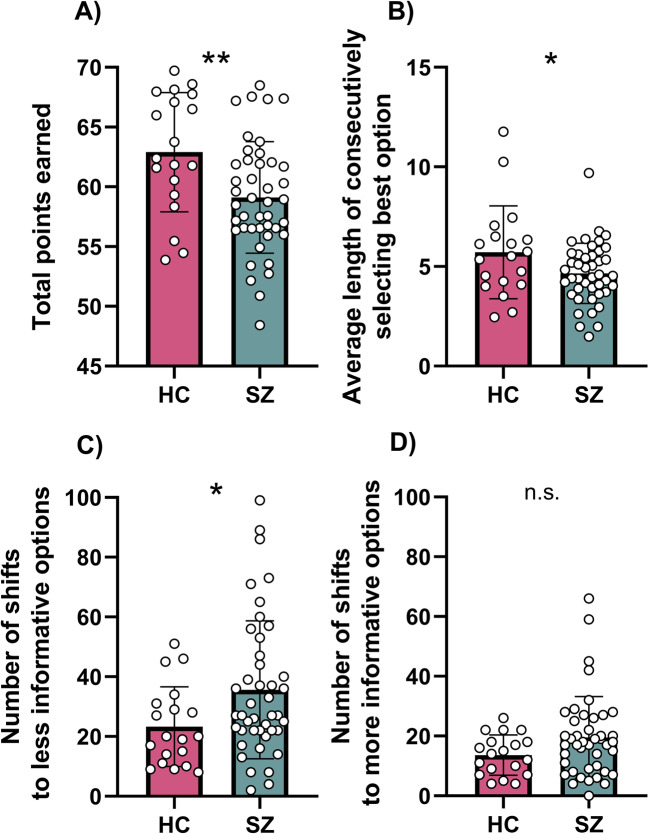
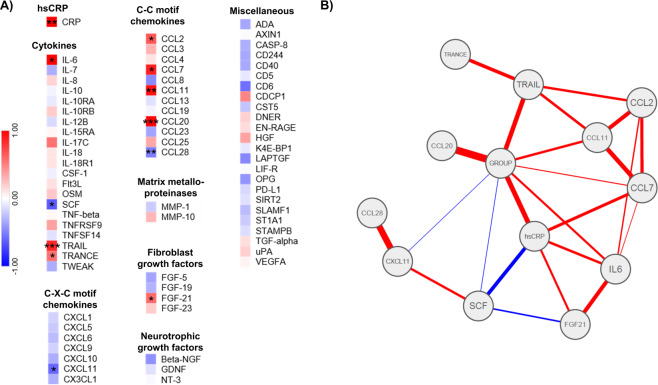
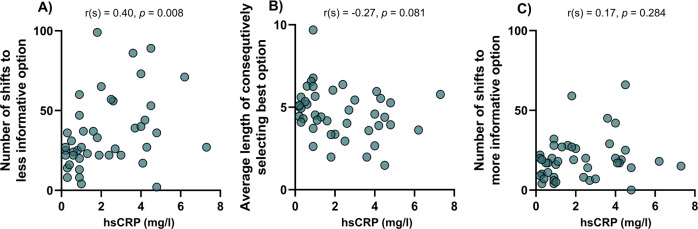
One aspect of goal-directed behavior, which is known to be impaired in patients with schizophrenia (SZ), is balancing between exploiting a familiar choice with known reward value and exploring a lesser known, but potentially more rewarding option. Despite its relevance to several symptom domains of SZ, this has received little attention in SZ research. In addition, while there is increasing evidence that SZ is associated with chronic low-grade inflammation, few studies have investigated how this relates to specific behaviors, such as balancing exploration and exploitation. We therefore assessed behaviors underlying the exploration-exploitation trade-off using a three-armed bandit task in 45 patients with SZ and 19 healthy controls (HC). This task allowed us to dissociate goal-unrelated (random) from goal-related (directed) exploration and correlate them with psychopathological symptoms. Moreover, we assessed a broad range of inflammatory proteins in the blood and related them to bandit task behavior. We found that, compared to HC, patients with SZ showed reduced task performance. This impairment was due to a shift from exploitation to random exploration, which was associated with symptoms of disorganization. Relative to HC, patients with SZ showed a pro-inflammatory blood profile. Furthermore, high-sensitivity C-reactive protein (hsCRP) positively correlated with random exploration, but not with directed exploration or exploitation. In conclusion, we show that low-grade inflammation in patients with SZ is associated with random exploration, which can be considered a behavioral marker for disorganization. hsCRP may constitute a marker for severity of, and a potential treatment target for maladaptive exploratory behaviors.
Conflict of interest statement
The authors declare no competing interests.
Figures
Similar articles
-
How does apathy impact exploration-exploitation decision-making in older patients with neurocognitive disorders?NPJ Aging. 2023 Oct 30;9(1):25. doi: 10.1038/s41514-023-00121-5. NPJ Aging. 2023. PMID: 37903801 Free PMC article.
-
Dopamine blockade impairs the exploration-exploitation trade-off in rats.Sci Rep. 2019 May 1;9(1):6770. doi: 10.1038/s41598-019-43245-z. Sci Rep. 2019. PMID: 31043685 Free PMC article.
-
Delay discounting and task performance consistency in patients with schizophrenia.Psychiatry Res. 2014 Feb 28;215(2):286-93. doi: 10.1016/j.psychres.2013.11.013. Epub 2013 Dec 4. Psychiatry Res. 2014. PMID: 24388727 Free PMC article.
-
Development of directed and random exploration in children.Dev Sci. 2021 Jul;24(4):e13095. doi: 10.1111/desc.13095. Epub 2021 Mar 8. Dev Sci. 2021. PMID: 33539647
-
Reduced learning bias towards the reward context in medication-naive first-episode schizophrenia patients.BMC Psychiatry. 2022 Feb 16;22(1):123. doi: 10.1186/s12888-021-03682-5. BMC Psychiatry. 2022. PMID: 35172748 Free PMC article.
Cited by
-
A causal role of the right dorsolateral prefrontal cortex in random exploration.Sci Rep. 2024 Oct 22;14(1):24796. doi: 10.1038/s41598-024-76025-5. Sci Rep. 2024. PMID: 39433838 Free PMC article.
-
Common and disorder-specific upregulation of the inflammatory markers TRAIL and CCL20 in depression and schizophrenia.Sci Rep. 2021 Sep 28;11(1):19204. doi: 10.1038/s41598-021-98769-0. Sci Rep. 2021. PMID: 34584171 Free PMC article.
-
Quinolinic acid is associated with cognitive deficits in schizophrenia but not major depressive disorder.Sci Rep. 2021 May 11;11(1):9992. doi: 10.1038/s41598-021-89335-9. Sci Rep. 2021. PMID: 33976271 Free PMC article.
-
Reviewing explore/exploit decision-making as a transdiagnostic target for psychosis, depression, and anxiety.Cogn Affect Behav Neurosci. 2024 Oct;24(5):793-815. doi: 10.3758/s13415-024-01186-9. Epub 2024 Apr 23. Cogn Affect Behav Neurosci. 2024. PMID: 38653937 Free PMC article. Review.
-
Acetylcholine and noradrenaline enhance foraging optimality in humans.Proc Natl Acad Sci U S A. 2023 Sep 5;120(36):e2305596120. doi: 10.1073/pnas.2305596120. Epub 2023 Aug 28. Proc Natl Acad Sci U S A. 2023. PMID: 37639601 Free PMC article. Clinical Trial.
References
LinkOut - more resources
Full Text Sources
Other Literature Sources
Research Materials
