


Ecological adaptation drives wood frog population divergence in life history traits
- PMID: 33536638
- PMCID: PMC8102587
- DOI: 10.1038/s41437-021-00409-w
Ecological adaptation drives wood frog population divergence in life history traits
Abstract
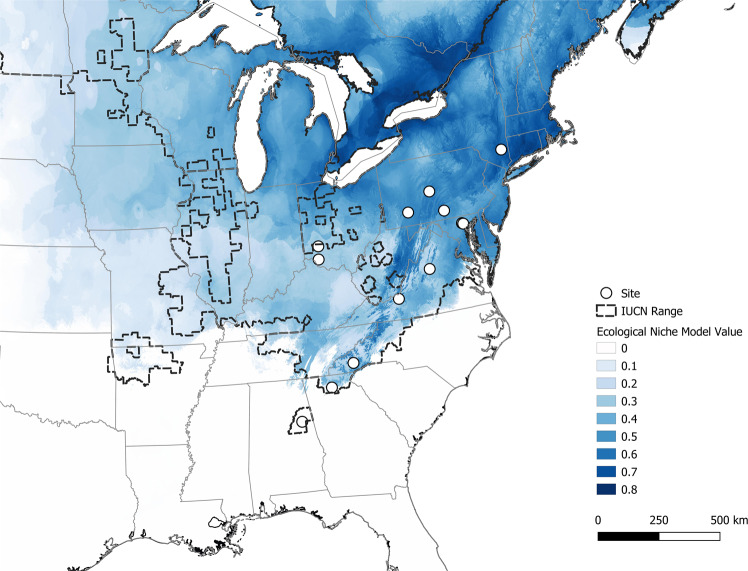
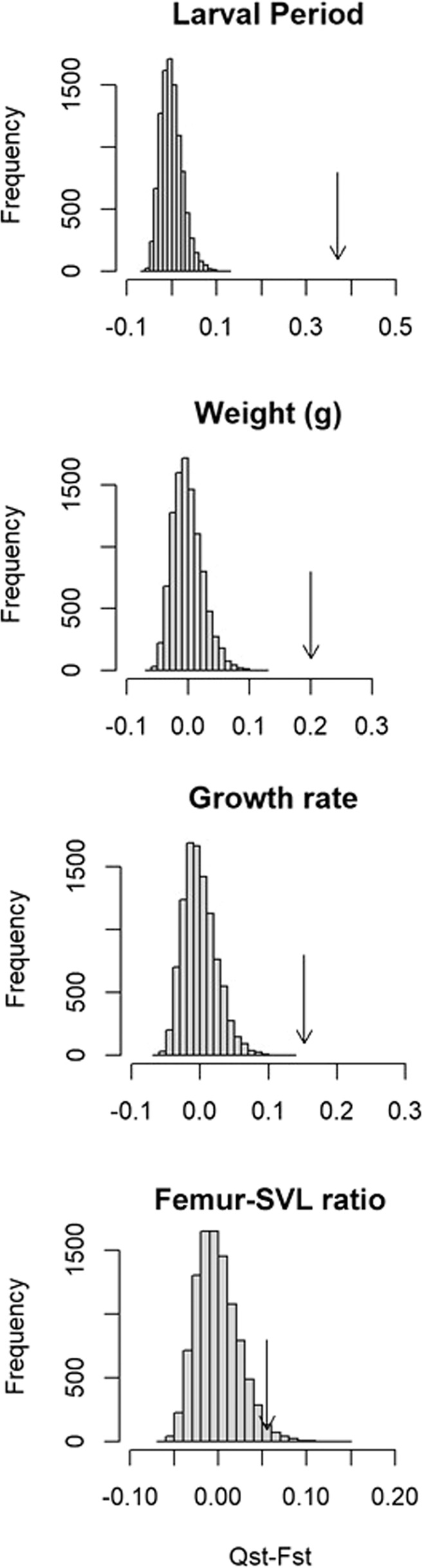
Phenotypic variation among populations is thought to be generated from spatial heterogeneity in environments that exert selection pressures that overcome the effects of gene flow and genetic drift. Here, we tested for evidence of isolation by distance or by ecology (i.e., ecological adaptation) to generate variation in early life history traits and phenotypic plasticity among 13 wood frog populations spanning 1200 km and 7° latitude. We conducted a common garden experiment and related trait variation to an ecological gradient derived from an ecological niche model (ENM) validated to account for population density variation. Shorter larval periods, smaller body weight, and relative leg lengths were exhibited by populations with colder mean annual temperatures, greater precipitation, and less seasonality in precipitation and higher population density (high-suitability ENM values). After accounting for neutral genetic variation, the QST-FST analysis supported ecological selection as the key process generating population divergence. Further, the relationship between ecology and traits was dependent upon larval density. Specifically, high-suitability/high-density populations in the northern part of the range were better at coping with greater conspecific competition, evidenced by greater postmetamorphic survival and no difference in body weight when reared under stressful conditions of high larval density. Our results support that both climate and competition selection pressures drive clinal variation in larval and metamorphic traits in this species. Range-wide studies like this one are essential for accurate predictions of population's responses to ongoing ecological change.
Conflict of interest statement
The authors declare that they have no conflict of interest.
Figures


References
-
- Allen JA. The influence of physical conditions in the genesis of species. Radic Rev. 1877;1:108–140.
-
- Amado TF, Bidau CJ, Olalla-Tárraga MÁ. Geographic variation of body size in New World anurans: energy and water in a balance. Ecography. 2019;42(3):456–466. doi: 10.1111/ecog.03889. - DOI
-
- Ashton KG. Do amphibians follow Bergmann’s rule? Can J Zool. 2002;80(4):708–716. doi: 10.1139/z02-049. - DOI
Publication types
MeSH terms
LinkOut - more resources
Full Text Sources
Other Literature Sources
