


Physical Activity Drops During Summer Holidays for 6- to 9-Year-Old Children
- PMID: 33537285
- PMCID: PMC7848070
- DOI: 10.3389/fpubh.2020.631141
Physical Activity Drops During Summer Holidays for 6- to 9-Year-Old Children
Abstract
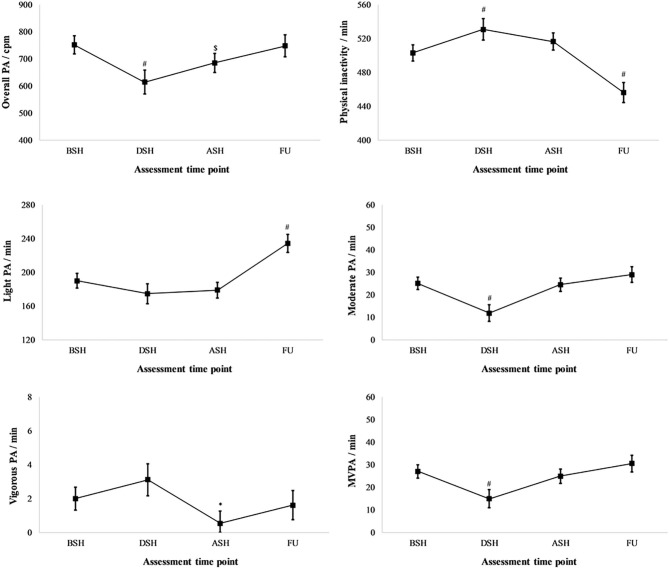
Regular physical activity (PA) reduces the health risk of childhood obesity and associated chronic diseases as well as mental health problems. Since PA declines as children age as well with future generations it is of highest importance to intervene in school and out-of-school settings. Out-of-school periods affect children's PA as it is mainly left to the interest and motivation of their parents. We compared accelerometer-based PA patterns in 93 6- to 9-year old children assessed four times: before (May/June), during (August), and after (September) summer holidays and at a 1-year follow up (May/June). Before summer holidays children were assessed also for anthropometry and motor tests. During summer holidays overall PA decreased by 18% (p < 0.001), physical inactivity increased by 5.5% (p < 0.001), moderate PA decreased by 53% (p < 0.001) and moderate to vigorous PA decreased by 45% (p < 0.001) when compared to before summer holidays. Furthermore, overall PA remained diminished also after summer holidays by 8.8% (p = 0.001) but recovered to baseline values at 1-year follow up. About 30% of overall PA and moderate to vigorous PA decrease during summer holidays could be explained by children's fitness level as a greater decrease was found in children with better results in standing long jump and 300-meter running time. Our finding detects an alarming summer holiday decrease in children PA that should not be neglected in future studies and intervention designs.
Keywords: MVPA; accelerometer; physical inactivity; sedentary behavior; vacations.
Copyright © 2021 Volmut, Pišot, Planinšec and Šimunič.
Conflict of interest statement
The authors declare that the research was conducted in the absence of any commercial or financial relationships that could be construed as a potential conflict of interest.
Figures
References
-
- Fox K, Riddoch CJ. At Least Five a Week- Evidence on the Impact of Physical Activity and Its Relationship to Health. A Report From the Chief Medical Officer (2004).
-
- Volmut T, Pišot R, Šimunič B. Objectively measured physical activity in children aged from 5 to 8 years/objektivno izmerjena gibalna aktivnost od pet- do osemletnih otrok. Slov J Public Health. (2013) 52:9–18. 10.2478/sjph-2013-0002 - DOI
Publication types
MeSH terms
LinkOut - more resources
Full Text Sources
Other Literature Sources
Medical
