


Apolipoprotein E4-driven effects on inflammatory and neurotrophic factors in peripheral extracellular vesicles from cognitively impaired, no dementia participants who converted to Alzheimer's disease
- PMID: 33537405
- PMCID: PMC7842191
- DOI: 10.1002/trc2.12124
Apolipoprotein E4-driven effects on inflammatory and neurotrophic factors in peripheral extracellular vesicles from cognitively impaired, no dementia participants who converted to Alzheimer's disease
Abstract
Introduction: In brain, extracellular vesicles (EVs) play an essential role in the neuron-glia interface and ensure the crosstalk between the brain and the periphery. Some studies now link the pathway dysfunction of the EVs to apolipoprotein E gene variant (APOE ε4) and the risk of progression to Alzheimer's disease (AD). To better understand the role of APOE ε4 in pre-clinical AD, we have determined levels of pathogenic, neurotrophic and inflammatory proteins in peripheral EVs (pEVs) and in plasma from cognitively impaired, no dementia (CIND) participants stratified upon the absence (APOE ε4-) or the presence (APOE ε4+ ) of the ε4 allele of APOE.
Methods: Levels of 15 neurodegenerative, neurotrophic and neuroinflammatory proteins were quantified in pEVs and compared to their plasma levels from cognitively normal and CIND participants.
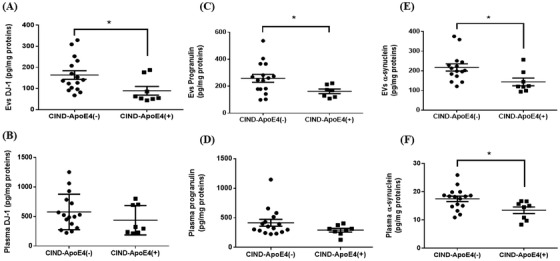
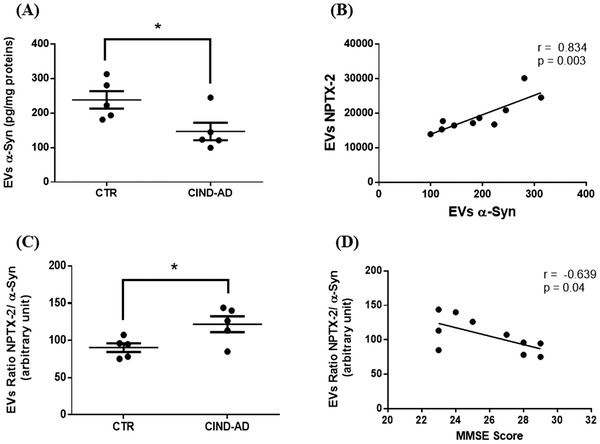
Results: Levels of neurotrophic and inflammatory markers were reduced in pEVs from APOE ε4+. The pentraxin-2/α-synuclein ratio measured in pEVs was able to predict AD 5 years before the onset among APOE ε4+-CIND individuals.
Discussion: Our findings suggest an alteration of the endosomal pathway in APOE ε4+ and that pEVs pentraxin-2/α-synuclein ratio could serve as a useful early biomarker for AD susceptibility.
Keywords: Alzheimer's disease; DJ‐1; S100B; biomarkers; extracellular vesicles; lipocalin; pentraxin‐2; α‐synuclein.
© 2021 The Authors. Alzheimer's & Dementia: Translational Research & Clinical Interventions published by Wiley Periodicals, Inc. on behalf of Alzheimer's Association.
Conflict of interest statement
The authors report that they have no conflict of interest to disclose.
Figures

References
-
- 2020 Alzheimer's disease facts and figures. Alzheimers Dement. 2020;. 16(3):391‐460.
-
- Mattsson N, Groot C, Jansen WJ, et al. Prevalence of the apolipoprotein E ε4 allele in amyloid β positive subjects across the spectrum of Alzheimer's disease. Alzheimers Dement. 2018;14(7):913‐924. - PubMed
-
- de Oliveira FF, Chen ES, Smith MC, Bertolucci PHF. Selected LDLR and APOE polymorphisms affect cognitive and functional response to lipophilic statins in Alzheimer's disease. J Mol Neurosci. 2020;70(10):1574‐1588. - PubMed
LinkOut - more resources
Full Text Sources
Other Literature Sources
Miscellaneous