Review
. 2021 Apr;23(4):239.
doi: 10.3892/mmr.2021.11878. Epub 2021 Feb 4.

The potential role and trend of HIF‑1α in intervertebral disc degeneration: Friend or foe? (Review)

Affiliations
Review

The potential role and trend of HIF‑1α in intervertebral disc degeneration: Friend or foe? (Review)

Yongjin Li et al. Mol Med Rep. 2021 Apr.

Abstract

Lower back pain (LBP) is one of the most common reasons for seeking medical advice in orthopedic clinics. Increasingly, research has shown that symptomatic intervertebral disc degeneration (IDD) is mostly related to LBP. This review first outlines the research and findings of studies into IDD, from the physiological structure of the intervertebral disc (IVD) to various pathological cascades. The vicious cycles of IDD are re‑described in relation to the analysis of the relationship among the pathological mechanisms involved in IDD. Interestingly, a 'chief molecule' was found, hypoxia‑inducible factor‑1α (HIF‑1α), that may regulate all other mechanisms involved in IDD. When the vicious cycle is established, the low oxygen tension activates the expression of HIF‑1α, which subsequently enters into the hypoxia‑induced HIF pathways. The HIF pathways are dichotomized as friend and foe pathways according to the oxygen tension of the IVD microenvironment. Combined with clinical outcomes and previous research, the trend of IDD development has been predicted in this paper. Lastly, an early precautionary diagnosis and treatment method is proposed whereby nucleus pulposus tissue for biopsy can be obtained through IVD puncture guided by B‑ultrasound when the patient is showing symptoms but MRI imaging shows negative results. The assessment criteria for biopsy and the feasibility, superiority and challenges of this approach have been discussed. Overall, it is clear that HIF‑1α is an indispensable reference indicator for the accurate diagnosis and treatment of IDD.

Keywords: ntervertebral disc degeneration; hypoxia‑inducible factor‑1α; nucleus pulposus; extracellular matrix; angiogenesis; apoptosis; matrix metalloproteinases; autophagy; inflammation; non‑coding RNAs.


Conflict of interest statement

The authors declare that they have no competing interests.

Figures
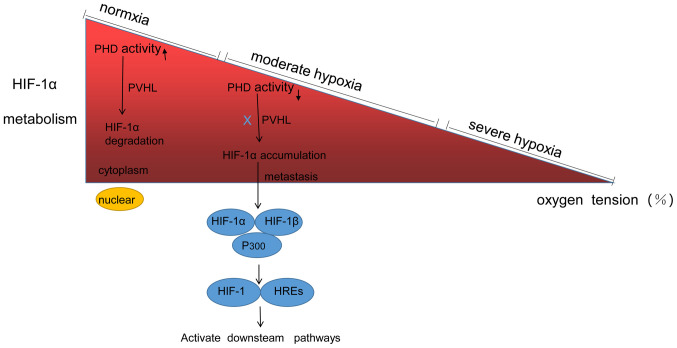
Figure 1.
Figure 1.
HIF-1α metabolism. HIF-1 belongs to the Per-Arnt-Sim family, heterodimeric proteins composed of α and β subunits. Under normoxia, the α subunit is hydroxylated and subsequently activates PHD, which is then degraded HIF-1α via pVHL. However, the PHD activity is reduced during moderate and severe hypoxia, following which the degradation of the α subunit is inhibited, so HIF-1α gradually accumulates in the cytoplasm. HIF-1α then enters the nucleus and binds to HIF-1β to form an ectopic dimer, HIF-1, which recognizes and binds to HREs to activate the downstream target genes. HIF-1α, hypoxia-inducible factor-1α; PHD, prolyl hydroxylase; HREs, hypoxia responsive elements; pVHL, protein von HippeI-Lindau.
Figure 2.
Figure 2.
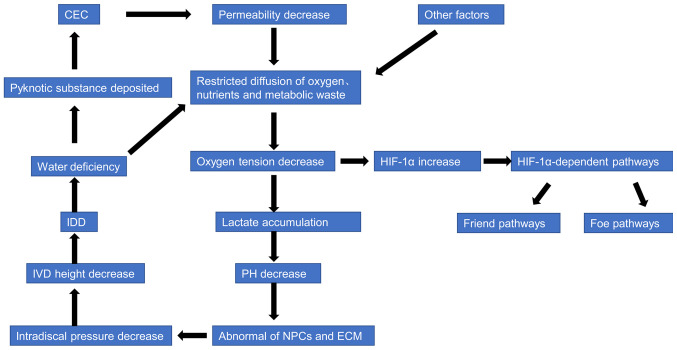
Vicious cycle pathways. The center of the vicious cycle pathways is restricted diffusion of oxygen, nutrients and metabolic waste. Two critical factors contributing to these restrictions are the decrease of cartilage endplate permeability and water deficiency of IVD. The oxygen tension is lower in the IVD microenvironment as a result of poor diffusion. This low oxygen tension establishes the vicious cycle pathways and promotes the expression of HIF-1α, which subsequently enters into the hypoxia-induced HIF pathways. The HIF pathways are dichotomized as friend and foe pathways according to the oxygen tension. IVD, intervertebral disc; HIF-1α, hypoxia-inducible factor-1α; CEC, cartilage endplate calcification; IDD, IVD degeneration; NPC, nucleus pulposus cells; ECM, extracellular matrix.
Figure 3.
Figure 3.
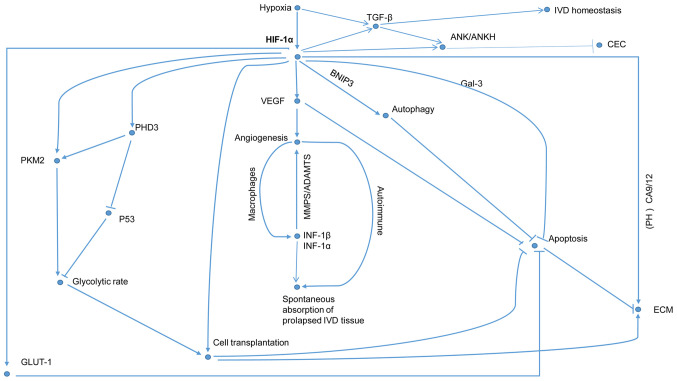
Friend pathways. During moderate hypoxia, the friend role of HIF-1α is increasingly reinforced as oxygen tension gradually decreases. There are a number of pathways in this process, but the end point is the upregulation of ECM synthesis. HIF-1α, hypoxia-inducible factor-1α; ECM, extracellular matrix; PKM2, pyruvate kinase M2; GLUT-1, glucose transporter 1; PHD3, prolyl hydroxylase 3; VEGF, vascular endothelial growth factor; INF-1, eukaryotic initiation factor 4A; MMPS, matrix metalloproteinases; ADAMTS, a disintegrin and metalloproteinase with thrombospondin motifs; BNIP3, BCL2 interacting protein 3; TGF-β, transforming growth factor-β; IVD, intervertebral disc; ANK/ANKH, progressive ankylosis; Gal-3, galectin 3; CEC, cartilage endplate calcification; CA, carbonic anhydrase.
Figure 4.
Figure 4.
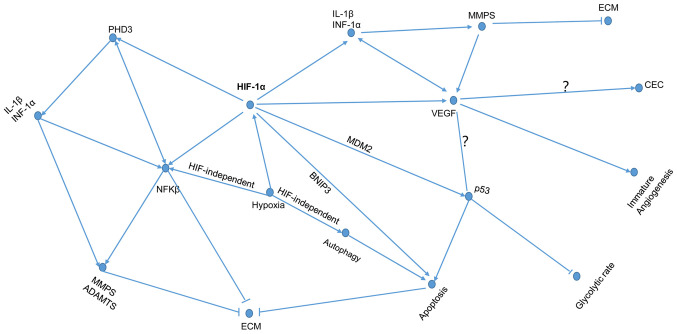
Foe pathways. During severe hypoxia, the foe role of HIF-1α is increasingly reinforced as the oxygen tension gradually decreases. HIF-1α, hypoxia-inducible factor-1α; IL, interleukin; PHD3, prolyl hydroxylase 3; INF-1, eukaryotic initiation factor 4A; MMPS, matrix metalloproteinases; ADAMTS, a disintegrin and metalloproteinase with thrombospondin motifs; ECM, extracellular matrix; BNIP3, BCL2 interacting protein 3; MDM2, mouse double minute 2 homolog; NFKβ, nuclear factor κβ; VEGF, vascular endothelial growth factor; CEC, cartilage endplate calcification.

References

    1. Deyo RA, Tsui-Wu YJ. Descriptive epidemiology of low-back pain and its related medical care in the United States. Spine (Phila Pa 1976) 1987;12:264–268. doi: 10.1097/00007632-198704000-00013. - DOI - PubMed
    1. Andersson GB. Epidemiological features of chronic low-back pain. Lancet. 1999;354:581–585. doi: 10.1016/S0140-6736(99)01312-4. - DOI - PubMed
    1. Vos T, Flaxman AD, Naghavi M, Lozano R, Michaud C, Ezzati M, Shibuya K, Salomon JA, Abdalla S, Aboyans V, et al. Years lived with disability (YLDs) for 1160 sequelae of 289 diseases and injuries 1990–2010: A systematic analysis for the Global Burden of Disease Study 2010. Lancet. 2012;380:2163–2196. doi: 10.1016/S0140-6736(12)61729-2. - DOI - PMC - PubMed
    1. Chen S, Fang XQ, Wang Q, Wang SW, Wang SW, Hu ZJ, Zhou ZJ, Xu WB, Wang JY, Qin A, Fan SW. PHD/HIF-1 upregulates CA12 to protect against degenerative disc disease: A human sample, in vitro and ex vivo study. Lab Invest. 2016;96:561–569. doi: 10.1038/labinvest.2016.32. - DOI - PubMed
    1. Luoma K, Riihimäki H, Luukkonen R, Raininko R, Viikari-Juntura E, Lamminen A. Low back pain in relation to lumbar disc degeneration. Spine (Phila Pa 1976) 2000;25:487–492. doi: 10.1097/00007632-200002150-00016. - DOI - PubMed

MeSH terms

Substances