


A report on seven fetal cases associated with 15q11-q13 microdeletion and microduplication
- PMID: 33538077
- PMCID: PMC8104164
- DOI: 10.1002/mgg3.1605
A report on seven fetal cases associated with 15q11-q13 microdeletion and microduplication
Abstract
Background: The 15q11-q13 region contains three breakpoints (BP1 to BP3), and copy number variations often occur in the region.
Aims: 15q11-q13 microdeletion and microduplication are usually associated with Prader-Willi and Angelman syndromes, respectively. It is not yet clear to what extent microdeletion and microduplication affect the physical health of the fetus and the child. In this study, we examined seven fetuses ranging in gestational age from 15 to 27 weeks.
Materials & methods: Detailed prenatal screening and laboratory examinations were performed, while karyotype analysis and chromosomal microarray analysis (CMA) of the amniotic fluid and umbilical cord blood were applied for genetic analysis.
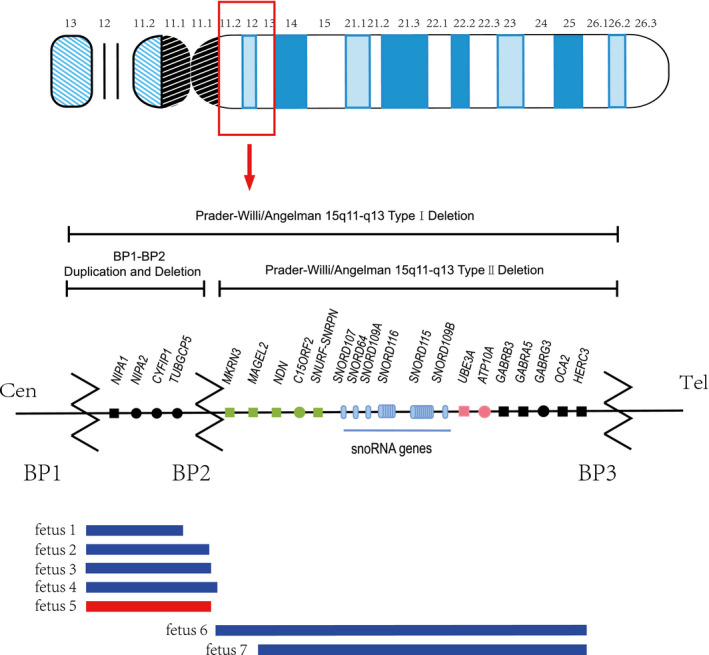
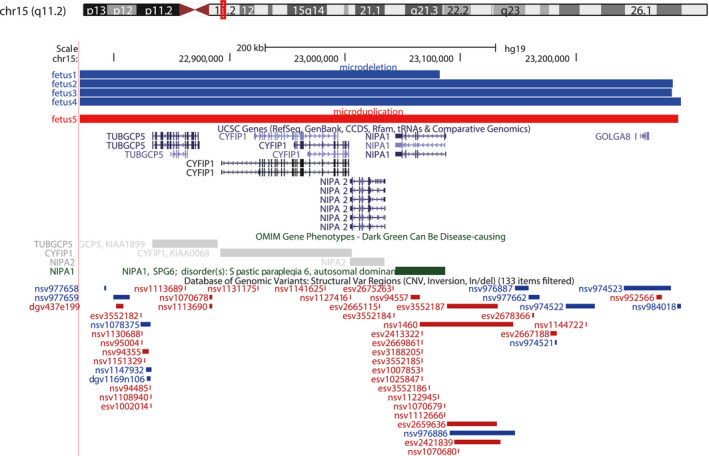
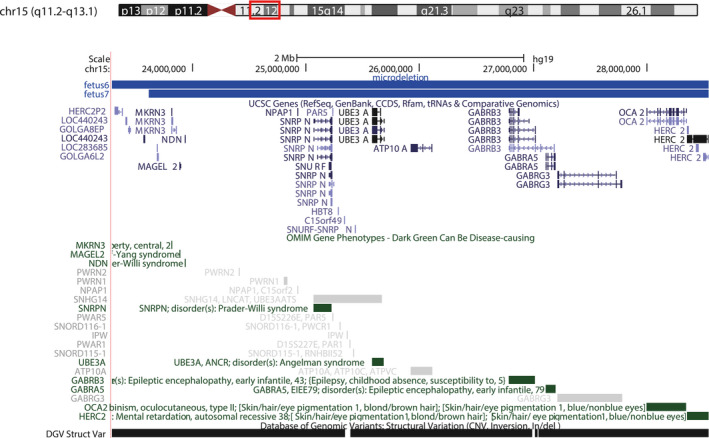
Results: CMA analysis showed that four fetuses harbored a microdeletion and one fetus showed a microduplication at 15q11.2 BP1-BP2, two fetuses had a microdeletion at 15q11-q13 BP2-BP3, and one fetus had an additional microdeletion at 16p13.11.
Discussion: There is no clear standard for the clinical diagnosis of 15q11-q13 microdeletion and microduplication, some of them have clinical phenotypes or are clinically affected.
Conclusion: Therefore, parents of such fetuses should be informed of the possibility of microdeletions or microduplications to mitigate the psychological burden, and medical consultation and assistance should be provided when communicating the results of the mid-gestation screening.
Keywords: 15q11-q13; Angelman syndrome; Prader-Willi syndrome; microdeletion; microduplication.
© 2021 The Authors. Molecular Genetics & Genomic Medicine published by Wiley Periodicals LLC.
Conflict of interest statement
The author solemnly states that there is no conflict of interest to be disclosed.
Figures
References
-
- Amos‐Landgraf, J. M. , Ji, Y. , Gottlieb, W. , Depinet, T. , Wandstrat, A. E. , Cassidy, S. B. , Driscoll, D. J. , Rogan, P. K. , Schwartz, S. , & Nicholls, R. D. (1999). Chromosome breakage in the Prader‐Willi and Angelman syndromes involves recombination between large, transcribed repeats at proximal and distal breakpoints. American Journal of Human Genetics, 65(2), 370–386. 10.1086/302510 - DOI - PMC - PubMed
-
- Bieth, E. , Eddiry, S. , Gaston, V. , Lorenzini, F. , Buffet, A. , Conte Auriol, F. , Molinas, C. , Cailley, D. , Rooryck, C. , Arveiler, B. , Cavaillé, J. , Salles, J. P. , & Tauber, M. (2015). Highly restricted deletion of the SNORD116 region is implicated in Prader‐Willi syndrome. European Journal of Human Genetics, 23(2), 252–255. 10.1038/ejhg.2014.103 - DOI - PMC - PubMed
-
- Buiting, K. , Körner, C. , Ulrich, B. , Wahle, E. , & Horsthemke, B. (1999). The human gene for the poly(A)‐specific ribonuclease (PARN) maps to 16p13 and has a truncated copy in the Prader‐Willi/Angelman syndrome region on 15q11–>q13. Cytogenetics and Cell Genetics, 87, 125–131. 10.1159/000015378 - DOI - PubMed
Publication types
MeSH terms
Supplementary concepts
LinkOut - more resources
Full Text Sources
Other Literature Sources
